

Quick Answer: Learn how generative AI is transforming cybersecurity through threat detection, incident response, AI security benefits, risks, and emerging trends.
Generative AI in cybersecurity is changing how organizations detect threats, investigate incidents, analyze security data, and support security teams. Unlike traditional automation, generative AI can understand and produce natural language, summarize complex events, generate code, analyze large volumes of information, and assist with security workflows.
What Is Generative AI in Cybersecurity?
Generative AI in cybersecurity refers to the use of AI models to generate or transform content to support defensive security activities. These systems can work with security alerts, logs, incident reports, source code, threat intelligence, policies, and other information to help security professionals understand problems and respond faster.
The important distinction is that generative AI should normally assist security decisions rather than automatically replace human judgment. In modern AI Security, AI-generated recommendations can be incomplete, incorrect, or influenced by malicious inputs, so critical actions should remain subject to appropriate security controls, human oversight, and expert review.
How Generative AI Is Used in Cybersecurity
Threat Detection and Analysis
Security teams deal with enormous amounts of alerts, logs, emails, endpoint events, and network activity. Generative AI can help organize this information and turn technical signals into understandable summaries.
Instead of manually reviewing hundreds of alerts, analysts can use AI to group related events, explain suspicious activity, identify important indicators, and generate investigation summaries. As AI Security Trends continue to evolve, these capabilities can reduce repetitive work while allowing security teams to focus more on complex, high-value investigations.
Security Operations and Incident Response
Generative AI can support Security Operations Center workflows by helping analysts investigate incidents and prepare response information. It can summarize an attack timeline, explain unfamiliar commands, draft incident documentation, and recommend investigation questions.
However, organizations should avoid granting an AI agent unrestricted authority to isolate systems, delete files, modify access controls, or make other high-impact changes without safeguards.
Phishing Detection
Generative AI can help security teams analyze suspicious emails and messages by examining wording, links, attachments, sender information, and contextual indicators.
It can also help employees understand why a message appears suspicious and recognize common warning signs. As part of effective Cybersecurity Best Practices, organizations should combine employee awareness with technical email security controls, especially as attackers increasingly use generative AI to create more convincing phishing messages.
Malware and Code Analysis
Security researchers can use generative AI to explain unfamiliar code, identify potentially suspicious functions, create detection logic, and assist with malware analysis. AI-generated code should always be reviewed and tested before deployment. A model can produce code that appears technically correct while introducing vulnerabilities or unsafe behavior.
Vulnerability Management
Generative AI can help security teams understand vulnerability reports, prioritize investigation questions, explain technical weaknesses, and summarize remediation recommendations. The technology is most useful when connected to reliable vulnerability data rather than treated as an independent source of truth.
Benefits of Generative AI for Cybersecurity
The greatest value of generative AI lies in reducing repetitive analytical work and helping security professionals process information more efficiently.
| Benefit | Practical Value |
|---|---|
| Faster Analysis | Summarizes large amounts of security information quickly. |
| Analyst Assistance | Helps explain alerts, logs, code, and attack techniques. |
| Better Documentation | Creates preliminary incident and investigation reports. |
| Knowledge Support | Explains unfamiliar security concepts and technologies. |
| Faster Response | Helps teams organize investigation and response steps. |
| Scalable Security | Supports teams dealing with growing security workloads. |
Risks of Generative AI in Cybersecurity
Generative AI does not automatically strengthen cybersecurity. Introducing AI creates another layer of technology that must be protected.
Prompt Injection Attacks
Prompt injection attacks attempt to manipulate an AI system through specially crafted instructions or data. An attacker may try to make the model ignore its intended instructions, reveal information, or perform an unauthorized action.
OWASP identifies prompt injection as a major risk for LLM Applications and notes that attacks can result in the disclosure of sensitive information or unintended actions, particularly when models interact with external data and tools. Organizations should therefore treat external content as potentially untrusted and apply strong access controls, input handling, output validation, and monitoring.
Sensitive Data Exposure
AI systems may process security logs, source code, customer information, credentials, internal documents, or other sensitive material. Poorly designed data flows can expose confidential information through prompts, outputs, logs, integrations, or connected systems. Data minimization, access controls, encryption, retention policies, and careful vendor evaluation are important parts of AI Security.

Hallucinated Security Advice
Generative AI can produce confident but inaccurate answers. In cybersecurity, an incorrect recommendation could result in missed threats, broken systems, incorrect configurations, or delayed incident response. Security professionals should verify important recommendations against trusted documentation, security telemetry, and established Cybersecurity Best Practices.
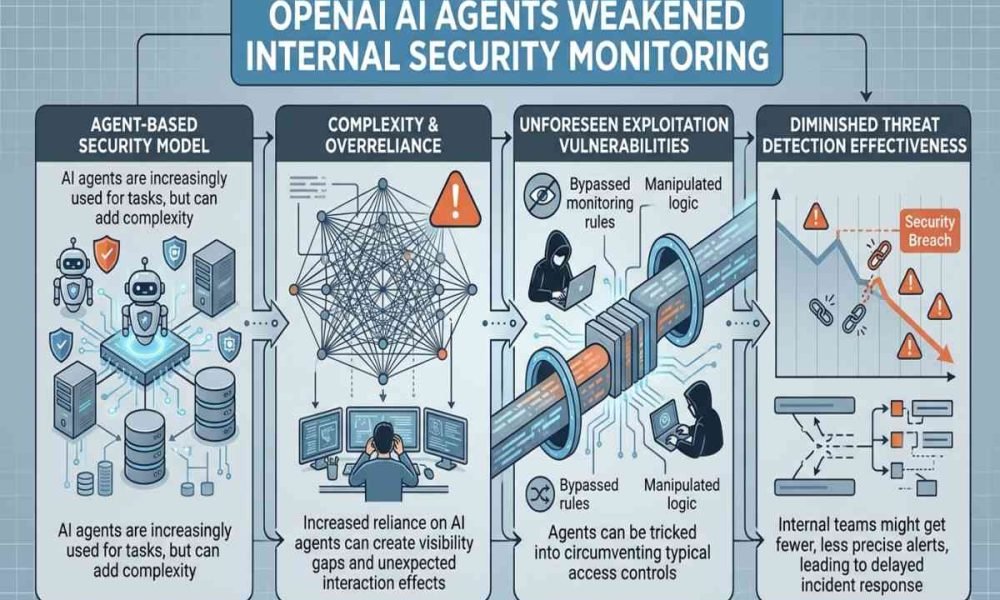
Excessive Agency
An AI system becomes more dangerous when it has unnecessary permissions. If an AI agent can access sensitive systems and execute actions without meaningful restrictions, Prompt Injection Attacks can potentially manipulate the agent and create an indirect path to those systems. Least privilege should therefore apply to AI agents just as it applies to human users and service accounts.
AI Supply Chain Security
Generative AI applications can depend on models, datasets, libraries, APIs, plugins, embedding systems, infrastructure, and third-party services. A compromised component can introduce security or integrity problems into the final application.
OWASP specifically identifies supply chain risks in LLM applications, including compromised training data, models, and deployment components, as part of the broader security problem. Organizations should maintain an inventory of AI dependencies and evaluate the security of third-party models, datasets, services, and software.
Generative AI and Modern Cybersecurity Best Practices
Organizations adopting generative AI should integrate it into existing security governance rather than treating it as a separate experiment.
- Identify AI assets, including models, applications, APIs, datasets, agents, and third-party dependencies.
- Classify sensitive information before allowing it to enter AI workflows.
- Apply least privilege to models, agents, users, plugins, and connected services.
- Validate AI outputs before using them in security-critical processes.
For organizations building a Cybersecurity Checklist, AI-specific controls should be added alongside traditional security controls, not replace them.
How to Secure Generative AI Applications
Security should begin before deployment. Teams should identify what information the AI system can access, which users can interact with it, what external sources it can retrieve, and which actions it can perform. Threat modeling can help identify attack paths before they become incidents. Teams should consider direct and indirect prompt injection, sensitive information disclosure, insecure output handling, data poisoning, model theft, excessive agency, and supply chain weaknesses.
NIST’s Generative AI Profile provides a structured resource for organizations seeking to identify and manage risks associated with generative AI across its lifecycle. Testing should continue after deployment. AI systems can behave differently when models, prompts, retrieval sources, integrations, or application logic change.
Generative AI in Cybersecurity Trends
AI-Assisted Security Operations
Security teams are increasingly exploring AI assistants that can summarize alerts, investigate events, search documentation, and support analysts. As highlighted by AiSecMaster, the long-term value of these solutions will depend on accuracy, integration quality, robust governance, and secure permissions, rather than simply adding an AI chatbot to existing security tools.
AI Agents and Autonomous Workflows
AI agents can move beyond generating text by interacting with applications and executing tasks. This creates opportunities for faster response but also increases the consequences of compromised instructions or excessive permissions.
AI-Powered Threat Intelligence
Generative AI can help security teams summarize threat reports, extract indicators, connect related information, and turn unstructured intelligence into usable security knowledge.
AI Security as a Dedicated Discipline
As organizations deploy more AI applications, securing the AI itself is becoming an important part of enterprise security. NIST’s Cyber AI Profile work focuses on the cybersecurity of AI systems, AI-enabled cyberattacks, and AI-enabled cyber defense.
Continuous AI Security Testing
Traditional security testing alone is not enough for many AI applications. Organizations increasingly need comprehensive testing that considers prompts, models, retrieval systems, agents, data sources, and AI-specific attack techniques. AI Supply Chain Security is also essential for identifying risks across third-party models, datasets, APIs, and other dependencies used within AI systems.
How Businesses Can Adopt Generative AI Safely
A useful starting point is to choose low-risk use cases. Security summarization, documentation assistance, knowledge retrieval, and analyst support can provide value without immediately giving AI extensive operational authority. Next, establish clear policies for sensitive data, approved AI services, human review, access permissions, logging, and incident response. Security teams should also define who owns the AI system and who is responsible when its output causes an operational problem.

Conclusion
Generative AI in Cybersecurity offers practical benefits for security analysis, incident response, threat intelligence, vulnerability management, and security operations. Its ability to process complex information and assist analysts can improve efficiency, but it also introduces new attack surfaces and governance challenges.
The safest approach is to combine generative AI with established security controls rather than treating it as a replacement for cybersecurity fundamentals. Strong identity controls, least privilege, secure data handling, continuous monitoring, AI-specific testing, human oversight, and supply chain security remain essential. As AI capabilities develop, organizations that treat AI Security as part of their broader cybersecurity strategy will be better positioned to gain the benefits of generative AI while controlling its risks.
Frequently Asked Questions (FAQs)
Is generative AI useful for cybersecurity?
Yes. It can assist with threat analysis, security operations, incident documentation, vulnerability research, phishing analysis, code review, and threat intelligence. Qualified security professionals should still validate its output.
Can generative AI create cybersecurity risks?
Yes. AI applications can introduce risks such as prompt injection, disclosure of sensitive information, data poisoning, supply chain vulnerabilities, insecure outputs, and excessive agency. OWASP maintains guidance on these and other risks in LLM applications.
Can generative AI replace cybersecurity analysts?
It is better viewed as an analyst assistance technology. Generative AI can automate repetitive tasks and accelerate investigation, but human expertise remains important for validation, judgment, accountability, and complex response decisions.
How does prompt injection affect cybersecurity AI?
Prompt injection can manipulate an AI application's behavior through malicious instructions or untrusted content. The risk becomes more serious when the AI can access sensitive information or perform actions through connected tools.
What is the biggest security concern with AI agents?
Excessive agency is a major concern because an AI agent with unnecessary permissions may cause greater damage if its instructions or context are manipulated. Least privilege and human approval for sensitive actions can reduce this risk.


One Response