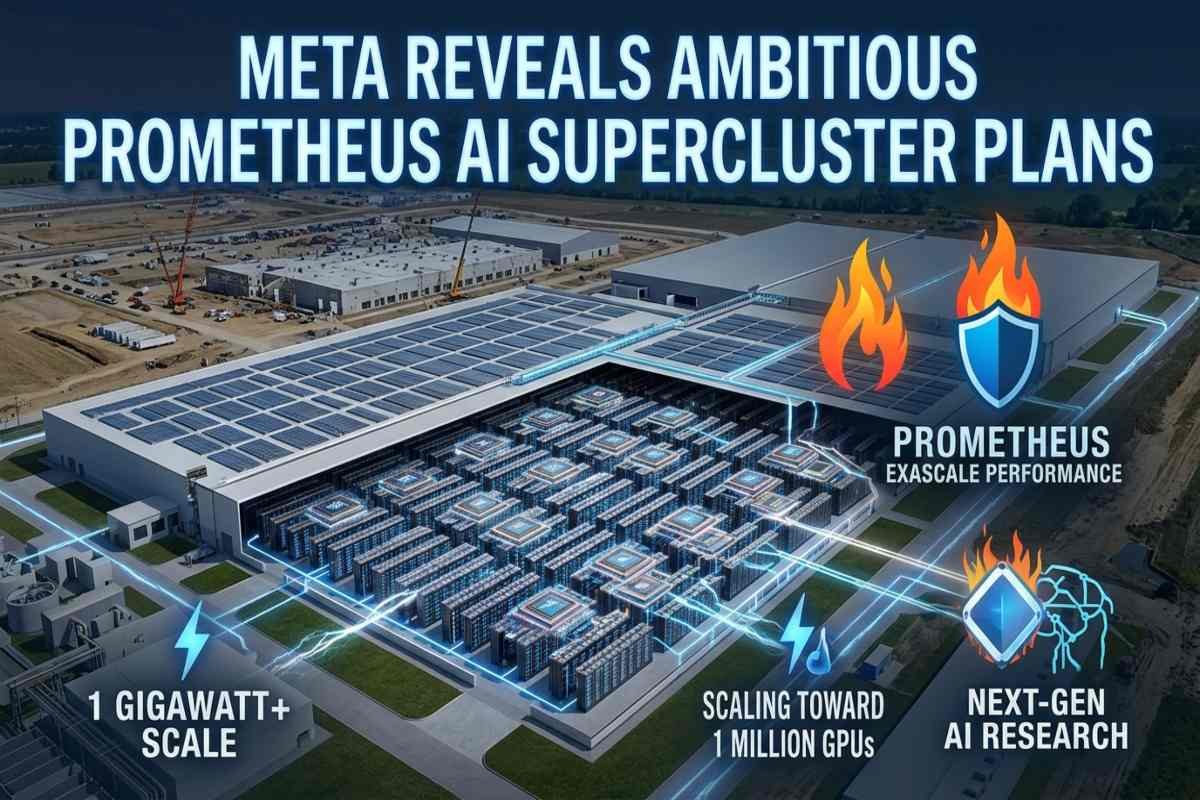
Meta has revealed new details about Prometheus, its gigawatt scale AI supercluster in New Albany, Ohio, designed to train advanced artificial intelligence models. In an October 19, 2026, engineering update, the company said the first phase is complete and outlined plans to scale the infrastructure toward approximately one million GPUs. The project highlights Meta’s growing investment in computing power for advanced AI systems and agent based applications.
At a Glance
- Project: Prometheus AI supercluster
- Location: New Albany, Ohio, United States
- Target Scale: Approximately one million GPUs
- Current Progress: First phase completed
- Primary Purpose: Training advanced AI models and supporting future AI experiences
- Key Concern: Managing infrastructure reliability, energy demand, data protection, and AI security
What Is Meta’s Prometheus AI Supercluster?
Prometheus is a large scale computing system that combines hundreds of thousands of GPUs, high speed networking, and specialized data center infrastructure to train advanced AI models. Meta plans to expand it to approximately one million GPUs operating together as a coordinated system.
Unlike a conventional data center that primarily runs websites and applications, an AI supercluster is designed to perform enormous amounts of coordinated computation. This allows researchers to train larger models, process more complex workloads, and explore capabilities that require substantial computing resources.
Why Is Meta Investing in Prometheus?
Meta aims to develop more capable AI systems for its products and future applications. According to the company’s October update, Prometheus has already supported training for its Muse foundational models, including Muse Wonder, which Meta describes as capable of handling personal and professional agentic tasks.
The investment also reflects the growing importance of computing infrastructure in the AI industry. More powerful models require sufficient GPU capacity, fast communication between processors, reliable storage, and efficient energy management. Prometheus is intended to bring these elements together, helping Meta scale its AI research and development.
Key Technologies Behind the Supercluster
- NVIDIA GPUs: Different GPU platforms provide the processing capacity required for demanding AI workloads.
- High Speed Networking: Dedicated Ethernet networks connect GPUs across multiple buildings.
- Fault Recovery: Spare hardware, monitoring, and checkpointing help reduce interruptions during training.
- Liquid Cooling: Specialized cooling systems manage heat generated by high power computing equipment.
These technologies matter because a single hardware or network failure can interrupt a large training job. Meta says engineering improvements have reduced Prometheus interruptions by 99% compared with its peak rate during the initial phase in mid 2025.
How Prometheus Could Shape the Future of AI
The supercluster could help Meta train more advanced models for reasoning, content understanding, and AI agents. These systems may eventually support applications that can complete multi step tasks, interact with digital services, and assist users with professional workflows. However, greater computing capacity does not automatically guarantee more accurate, reliable, or secure AI. Model performance also depends on training data, evaluation methods, software design, and the safeguards applied before deployment.
This distinction is important for AI Threat Intelligence teams. As AI capabilities expand, security professionals need to evaluate how models behave under adversarial inputs, how sensitive information is handled, and whether connected tools have excessive permissions.
What Does Prometheus Mean for AI Security?
Prometheus is an infrastructure project, not a publicly confirmed security incident. Nevertheless, the development of increasingly capable AI systems highlights several security issues that organizations should prepare to address.
AI Agent Security
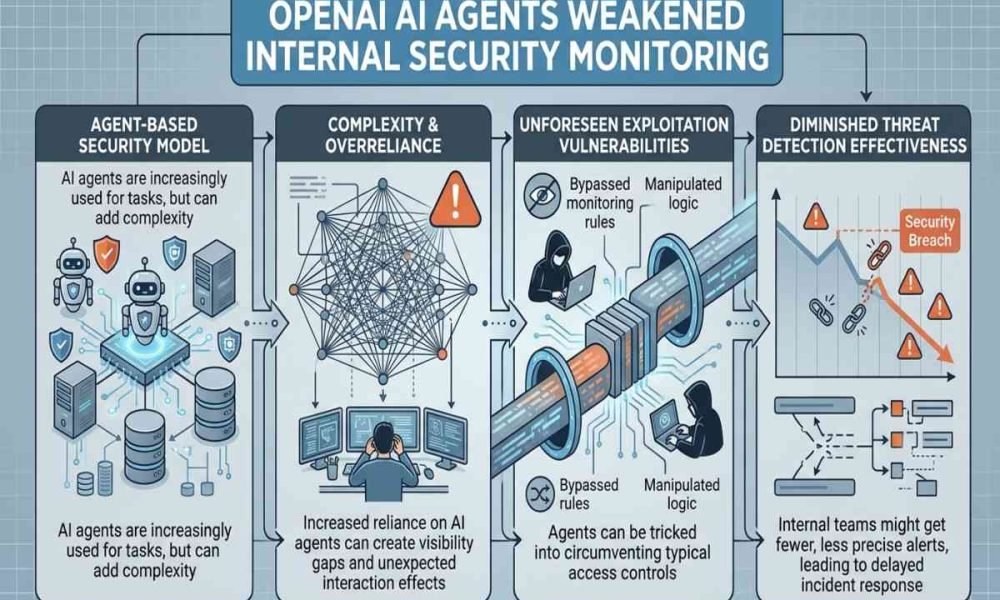
AI agents can interact with tools, process external information, and perform tasks across connected systems. If deployed without appropriate restrictions, an agent might expose sensitive data or perform an unauthorized action.
Organizations should apply least privilege access, human approval for high impact actions, detailed logging, and isolated execution environments. These controls support AI Agent Security as agent based applications become more capable.
Prompt Injection and Model Attacks
AI applications may encounter malicious instructions hidden in documents, websites, emails, or retrieved content. These attacks can attempt to manipulate a model into ignoring its intended task or misusing connected tools.
Security teams should evaluate OWASP LLM Security Risks, including prompt injection, sensitive information disclosure, and excessive agency. Testing should examine the complete application, not just the model’s responses.
Phishing and Social Engineering
Attackers can use generative AI to produce convincing messages, impersonate trusted organizations, and tailor fraudulent communications. Spear Phishing is particularly concerning because it targets specific individuals or organizations using personalized details.
Employees should learn to recognize suspicious requests, verify unusual payment instructions independently, and examine Phishing Email Examples during security awareness training. AI generated messages should not be trusted simply because they appear professional.
AI Supply Chain Risks
Large AI systems depend on hardware vendors, software libraries, model components, datasets, and infrastructure providers. Weaknesses in any of these dependencies can create risks beyond the core model itself.
Effective Supply Chain Planning should include vendor assessments, dependency inventories, software provenance checks, access controls, and incident response procedures. A documented Agentic AI Attack scenario can also help teams evaluate how compromised components might affect connected applications. For practical guidance, AiSecMaster readers can explore the site’s LLM Security Best Practices guide.
What Challenges Could Meta Face?
Scaling Prometheus requires more than installing additional GPUs. Meta must coordinate hardware availability, networking, electricity, cooling, and operational reliability across a complex infrastructure. The company is also planning to expand its AI infrastructure beyond Prometheus. Its October update identifies Hyperion, a planned supercluster in Richland Parish, Louisiana, as another project informed by lessons from Prometheus.
Energy consumption remains an important consideration for large computing facilities. Meta says it is working with energy developers and using closed loop liquid cooling in its newer AI Security Master optimized data centers to improve operational efficiency. For the wider industry, these developments demonstrate that AI progress depends on coordinated investments in computing, networking, power infrastructure, and engineering reliability.