
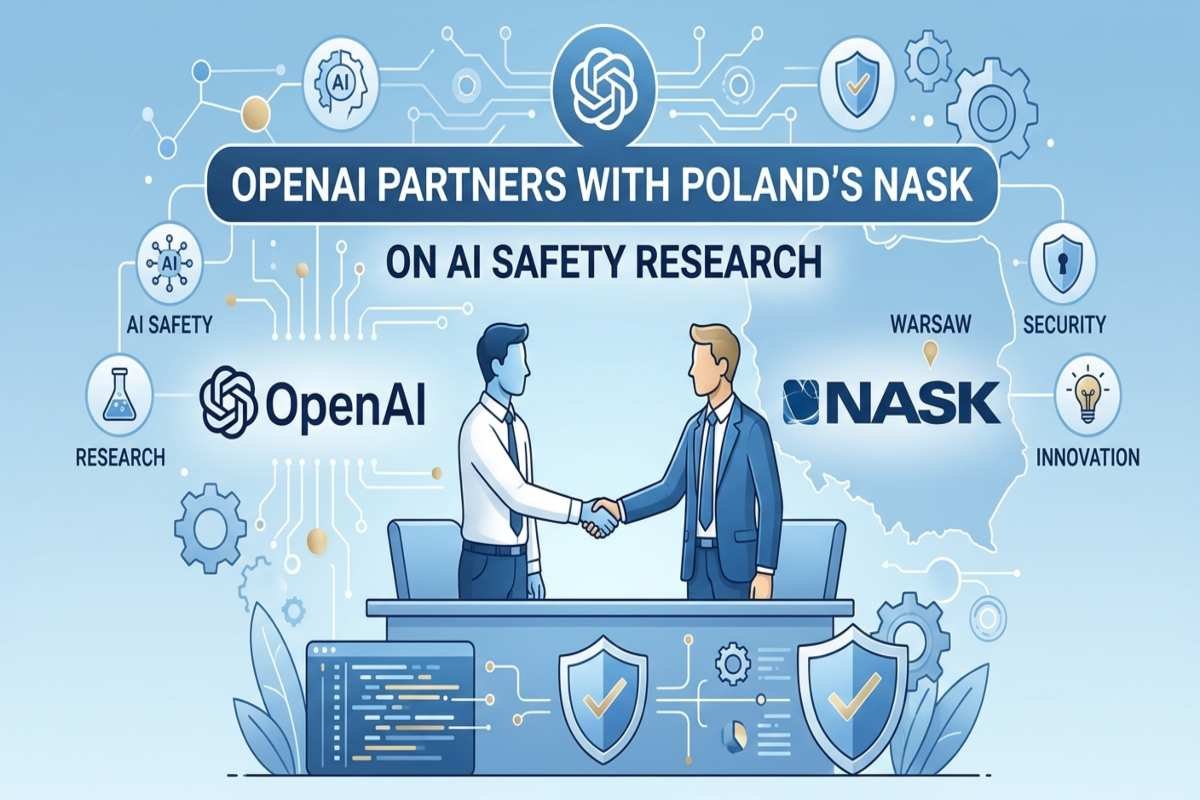
OpenAI has announced a partnership with Poland’s National Research Institute, NASK, to advance artificial intelligence safety, cybersecurity, and technical research. Advertised on October 23, 2026, the agreement will explore ways to evaluate increasingly capable AI systems, identify vulnerabilities, and strengthen safeguards against emerging risks.
The collaboration brings together an AI developer and a national research institution to investigate how advanced AI systems can be made more reliable and secure. For US businesses, cybersecurity professionals, and AI developers, the announcement highlights the growing importance of international cooperation in AI security.
What Will OpenAI and NASK Research?
The agreement connects OpenAI with NASK’s AI Safety Research Center, which serves as Poland’s Artificial Intelligence Safety Institute. According to OpenAI, the organizations will explore technical research aimed at understanding emerging risks and improving the protections used in increasingly capable AI systems.
- AI System Evaluation: Assessing the capabilities and behavior of advanced models to identify potential weaknesses.
- Vulnerability Research: Investigating flaws that could expose AI systems or the applications connected to them to security risks.
- Stronger Safeguards: Exploring methods that make AI systems more dependable and better protected against misuse.
The announcement does not yet specify individual research projects, a funding amount, a completion date, or measurable milestones. The practical impact will depend on how the partnership translates these goals into research, testing, and security improvements.
Why Is This Partnership Important for AI Cybersecurity?
AI models increasingly support software development, data analysis, customer service, and security operations. As these systems gain access to external tools and business data, weaknesses in their design can create risks beyond inaccurate answers. For example, an AI assistant connected to a company’s internal systems could encounter malicious instructions hidden inside a document.
This is why AI Agent Security is becoming an important part of cybersecurity research. Testing must examine not only what a model says but also what it can do, which tools it can access, and whether its actions remain within authorized boundaries. The partnership’s focus on evaluation and safeguards is relevant to these challenges, although OpenAI has not confirmed that this specific scenario is part of the joint research program.
What Previous Cybersecurity Work Connects to This Announcement?
The partnership builds on existing cooperation between OpenAI and Polish cyber defenders. In July 2026, CERT Polska, which operates within NASK, gained access to OpenAI’s cyber-capable models through its Daybreak program.
CERT Polska subsequently reported identifying six vulnerabilities in MikroTik RouterOS. Some vulnerabilities could be combined to compromise affected devices without authentication, and MikroTik released security fixes. CERT Polska later reported that attackers were exploiting the vulnerability combination and recommended applying updates.
AI Threat Intelligence can support vulnerability analysis, investigation, and prioritization. However, AI-generated findings should be independently verified before organizations make security decisions or deploy changes to production systems.
Which AI Security Risks Deserve More Attention?
The partnership is relevant to several established risk categories that AI developers and security teams should monitor.These categories align with risks documented by the OWASP GenAI Security Project, including its 2026 LLM security guidance.
Organizations should also consider OWASP LLM Security Risks when designing security assessments. A structured review can help teams test realistic attack scenarios instead of relying solely on general model safety evaluations. An Agentic AI Attack becomes particularly concerning when an AI agent can interact with external systems, execute code, or access sensitive records without adequate authorization checks.
How Can Businesses Prepare for Emerging AI Threats?
US businesses do not need to wait for the partnership to publish research before improving their own defenses. Practical safeguards can reduce exposure while AI security standards and evaluation methods continue to evolve.
- Limit Agent Permissions: Give AI systems only the access needed for their assigned tasks, and require approval for sensitive or irreversible actions.
- Test for Prompt Injection: Evaluate how applications handle malicious instructions embedded in user inputs, emails, documents, and retrieved content.
- Strengthen Supply Chain Planning: Track model providers, third-party components, datasets, dependencies, and security updates as part of broader Supply Chain Planning.
- Protect Confidential Information: Apply access controls, data minimization, encryption where Appropriate, and monitoring for suspicious access.
- Monitor and Validate Outputs: Log important agent actions, verify generated code, and test security controls before deploying changes.
These measures complement established application-security practices. For additional resources, AiSecMaster can connect this news article to its existing guides on LLM security best practices and source code security.
What Happens Next?
OpenAI and NASK have announced a shared direction for AI safety and security research, but the public announcement does not establish specific project deadlines, funding, or completed outcomes. Future disclosures about research priorities, testing methods, and published findings will help clarify the partnership’s practical impact.
For the US Cybersecurity Community, the key takeaway is that AI safety requires more than improving model responses. It also requires testing real-world behavior, limiting system permissions, finding vulnerabilities, and coordinating across organizations and national borders. AI agents become more integrated into business operations, AiSecMaster will continue covering developments in AI security, emerging threats, and practical defenses that help organizations make informed decisions.







One Response