
AI data protection is therefore becoming an important part of modern cybersecurity. Organizations need to understand what information their AI systems can access, how that information is processed, where it is stored, and who can use it. In this guide, we will explain what AI data protection means, why it matters, the major risks businesses should understand, and the best practices organizations can use to keep sensitive information safe.
What Is AI Data Protection?
AI data protection refers to the policies, technologies, and security practices used to protect information that is collected, processed, stored, or accessed by artificial intelligence systems. The goal is to prevent unauthorized access, accidental exposure, misuse, theft, manipulation, and loss of sensitive information.
AI data protection applies to different types of information, including training data, user prompts, AI-generated responses, documents used by AI applications, databases, logs, and information exchanged between AI systems and external services.
Why AI Data Protection Is Important
AI applications can process information at a very large scale. This makes them valuable for businesses, but it also means that a security incident could expose a significant amount of information. For example, an AI assistant connected to an internal company knowledge base may have access to hundreds or thousands of documents. If access controls are incorrectly configured, an unauthorized user could potentially retrieve information they should not be able to see.
Employees can also accidentally expose sensitive information by entering confidential business data into public AI services. Strong AI Data Protect helps organizations reduce these risks while enabling employees and customers to benefit from AI.
Types of Data That AI Systems May Process
Different AI applications process different types of information. Understanding what data is involved is the first step toward protecting it.
- Customer names and contact information
- Email addresses and phone numbers
- Financial and payment information
- Employee records
- Business documents
- Source code
- Passwords and authentication credentials
- Internal company communications
- Product and business strategy information
- Customer conversations
- Research and intellectual property
Not every AI system needs access to all of this information. Organizations should carefully determine what data is actually required for each application.
Understand Where AI Data Goes
One of the most important questions organizations should ask is where their data goes after it is submitted to an AI application. An AI Application may send information to an external model provider, store prompts in application logs, save documents in a database, or transfer information between multiple services. Organizations should understand these data flows before deploying an AI application for sensitive business activities.
Use Data Minimization
Data minimization is an important principle for protecting sensitive information. It means collecting and processing only the information that is necessary for a specific purpose. For example, if an AI chatbot only needs a customer’s order number to answer a question, there may be no reason to provide the customer’s complete personal profile. Reducing unnecessary data access can lower the potential impact of a security incident.
Businesses should regularly review what information their AI systems can access and remove unnecessary data whenever possible.
Apply Strong Access Controls
Access control is one of the most important components of AI data protection. AI applications should only have access to the information and systems they need to perform their intended tasks. Organizations should use role-based access controls to determine which users and systems can access specific information.
For example, an AI assistant used by a customer service team should not automatically have access to confidential financial records or employee information unless that access is necessary and properly authorized.
Follow the Principle of Least Privilege
The principle of least privilege means giving users, applications, and AI systems only the permissions they require. This is especially important for AI agents that can interact with external tools and business systems.
An AI agent with unnecessary permissions may create a larger security risk if its behavior is manipulated or its credentials are compromised. As part of Modern Cybersecurity, organizations should regularly review AI agent permissions, follow the principle of least privilege, limit access to sensitive resources, and remove permissions that are no longer required to reduce potential security risks.
Protect AI Training Data
Training data can have a major impact on an AI system. Organizations should carefully control who can access, modify, or upload training data.
Unauthorized changes to training datasets can affect model behavior and potentially introduce security or quality problems. Businesses should maintain appropriate access controls and monitoring around important datasets. They should also verify the source and quality of data before including it in an AI system.
Protect AI Knowledge Bases
Many modern AI applications use retrieval systems or knowledge bases to provide information to users. These systems may contain internal documents, product information, policies, or customer records.
Access permissions should be carefully designed so that users can only retrieve information they are authorized to access. An AI assistant should not bypass the organization’s existing access controls simply because it can search a large knowledge base. Data permissions should therefore remain connected to the identity and authorization of the user requesting the information.
Encrypt Sensitive AI Data
Encryption provides an additional layer of protection for sensitive information. Organizations should consider encryption for data stored in databases, cloud storage, backups, and other systems. Sensitive information should also be protected during transmission between applications and services. Encryption does not solve every security problem, but it can reduce the risk of information being exposed if unauthorized parties gain access to stored or transmitted data.
Protect AI Prompts and Responses
Prompts and AI-generated responses can contain sensitive information. Organizations sometimes focus on protecting databases while overlooking application logs and conversation histories.
For example, an employee may submit confidential business information to an AI assistant. If the application stores that prompt in an unsecured log, the information may become accessible to people who should not have access to it. Businesses should therefore determine what prompts and responses are stored, how long they are retained, and who can access them.

Use Data Masking and Redaction
Data masking and redaction can reduce the amount of sensitive information exposed to AI systems. For example, an application may detect sensitive information, such as payment details or personal identifiers, and replace it with masked values before sending the request to an AI model. This approach allows an AI system to perform useful tasks while reducing unnecessary exposure of sensitive information and supporting stronger AI security practices. AiSecMaster recommends combining data masking with access controls, encryption, and continuous monitoring for a more effective data protection strategy.
Monitor AI Data Usage
Organizations should monitor how sensitive information moves through their AI applications. Monitoring can help identify unusual behavior, unauthorized access, unexpected data transfers, and other potential security problems. Security teams should pay attention to unusual increases in data access, repeated requests for sensitive information, and unexpected communication with external services. Monitoring can also provide useful information during security investigations.
Secure AI APIs
AI applications often communicate with external models and services through APIs. These connections need to be protected carefully. Organizations should use strong authentication and authorization mechanisms for AI APIs. API keys and other credentials should be stored securely and should never be exposed in source code or public repositories. Rate limiting can also help prevent abuse and excessive requests. API activity should be monitored to investigate suspicious usage quickly.
Prevent Accidental Data Exposure by Employees
Not every AI Security problem comes from external attackers. Employees can accidentally expose sensitive information through inappropriate use of AI tools. For example, an employee might copy confidential customer information into a public AI chatbot to ask for help with a task.
Organizations should create clear policies explaining what information employees can and cannot submit to AI services. Security awareness training should also explain why these rules are important and provide employees with safe alternatives.
Use AI Data Security Policies
A formal AI data security policy can help organizations establish consistent rules for using artificial intelligence. The policy should explain which AI tools are approved, what types of information can be processed, who is authorized to use AI systems, and what security controls are required. Policies should also address data retention, access controls, monitoring, incident response, and third-party AI services.
Regularly Review AI Systems
AI applications are not static. Developers may change models, prompts, APIs, datasets, plugins, and application features. Each change can introduce new security or privacy risks. Organizations should therefore conduct regular security and privacy reviews. These reviews can help identify unnecessary permissions, outdated configurations, excessive data access, and other weaknesses.
AI Data Protection and Privacy
Data protection and privacy are closely connected. Organizations need to understand not only how to secure information but also how it is collected and used.
Businesses should consider applicable privacy requirements when designing AI applications that process personal information. They should also provide appropriate transparency about how personal information is processed and avoid collecting unnecessary information.
What Businesses Should Do After a Data Incident
Even organizations with strong security controls should prepare for the possibility of a data incident. A response plan should identify who is responsible for investigating the incident, how access should be restricted, how affected systems should be secured, and how relevant stakeholders should be informed. For AI systems, the plan should also address Prompt Injection Attacks, including how malicious instructions can manipulate AI behavior, expose sensitive data, or trigger unauthorized actions.
Organizations should also review the incident afterward to determine the cause and how similar incidents can be prevented in the future.
Common AI Data Protection Mistakes
Businesses should avoid several common mistakes when implementing AI systems.
- Giving AI applications unnecessary access to sensitive information
- Allowing employees to use unapproved AI services for confidential work
- Failing to protect AI prompts and conversation logs
- Using weak API authentication
- Keeping sensitive information longer than necessary
- Ignoring third-party AI service risks
- Failing to monitor AI data activity
- Not reviewing AI permissions after application updates
Avoiding these mistakes can significantly improve an organization’s AI data protection strategy.
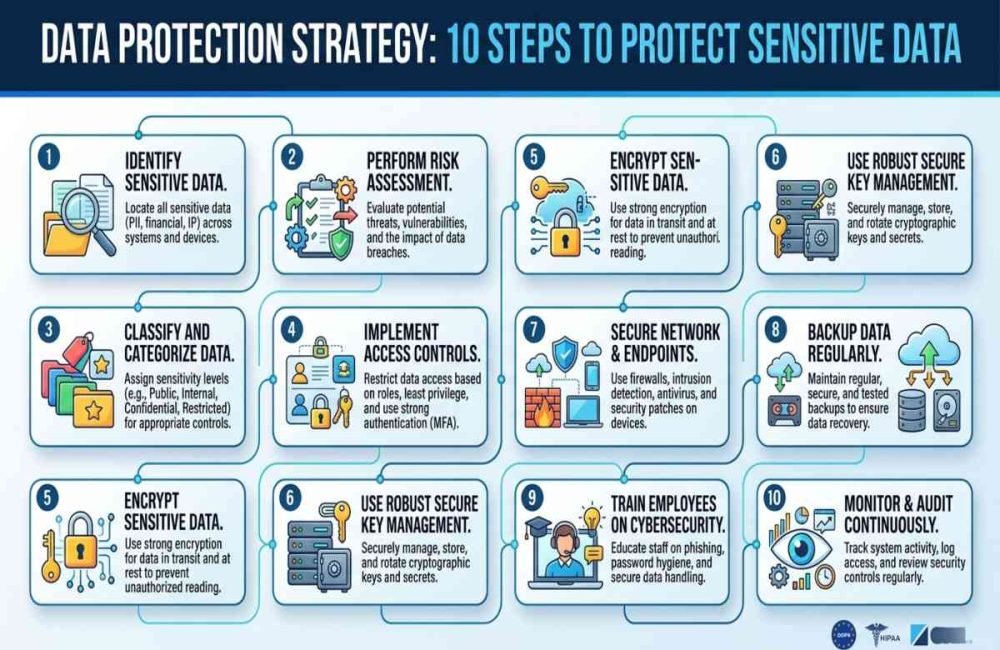
AI Data Protection Best Practices
Organizations can follow several practical steps to improve the security of information used by AI systems.
- Identify all AI applications and the data they process.
- Classify sensitive information before using it with AI.
- Apply the principle of least privilege.
- Use strong authentication and authorization.
- Encrypt sensitive information where appropriate.
- Monitor AI requests, responses, and data transfers.
- Protect AI APIs and credentials.
- Use data masking or redaction when appropriate.
- Create clear employee AI usage policies.
- Regularly test and review AI applications.
- Limit unnecessary data retention.
- Prepare an incident response plan.
The Future of AI Data Protection
As artificial intelligence becomes more deeply integrated into business operations, protecting AI-related data will become increasingly important. Organizations will need better visibility into how AI systems access and process information. Automated data classification, privacy controls, security monitoring, and AI-specific data protection technologies are likely to become more common.
Businesses will also need to consider the security of AI agents that can independently interact with databases, applications, and external services. Strong access controls and clear boundaries will be especially important as AI systems become more capable.

Conclusion
AI Data Protection is an essential part of responsible artificial intelligence adoption. AI systems can process valuable and sensitive information, making them an attractive target for attackers and a potential source of accidental data exposure.
Organizations can reduce these risks by understanding their AI data flows, minimizing unnecessary data access, applying strong permissions, protecting APIs, encrypting sensitive information, monitoring activity, and training employees. Businesses should also remember that AI security is an ongoing process. New models, applications, integrations, and features can introduce new risks over time.
Frequently Asked Questions (FAQs)
What is AI Data Protection?
AI Data Protection refers to the use of security, privacy, and governance practices to protect data processed by artificial intelligence systems. It helps prevent unauthorized access, data leakage, misuse, and exposure of sensitive information.
Why is AI Data Protection important?
AI systems often process large amounts of sensitive and business-critical information. Strong AI Data Protection helps organizations reduce privacy risks, prevent data breaches, and maintain control over how data is collected, stored, processed, and shared.
How does AI protect sensitive data?
AI can support data protection through anomaly detection, automated monitoring, access control analysis, data classification, and threat detection. However, AI should work alongside established security controls rather than replace them.
What are the main risks to AI data?
Common risks include unauthorized access, data breaches, data leakage, insecure AI applications, excessive data collection, weak access controls, and exposure of sensitive information through AI prompts or outputs.
How can organizations improve AI Data Protection?
Organizations can improve AI Data Protection by minimizing data collection, encrypting sensitive information, applying strict access controls, monitoring AI systems, securing APIs, anonymizing data where appropriate, and regularly reviewing security policies.



One Response