
AI Data Privacy is the practice of protecting personal, confidential, and sensitive information when artificial intelligence systems collect, process, store, retrieve, or generate data. It matters because AI applications can interact with large datasets, third-party services, model providers, databases, and business systems.
The biggest privacy mistake is assuming that an AI system automatically protects everything entered into it. Depending on the application and its configuration, sensitive information can be exposed through prompts, logs, model outputs, connected data sources, compromised accounts, or poorly designed integrations. This guide explains the major AI Data Privacy risks and practical ways individuals and organizations can reduce them.
What Is AI Data Privacy?
AI Data Privacy refers to controlling how information is collected, used, stored, shared, and deleted throughout an AI system’s lifecycle. It covers data entered by users, training and fine-tuning data, retrieved information, application logs, model outputs, and data exchanged with external services.
Privacy is closely connected to cybersecurity, but the two are not identical. Cybersecurity focuses heavily on protecting systems and information from unauthorized access or disruption, while privacy also asks whether information should be collected or processed in the first place and whether it is being used appropriately.
NIST’s AI Risk Management Framework treats privacy-enhanced as one of the characteristics of trustworthy AI and recommends considering trustworthiness throughout design, development, deployment, use, and evaluation.
Why Is AI Data Privacy Important?
AI systems can process information at a scale and speed that makes traditional privacy assumptions less reliable. A single application may combine user prompts with documents, databases, APIs, conversation history, and external knowledge sources. This creates additional privacy boundaries that organizations need to understand.
For example, an employee might paste a confidential contract into an AI assistant to summarize it. Even if the employee has legitimate access to the document, the organization still needs to understand how that AI application handles the submitted information. The privacy question is therefore not simply “Who has access to the data?” It is also “Why is the data being processed, where does it go, and what happens to it afterward?”
Major AI Data Privacy Risks
Sensitive Information Disclosure
AI applications can expose personal information, financial details, credentials, confidential business information, health information, or other sensitive content through their outputs. OWASP’s current GenAI security guidance identifies Sensitive Information Disclosure as a major LLM application risk. It recommends measures such as data sanitization and clear policies explaining how submitted information is processed.
A practical example is an internal chatbot connected to company documents. If access controls are poorly implemented, a user could potentially receive information that they were never authorized to see.
Excessive Data Collection
For example, an AI customer-support system may only need an order number and issue description. Collecting a customer’s full address, payment information, identity documents, and unrelated account history creates unnecessary privacy exposure. A useful principle is data minimization: collect and process only the information required for the specific task.
Training Data Exposure
Training and fine-tuning introduce another privacy consideration. Sensitive information can become part of datasets if organizations do not properly identify, remove, or control it. NIST notes that AI can create re-identification risks because of its ability to analyze disparate datasets and because of potential leakage from model training.
Organizations should therefore establish clear rules for what data may enter training, fine-tuning, evaluation, and retrieval pipelines.
Prompt and Conversation Data
Users frequently provide sensitive information directly through prompts.
- Internal source code
- Customer records
- Business strategies
- Passwords or API keys
- Legal documents
- Financial information
- Personal identifiers
The safest approach is not to assume that an AI service will automatically make sensitive information safe. Users should understand the service’s data-handling policies and organizational controls before submitting confidential information.
Third Party AI Services
Many AI applications depend on external model providers, APIs, plugins, cloud platforms, vector databases, or analytics services. This creates a Data Supply Chain. Information submitted to one application could potentially pass through multiple technical components. Organizations should therefore evaluate third-party providers, contracts, access controls, retention practices, and data-processing terms before integrating them. This is especially important for enterprise AI systems handling regulated or confidential information.
How to Keep AI Data Safe
Classify Data Before Using AI
Start by determining what information the AI system is allowed to process. A simple classification model can separate information into:
Use Data Sanitization and Redaction
Organizations can automatically detect and remove sensitive information before it reaches an AI model.
- Personally identifiable information (PII)
- API keys
- Passwords
- Authentication tokens
- Payment information
- Internal identifiers
- Confidential documents
OWASP specifically recommends adequate data sanitization as part of reducing sensitive-information disclosure risks in LLM applications.
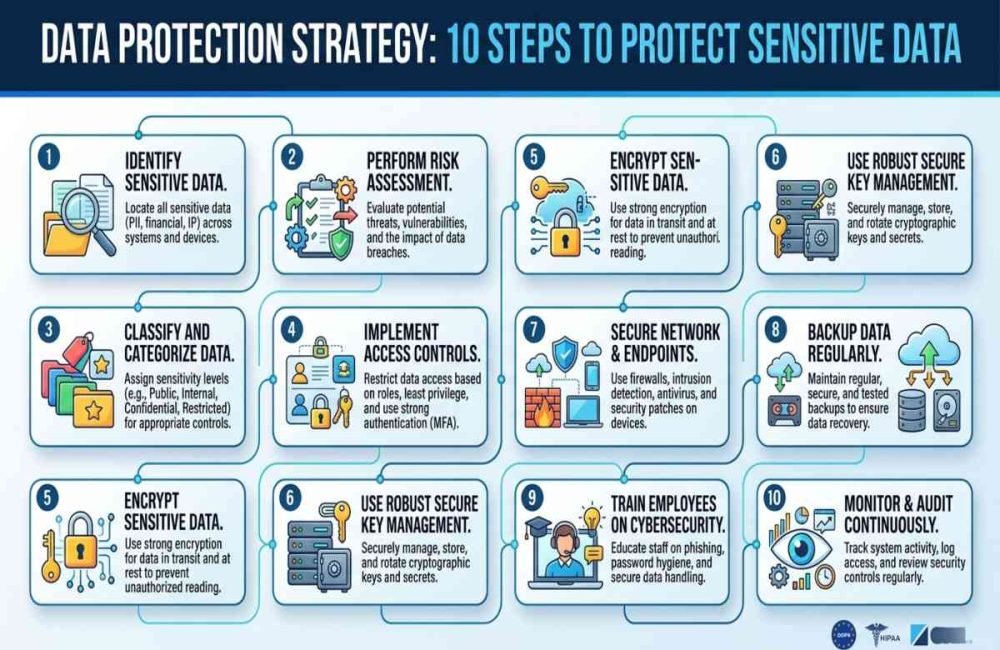
Apply Strong Access Controls
AI systems should follow the least-privilege principle. An AI assistant should only access the information required for its task. If a chatbot does not need access to payroll records, it should not have access to the payroll database. This becomes particularly important with Retrieval Augmented Generation (RAG) systems, where an AI model can retrieve information from internal data sources.
Encrypt Data
Encryption helps protect AI data both during transmission and while stored.
- AI application databases
- Cloud storage
- Backups
- API communications
- Training datasets
- Sensitive logs
- Vector databases
Encryption does not replace access control, but it provides an additional security layer if stored information is exposed.
Control Logging and Retention
Logs can become an overlooked privacy risk. An AI application may record prompts, responses, user identifiers, errors, and metadata. If those logs contain sensitive information and are retained indefinitely, they become another valuable target.
Organizations should establish:
- What is logged
- Why it is logged
- Who can access logs
- How long logs are retained
- When logs are deleted
- Whether sensitive fields are redacted
The goal is to retain useful security information without creating unnecessary copies of sensitive data.
AI Data Privacy and AI Security Work Together
Privacy protection cannot be separated completely from AI security. A privacy failure can result from a security weakness such as compromised credentials, excessive permissions, insecure APIs, prompt injection, or inadequate application controls. OWASP’s 2025 LLM risk list includes Prompt Injection, Sensitive Information Disclosure, Supply Chain, and Data and Model Poisoning, demonstrating how AI security risks can overlap with data protection concerns. For this reason, organizations should evaluate AI systems using both privacy and security perspectives.
Common AI Data Privacy Mistakes
Some privacy problems come from ordinary operational decisions rather than sophisticated attacks.
Giving AI Too Much Access
Connecting an AI assistant to every company database may be convenient, but it increases the impact of an application compromise or authorization failure.
Assuming Prompts Are Private
Users should not assume that information entered into an AI service receives the same protections as information stored inside an organization’s controlled systems.
Ignoring AI Logs
A company might secure its production database while allowing sensitive prompts and responses to remain accessible in application logs.
Relying Only on System Prompts
Instructions such as “never reveal confidential information” are not a replacement for technical authorization controls. OWASP notes that LLM outputs can be manipulated or circumvented and recommends application-level protections rather than relying solely on model instructions. AiSecMaster can build its AI security content around a connected privacy and security knowledge cluster. A strong internal-link structure could include:
Conclusion
AI Data Privacy is not simply about keeping information hidden from an AI model. It requires organizations to understand what data enters an AI system, where that data travels, who can access it, how long it remains available, and how the system’s outputs are controlled. The strongest approach combines data minimization, sanitization, encryption, least-privilege access, secure integrations, controlled logging, retention policies, and continuous risk assessment.
Frequently Asked Questions (FAQs)
What is AI Data Privacy?
AI Data Privacy is the protection and responsible handling of information processed by artificial intelligence systems. It includes data collection, storage, processing, sharing, access, retention, and deletion throughout the AI lifecycle.
What data should not be shared with AI?
Avoid submitting passwords, authentication tokens, confidential business information, unnecessary personal information, financial records, or other sensitive data to AI services unless the system is specifically approved and designed to handle it securely.
Can AI systems expose personal data?
Yes. AI applications can potentially expose sensitive information through prompts, outputs, connected data sources, logs, or weaknesses in application design. OWASP identifies sensitive-information disclosure as a major LLM application risk.
How can businesses protect AI data?
Businesses should combine data minimization, classification, sanitization, encryption, access control, retention policies, vendor assessment, monitoring, and privacy risk management.
Is AI privacy the same as cybersecurity?
No. They overlap, but they address different concerns. Cybersecurity primarily protects systems and information, while privacy also considers appropriate collection, processing, use, and handling of information.
What is the NIST AI RMF?
The NIST AI Risk Management Framework is a voluntary framework designed to help organizations manage AI risks and promote trustworthy AI. Its approach covers the AI lifecycle and includes privacy and security considerations.
Why is data minimization important for AI?
Data minimization reduces the amount of sensitive information an AI system can accidentally expose, misuse, or retain. If the system does not receive unnecessary data, that data cannot become an unnecessary privacy liability.


One Response