
Why Customer Data Protection Matters in AI Applications
AI applications can process large amounts of customer information very quickly. This capability makes AI useful for customer service and business automation, but it also means that a security mistake can potentially expose a large amount of information. For example, an AI customer support assistant may have access to customer orders, account information, previous conversations, and internal support documents. If the application’s permissions are incorrectly configured, a customer might receive information belonging to another customer. Protecting customer data is therefore not only about securing the AI model. The entire application environment must be protected.
Identify What Customer Data the AI Uses
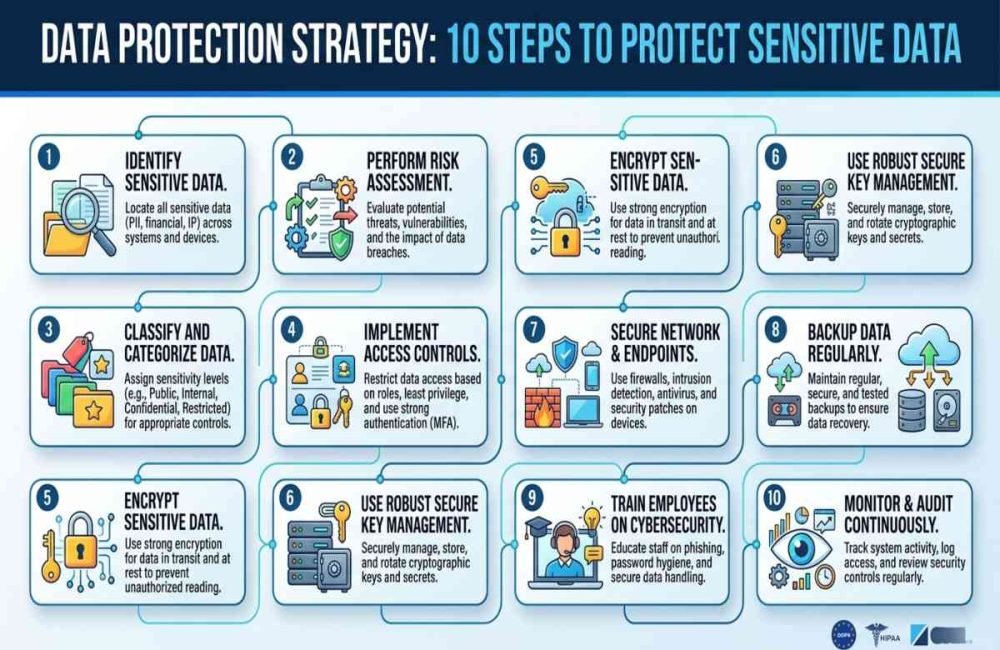
The first step toward protecting customer information is understanding exactly what data the AI application can access. Businesses should create an inventory of customer information used by their AI systems. This may include information stored in databases, customer relationship management platforms, support systems, cloud storage, and other business applications.
Once the data is identified, organizations can determine which information is necessary and which information should not be accessible to the AI application.
Collect Only Necessary Information
Data minimization is an important security and privacy practice. AI applications should only receive the information they need to perform their specific function. For example, a chatbot that answers questions about an order may only need an order number and relevant order details. It may not need access to a customer’s complete profile or unrelated account information. Reducing unnecessary data access limits the amount of information that could potentially be exposed during a security incident.
Use Strong Authentication
Authentication ensures that users are who they claim to be. AI-powered applications that process customer data should use appropriate authentication mechanisms. Businesses should avoid relying on weak passwords or insecure authentication methods. Multi-factor authentication can provide additional protection for accounts that have access to sensitive information. Authentication should also be implemented consistently across connected systems and APIs.
Implement Role Based Access Control
Not every user should have access to the same customer information. Role-based access control can help organizations determine what information different users are allowed to access. For example, a customer support representative may need access to order information but may not need access to internal financial records. AI applications should respect these permissions when retrieving information. The AI model should not become a way for users to bypass the organization’s existing access controls.
Follow the Principle of Least Privilege
The principle of least privilege means providing users and applications with only the permissions required to perform their tasks. This principle is particularly important for AI systems because modern AI applications may connect to multiple databases, APIs, documents, and business tools. An AI application should not automatically have access to an entire database when it only needs a small portion of the information. Limiting permissions reduces the potential impact of an application compromise or security mistake.
Secure Customer Databases
Customer information is often stored in databases that are connected to AI applications. These databases need strong security controls. Organizations should restrict database access, use secure authentication, apply appropriate permissions, and monitor access activity. Databases should also be regularly updated and tested for security vulnerabilities. Businesses should avoid exposing databases directly to the public internet unless there is a specific and properly secured requirement.
Protect AI APIs
APIs allow AI applications to communicate with databases, customer management systems, payment platforms, and other services. These APIs can become an important security boundary. API endpoints should use strong authentication and authorization. API credentials should be stored securely and should never be included in public source code. Organizations should also use rate limiting and monitoring to detect unusual API activity.

Encrypt Customer Information
Encryption can provide additional protection for customer information. Sensitive data should be protected when it is stored and when it is transmitted between systems. For example, secure connections should be used when an AI application communicates with an external service. Stored customer information should also be protected with appropriate encryption mechanisms. Encryption is not a complete security solution, but it can reduce the risk of data exposure if unauthorized access occurs.
Protect Customer Conversations
AI chatbots and virtual assistants may store conversations between customers and the business. These conversations can contain sensitive information. Organizations should determine whether conversation histories need to be stored and how long they should be retained. Access to customer conversations should be restricted to authorized users. Businesses should also avoid storing sensitive information in conversation logs when it is not necessary for the application’s functionality.
Prevent AI From Revealing Another Customer’s Data
One of the most important risks in AI customer applications is unauthorized information retrieval. Suppose an AI assistant has access to thousands of customer records. The system should verify the identity and permissions of the current user before retrieving information. The AI Model should not be responsible for making authorization decisions on its own. Security controls should be implemented at the application and data layers so that unauthorized records cannot be retrieved even if a user attempts to manipulate the AI.
Protect Against Prompt Injection
Prompt injection occurs when a user provides instructions designed to manipulate an AI system into ignoring its intended behavior. An attacker may attempt to convince an AI assistant to reveal internal instructions, access restricted information, or perform unauthorized actions.
Businesses should test AI applications against different prompt injection scenarios and implement security controls outside the AI model. Access permissions and authorization checks should remain active regardless of what instructions a user provides to the AI.
Use Data Masking
Data masking can reduce exposure of sensitive customer information by hiding or replacing parts of the original data. For example, an AI system may only need the last few digits of an account number rather than the complete number. Masking unnecessary information can reduce the amount of sensitive data available to the AI model.
Use Data Redaction
Data redaction involves removing sensitive information before it is processed by an AI system. An application could automatically detect certain sensitive information and remove it before sending the remaining content to an AI model. This can be useful when businesses need AI assistance with customer messages or documents that contain personal information.
Monitor Customer Data Access
Monitoring is an important part of AI data security. Businesses should track how customer information is accessed and used. Security teams should investigate unusual patterns such as large data requests, repeated attempts to access restricted information, unusual API activity, or unexpected database queries. Monitoring can help identify compromised accounts and applications before they cause significant damage.
Protect AI Application Logs
Application logs are useful for troubleshooting and security investigations, but they can accidentally contain customer information. Developers should avoid logging unnecessary personal information. If sensitive information must be logged, access to the logs should be restricted and retention should be carefully controlled. Security teams should also monitor access to sensitive logs.
Review Third Party AI Providers
Many businesses use external AI services instead of building their own AI models. Before sending customer information to a third-party service, organizations should carefully evaluate how that service handles data. Businesses should understand data retention practices, security controls, privacy policies, storage locations, and integration requirements. Only the minimum necessary customer information should be shared with external AI providers.
Train Employees
Employees can play an important role in protecting customer data. Businesses should train employees on safe AI usage and explain which types of customer information can be used with approved AI tools. Employees should understand that copying customer records into an unapproved AI application can create a serious security and privacy risk. Clear policies can help employees understand what is acceptable and what should be avoided.
Create an AI Data Protection Policy
A formal policy can help businesses establish consistent rules for protecting customer information and strengthening AI Security. An AI data protection policy should explain what data AI applications can access, which AI services are approved, how information should be stored, and who is responsible for AI security and data protection. The policy should also cover data retention, access control, third-party AI services, employee responsibilities, security monitoring, AI privacy, and incident response to reduce AI security risks and protect sensitive customer data.
Perform Regular Security Testing
AI applications should be tested regularly because their functionality can change over time. Developers may add new integrations, models, data sources, plugins, or features. These changes can create new vulnerabilities. Security testing should examine authentication, authorization, APIs, databases, AI prompts, data retrieval, and application behavior. Automated security scanners can help identify certain vulnerabilities, while manual testing can uncover more complex problems.
Prepare for Data Breaches
Organizations should have an incident response plan in case customer data is exposed. The plan should identify who will investigate the incident, how affected systems will be isolated, how access will be restricted, and how the organization will communicate with relevant stakeholders. Businesses should also review incidents after they are resolved to identify the root cause and improve security controls.
Common Customer Data Protection Mistakes
- Giving AI applications access to entire databases without proper restrictions
- Failing to implement user-level authorization
- Storing sensitive customer information in AI logs
- Using weak API authentication
- Allowing employees to use unapproved AI tools
- Sending unnecessary customer information to third-party AI services
- Failing to test AI applications for prompt injection
- Keeping customer data longer than necessary
- Ignoring unusual AI data access
The Future of Customer Data Protection and AI
AI-powered customer applications will continue to become more advanced. Businesses may use AI agents that can access multiple systems, understand customer history, make recommendations, and perform tasks automatically. These capabilities can improve customer service, but they also make access control increasingly important. Organizations will need to ensure that AI applications only access the information necessary for each task and that sensitive actions have appropriate safeguards. Privacy-focused AI design, automated monitoring, strong authorization, and continuous security testing will become increasingly important as AI adoption grows.

Conclusion
Protecting customer data in AI-powered applications requires a comprehensive security strategy. Businesses must secure not only the AI model but also the databases, APIs, knowledge bases, logs, user accounts, and external services connected to it. Organizations can reduce data leakage risks by minimizing data access, using strong authentication, applying least-privilege permissions, encrypting sensitive information, securing APIs, and monitoring customer data usage. Businesses should also test AI applications for prompt injection and unauthorized information retrieval. Employee education is equally important because careless use of AI tools can expose customer information.
As AI becomes a larger part of customer service and business operations, protecting customer information should remain a top priority. By combining strong cybersecurity controls with responsible AI data practices, businesses can provide the benefits of AI while maintaining customer trust and reducing the risk of sensitive information being exposed.
Frequently Asked Questions (FAQs)
How can AI applications protect customer data?
Use encryption, access controls, and data minimization.
Why is customer data security important in AI?
It prevents data breaches, leaks, and privacy violations.
Can AI models expose customer information?
Yes, if data access and model outputs are not properly controlled.
How can companies prevent AI data leaks?
Limit access, mask sensitive data, and monitor AI activity.
Should customer data be encrypted?
Yes, both during transmission and storage.