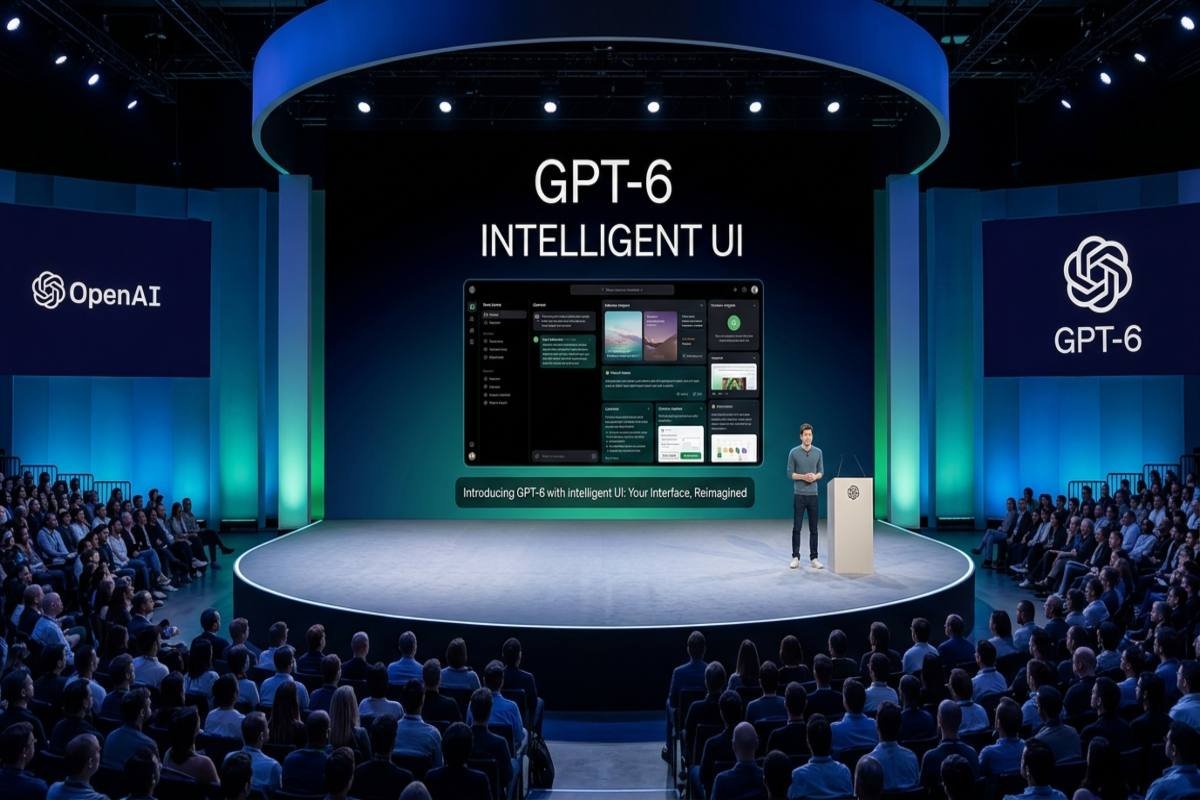
OpenAI has launched GPT-6 globally in ChatGPT, introducing a new Intelligent UI that can combine text, visuals, interactive elements, and task-specific tools in a single response. The update also brings faster response starts, improved web-search performance, and additional safety protections designed to reduce misuse of increasingly capable AI systems.
The release represents more than a model upgrade. OpenAI is changing how people interact with AI by allowing ChatGPT to adapt its interface to the task instead of presenting every answer as plain text.
GPT-6 at a Glance
GPT-6 is the latest generation of OpenAI models available in ChatGPT. According to OpenAI, the new system can decide whether a question is best answered with text, graphics, charts, forms, buttons, or an interactive experience.
- Interactive responses through Intelligent UI
- Visual explanations for complex topics
- On-demand calculators and other small tools
- Faster initial responses during web searches
- Improved ability to decide when information should be searched
- Stronger resistance to jailbreak and safety-bypass attempts
- GPT-6 Sol for paid ChatGPT plans and GPT-6 Luna for Free and Go users
What Is GPT-6 Intelligent UI?
The most visible change in GPT-6 is the Intelligent UI. Instead of limiting ChatGPT to text and static images, the system can generate interfaces that users can interact with directly inside a conversation.
For example, ChatGPT can create a calculator for financial planning, a bill-splitting tool, an interactive diagram for learning, or a comparison presented in a more useful visual format. OpenAI says the model chooses the format based on the user’s question and can still provide a normal text response when interaction would not add value.
This approach could make AI applications easier to use because people no longer have to learn a separate interface for every task. The user describes the goal, and the AI can construct an experience around that goal.
How GPT-6 Changes AI Interaction
Traditional software generally requires users to understand menus, buttons, forms, and workflows before completing a task. GPT-6 moves toward a different model in which the interface can be generated around the user’s intent. This becomes particularly useful for education, research, planning, data analysis, and productivity. Someone learning a complicated concept could interact with a visual explanation instead of reading several paragraphs, while another user could request a small tool specifically designed for a calculation.
The change also has implications for Autonomous AI Agents. As AI systems gain the ability to reason, use tools, browse information, and perform multi-step tasks, dynamically generated interfaces can become an important layer between users and AI actions.
GPT-6 and AI Security
Greater AI capability also creates new security considerations. When AI can generate interfaces, interact with information, and increasingly support complex workflows, organizations need to consider what permissions and data those experiences can access.
OpenAI says GPT-6 incorporates safety advances from GPT-6 Astra, with additional training focused on high-risk misuse involving cyberattacks, biological threats, and violence. OpenAI also reports stronger resistance to jailbreak attempts, including attacks that adapt across multiple conversation turns.
Organizations should also consider risks such as prompt injection and excessive permissions. An Agentic AI Attack could become more consequential when an AI system is connected to business applications or confidential information.
What Is GPT-6 Astra?
It is important to distinguish GPT-6 in ChatGPT from GPT-6 Astra. OpenAI previously introduced Astra as its highest-capability GPT-6 model for demanding professional tasks, including computer use, software engineering, cybersecurity, science, and complex knowledge work. The current ChatGPT rollout uses GPT-6 Sol for Plus, Pro, Business, and Enterprise users, while Free and Go users receive GPT-6 Luna. OpenAI says Astra’s safety advances have informed GPT-6’s development.
Therefore, GPT-6 Astra Launch should not be confused with the October 7 GPT-6 ChatGPT rollout.
What GPT-6 Means for Businesses
Businesses should view GPT-6 as both a productivity opportunity and a security consideration. Interactive AI could simplify internal tools, research workflows, customer support experiences, and data-driven tasks. At the same time, companies should establish clear policies before connecting AI systems to sensitive business environments. Security teams should review permissions, third-party integrations, data handling, authentication, and human approval requirements.
For AiSecMaster, the broader lesson is simple: more capable AI requires more mature security controls. AI adoption should be accompanied by threat modeling, monitoring, access management, and testing rather than relying solely on the model provider’s built-in safeguards.
What Comes Next for GPT-6?
OpenAI’s GPT-6 rollout points toward an AI experience where software increasingly adapts to the user rather than forcing users to adapt to fixed interfaces. Intelligent UI is an early example of this shift. For users, the immediate benefit is more interactive and flexible conversations. For security professionals, the important question is how these capabilities will affect data protection, AI application security, and emerging threats as AI systems become more autonomous.
AiSecMaster will continue tracking these developments, including AI Security resources covering AI security threats, AI privacy, prompt injection, and the security challenges created by increasingly capable AI systems.