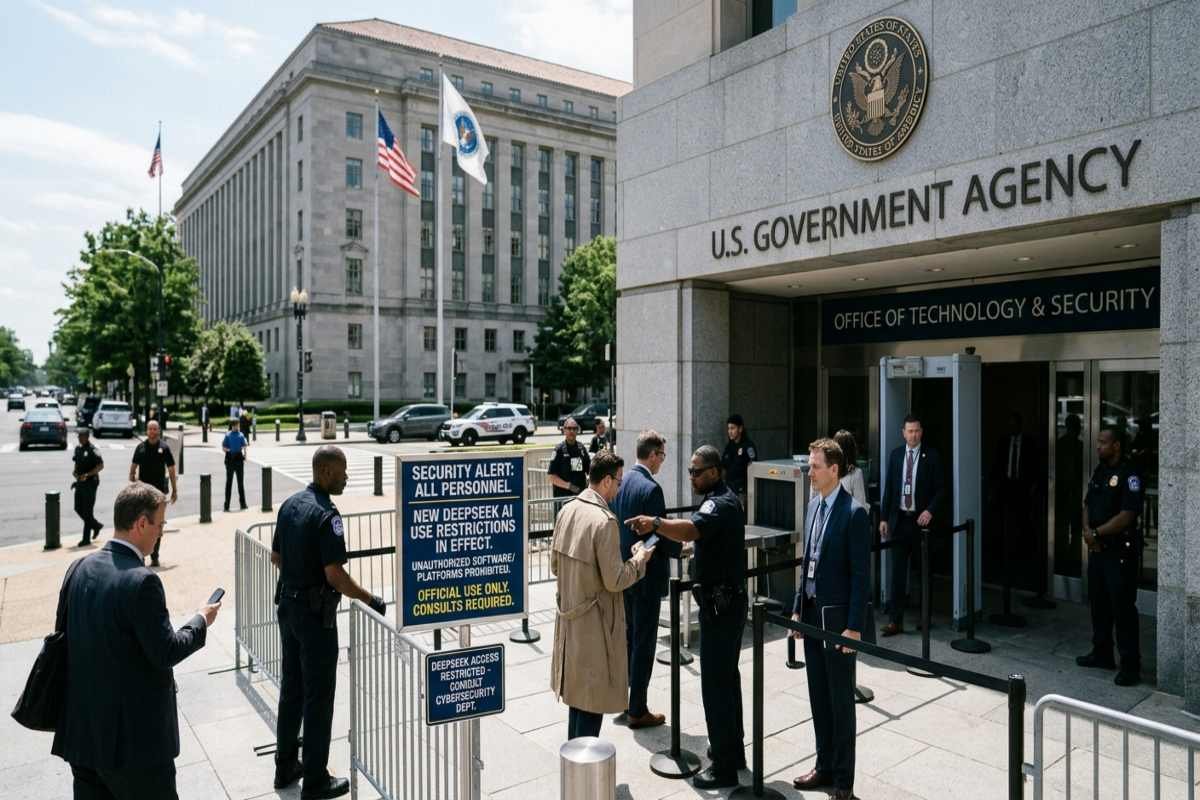
The United States has ordered federal civilian agencies to remove DeepSeek products from government IT systems and stop purchasing covered products and services. The Department of Homeland Security (DHS) published the order in the Federal Register on October 20, 2026, citing potential national security, data privacy, and cybersecurity risks. The restrictions also cover certain third-party products built using DeepSeek implementations. Source: Federal Register.
The decision represents a significant development in US government AI security policy. It highlights growing concerns about how artificial intelligence tools handle sensitive information, connect to external infrastructure, and introduce potential vulnerabilities into government networks.
What Does the DHS Order Require?
The DHS order, issued on July 24, 2026, and publicly disclosed in October, uses authority under the Federal Acquisition Supply Chain Security Act of 2018. It targets DeepSeek products and services developed by Hangzhou DeepSeek Artificial Intelligence Co., Ltd., its covered affiliates, and third-party products using DeepSeek implementations.
- Remove Covered Products: Agencies must remove DeepSeek-related products from civilian government IT systems.
- Stop New Purchases: Federal civilian agencies must exclude covered products from procurement.
- Review Exceptions: Agencies may request exceptions through the established government process.
- Monitor Potential Threats: DHS has also directed agencies to monitor traffic to and from government websites for potential DeepSeek-related risks.
The order includes exceptions for national security systems and sensitive compartmented information systems. It is not a blanket prohibition on every American’s personal use of DeepSeek.
Why Are US Officials Concerned About DeepSeek AI?
The government’s concerns focus on possible exposure of sensitive information, potential security weaknesses, and risks associated with technology connected to foreign infrastructure.
Sensitive Data and Privacy Risks
AI chatbots can receive prompts containing internal documents, personal information, business records, or confidential communications. If employees submit government information to an unapproved service, that information could be exposed through data handling practices, unauthorized access, or insecure integrations.
DHS warned that DeepSeek’s use could potentially transfer sensitive government data to China. These are government-identified risks, not proof that every DeepSeek interaction results in data theft.
Software Vulnerabilities and Supply Chain Risks
AI tools can introduce security concerns through applications, APIs, dependencies, plugins, and third-party integrations. A weakness in any component may create an entry point for attackers or expose sensitive systems. This makes AI Threat Intelligence and Supply Chain Planning important for organizations evaluating AI providers. Security teams should identify where AI models are used, which services depend on them, and whether those dependencies meet internal security requirements.
Potential Misuse of AI Capabilities
Advanced AI models can potentially assist malicious actors with reconnaissance, information analysis, and other harmful activities. However, the DHS order’s concerns about actionable intelligence and possible software vulnerabilities should not be interpreted as evidence that every DeepSeek model is malicious. Organizations should evaluate documented risks, test actual deployments, and avoid treating assumptions about an AI provider as a substitute for technical security assessments.
How Could These Restrictions Affect AI Security?
The restrictions reinforce an important principle: organizations should assess AI systems as part of their broader cybersecurity and vendor-risk programs. For example, a government contractor might use an AI-powered coding assistant built on a third-party model. Even if the contractor does not directly install the original chatbot, the underlying model could create compliance questions under the new order.
This scenario illustrates why AI Agent Security requires visibility into model providers, connected tools, permissions, and data flows. An autonomous system with access to internal files or external applications may create additional risks if its underlying components are not properly reviewed.
What Should Organizations Do to Reduce AI Security Risks?
- Inventory AI Applications: Identify chatbots, APIs, coding assistants, and third-party services used across the organization.
- Review Vendor Policies: Examine data retention, processing locations, access controls, and contractual security commitments.
- Restrict Sensitive Inputs: Prevent employees from submitting confidential information to unapproved AI services.
- AssessD: Check whether applications rely on restricted or unapproved AI models and components.
- Monitor Integrations: Review API traffic, permissions, authentication, and unusual data transfers.
- Test AI Applications: Evaluate prompt injection, information disclosure, excessive permissions, and other relevant threats.
- Maintain an Incident Response Plan: Define how teams will investigate suspicious AI activity and replace a compromised or noncompliant provider.
An Agentic AI Attack can become particularly concerning when an AI agent has permission to execute actions without adequate human review. Strong access controls, activity logging, and approval checkpoints help limit the potential impact.
What Happens Next?
The new restrictions demonstrate that US authorities are treating AI procurement and deployment as supply chain security issues. Agencies and contractors will need to understand which products fall within the order, document their dependencies, and follow applicable exception procedures. However, government restrictions on a particular provider do not automatically establish that all products from that provider are unsafe or that private-sector use is prohibited.
For AiSecMaster, the broader lesson is that AI adoption requires transparent vendor assessment, careful data governance, and continuous security monitoring. Organizations should base decisions on applicable rules, documented technical evidence, and their own risk exposure.