
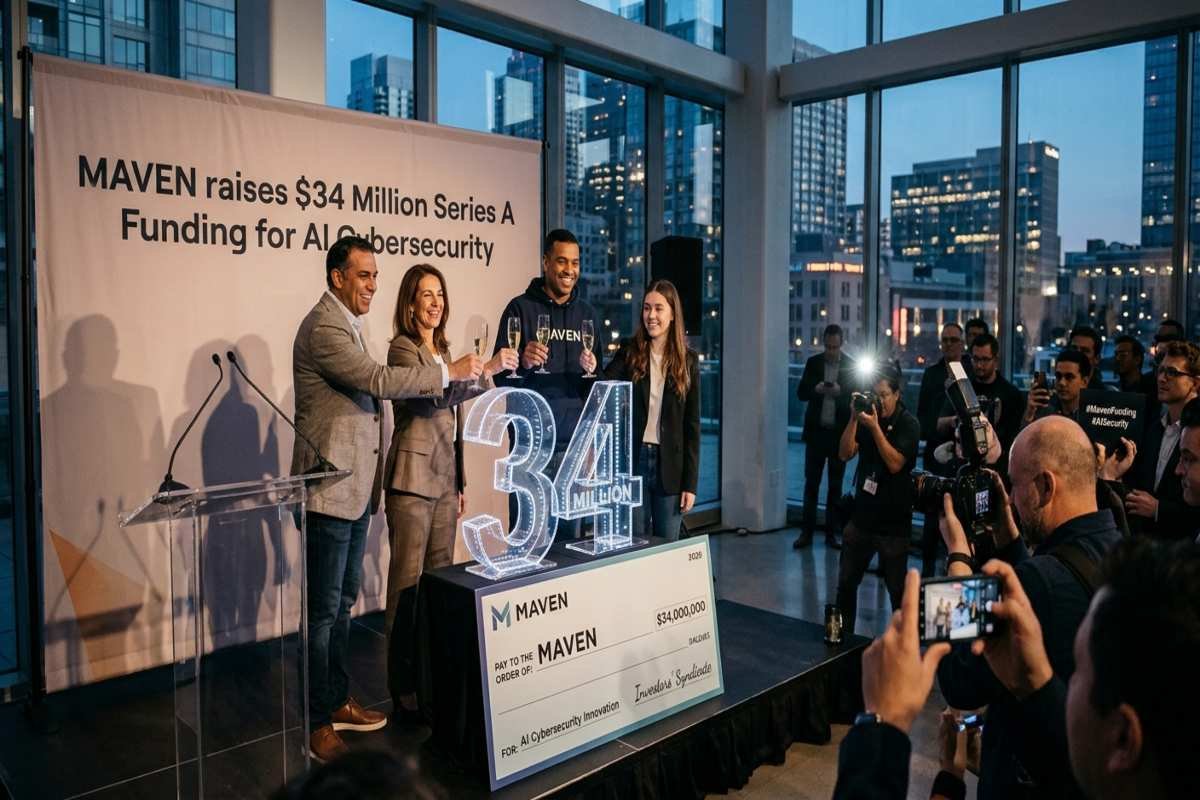
AI cybersecurity startup Mave has raised $34 million in total funding to develop AI powered security operations that help enterprises investigate threats and respond to cyberattacks. Announced on October 22, 2026, the funding includes a $28 million Series A led by Red Dot Capital Partners and an earlier $6 million seed round backed by Dell Technologies Capital and Emerge Ventures.
The Tel Aviv based company aims to connect existing security tools through an agentic AI platform, helping security teams investigate suspicious activity, reduce false positives, and coordinate responses without requiring all security data to be moved into a single database.
At a Glance
- Company: Mave, an enterprise cybersecurity startup.
- Total Funding: $34 million across seed and Series A rounds.
- Series A: $28 million led by Red Dot Capital Partners, with participation from Lumir Growth Partners.
- Seed Investors: Dell Technologies Capital and Emerge Ventures.
- Main Focus: AI agents for security operations, threat investigation, detection, and response.
- Funding Goals: Expand AI research, strengthen enterprise products, and grow internationally.
What Does Mave Do in AI Cybersecurity?
Mave develops an agentic security operations platform designed to help organizations manage fragmented cybersecurity systems. Instead of requiring analysts to investigate every alert manually across multiple dashboards, its AI agents gather context from connected security tools and correlate the available evidence.
The platform supports security operations center (SOC) teams with threat hunting, incident investigations, detection engineering, and response workflows. According to the company, its agents can identify relevant attack activity and recommend or execute authorized actions according to security team policies. This approach addresses a common enterprise challenge: security products may each collect valuable information, but analysts still need to connect the evidence to determine whether an incident is genuine.
Why Is Mave Raising Funding Now?
Enterprise security teams increasingly face a coordination problem: they must process alerts, investigate suspicious behavior, and respond across complex technology environments. When information is scattered among endpoint protection, identity management, cloud security, and network monitoring systems, analysts can lose valuable time switching between tools.
Mave is betting that AI agents can help close this gap by connecting evidence and automating repeatable investigation tasks. The company says its platform is already being used by major enterprises and managed security service providers, including organizations in regulated financial and healthcare sectors. These are company reported claims, not independent guarantees of performance.
How Could Mave’s AI Agents Change Threat Detection?
Traditional security tools often identify suspicious activity but still require human analysts to determine its significance. Agentic security systems aim to perform multiple connected tasks, gather evidence, and support decisions within defined permissions.
- Collect relevant identity, endpoint, and cloud activity.
- Compare the activity with normal behavior and known threat indicators.
- Investigate whether other systems show related suspicious activity.
- Present supporting evidence and recommend containment.
- Execute an approved response, such as disabling a compromised account, when authorized.
This illustrates how AI Threat Intelligence can support investigations when combined with reliable telemetry and contextual evidence. It does not mean an AI system can identify every attack or make every decision correctly.
Why Human Oversight Still Matters
Automated responses can reduce delays, but an incorrect decision could disrupt legitimate business operations. Security teams should enforce least privilege access, require approval for high impact actions, and maintain audit logs showing what the agent investigated and changed. These safeguards become especially important when organizations deploy AI Agent Security controls across systems containing sensitive information or business critical services.
What Will the $34 Million Funding Support?
Mave plans to use the investment to accelerate AI research, improve its enterprise platform, and expand its international presence. The company also intends to grow its workforce, with hiring focused on AI research and go to market operations. The funding may help Mave improve its ability to investigate complex incidents and integrate additional enterprise systems. However, investment alone does not establish how effectively the platform will perform across different customer environments.
For US Organizations evaluating similar technology, the practical questions are whether the platform integrates with existing tools, protects sensitive data, provides reliable evidence, and reduces investigation time without creating unacceptable operational risks.
Security Risks: What Should Businesses Consider?
AI driven security automation also introduces new questions about permissions, accountability, and system reliability. An agent with access to identity systems or cloud infrastructure could cause damage if manipulated or given excessive privileges.
- OWASP LLM Security Risks: Assess prompt injection, sensitive information disclosure, insecure tool interactions, and excessive agency using the OWASP GenAI Security Project.
- Supply Chain Planning: Review third party integrations, software dependencies, vendor access, and the security of connected data sources.
- Agentic AI Attack: Test whether manipulated inputs or compromised integrations could cause unauthorized actions.
- Auditability: Ensure every significant action can be traced to supporting evidence, permissions, and approval records.
These precautions help organizations assess both the benefits and the limitations of agentic cybersecurity platforms.
What Does Mave’s Funding Mean for the AI Security Market?
Mave’s $34 million funding announcement highlights investor interest in AI systems that help security teams investigate and respond to threats. Rather than focusing exclusively on detecting suspicious events, this category aims to connect detection, investigation, and response into a more coordinated workflow.
For AiSecMaster readers, the important development is the growing emphasis on accountable automation. The NIST Generative AI Risk Management Profile offers additional guidance for organizations evaluating AI related risks. The long term opportunity will depend on measurable security outcomes, dependable integrations, transparent decisions, and effective human oversight not funding totals alone.