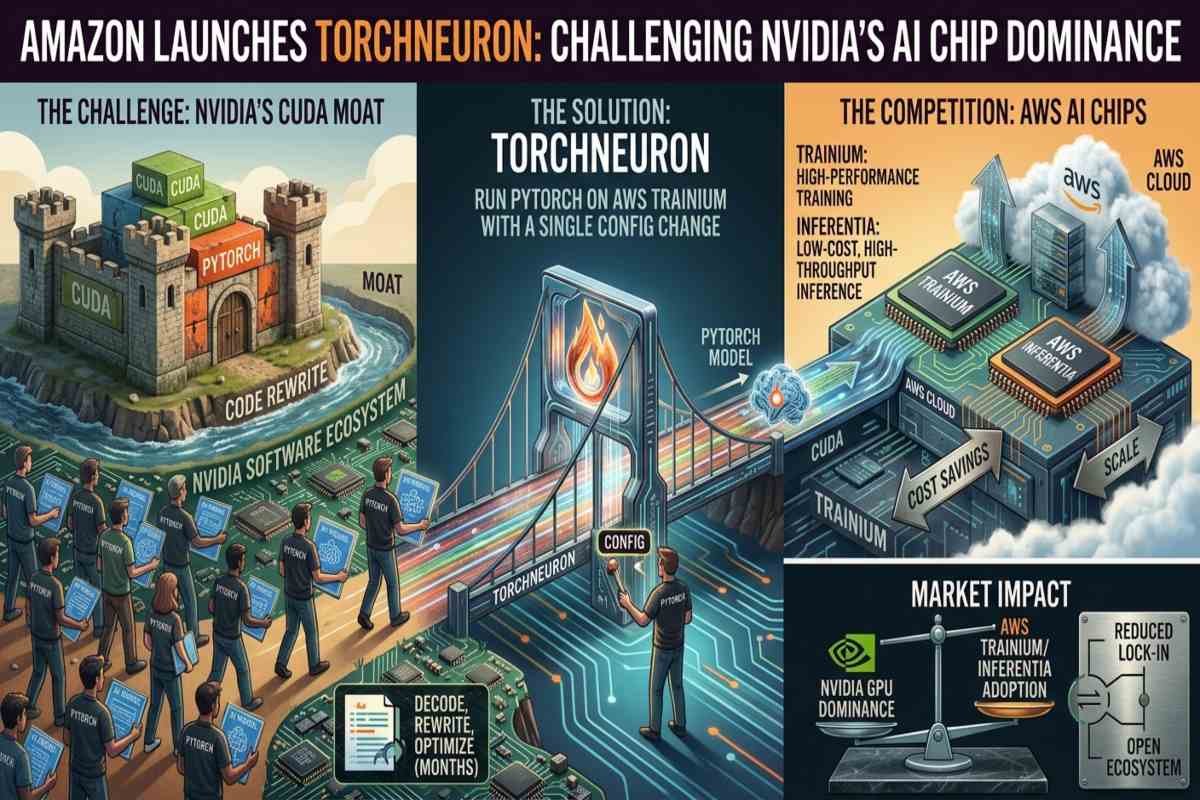
Amazon launched TorchNeuron on October 19, 2026, to make its custom Trainium AI chips easier to use as an alternative to NVIDIA GPUs. The open-source software backend allows developers to run existing PyTorch code on AWS Trainium with minimal changes, potentially reducing the engineering effort required to switch AI computing platforms. Amazon’s official announcement explains how the technology aims to expand hardware choice for AI developers.
At a Glance
TorchNeuron is an open-source PyTorch backend designed to run AI workloads on Amazon Web Services (AWS) Trainium processors. It aims to simplify hardware migration by allowing developers to use familiar PyTorch tools rather than extensively rewriting their applications for Amazon’s chip architecture. According to Amazon, TorchNeuron supports Trainium2 and Trainium3 and is scheduled to become publicly available in beta on October 20, 2026, under the Apache 2.0 license.
Why Is Amazon Challenging NVIDIA’s AI Chip Dominance?
NVIDIA has established a strong position in AI computing through its graphics processing units (GPUs), CUDA software platform, and extensive developer ecosystem. CUDA helps developers optimize AI applications for NVIDIA hardware, making the platform an important part of many machine learning workflows.
However, organizations building large AI models increasingly evaluate alternatives to manage computing costs, performance, and infrastructure availability. Amazon is addressing one major obstacle: moving existing software to different hardware can require significant development, testing, and optimization. TorchNeuron attempts to reduce this barrier. Rather than competing through chip specifications alone, Amazon is making software compatibility a central part of its strategy.
How Does TorchNeuron Work With AWS Trainium?
TorchNeuron connects PyTorch, an open-source machine learning framework, with Amazon’s Trainium AI accelerators. Developers can use familiar programming interfaces and select Trainium through a configuration change instead of extensively rewriting their model code. Amazon also describes support for eager execution, distributed computing interfaces, and custom kernel development. These capabilities can help teams experiment, debug, train, and optimize models within the Trainium environment.
The important distinction is that minimal code changes do not guarantee identical performance across every workload. Developers still need to validate model accuracy, supported operations, throughput, memory requirements, and deployment reliability before migrating production systems.
TorchNeuron vs. NVIDIA CUDA
| Feature | Amazon TorchNeuron | NVIDIA CUDA |
|---|---|---|
| Hardware Focus | AWS Trainium AI accelerators | NVIDIA GPUs and supported hardware |
| Main Advantage | PyTorch integration for Trainium | Mature GPU software ecosystem |
| Migration Consideration | Requires workload and compatibility testing | Existing CUDA workloads may need fewer changes |
| Cloud Environment | AWS infrastructure | Multiple deployment options |
| Best Evaluation Approach | Benchmark the target workload | Benchmark the target workload |
TorchNeuron does not automatically replace NVIDIA’s entire software ecosystem. Instead, it gives developers another option for workloads that can run effectively on Trainium. The practical winner will depend on performance, total operating cost, software compatibility, availability, and developer productivity.
What Could TorchNeuron Mean for AI Businesses?
For startups and enterprises, easier access to alternative AI chips could improve infrastructure flexibility. Organizations may be able to evaluate AWS Trainium without rebuilding their entire machine learning pipeline, potentially making hardware comparisons more practical.
- Lower Migration Effort: Existing PyTorch projects may require fewer code changes.
- Infrastructure Flexibility: Teams can compare AWS Trainium with NVIDIA-based systems.
- Workload Optimization: Businesses can benchmark different hardware configurations against their requirements.
- Cloud Integration: AWS customers can evaluate Trainium alongside other services in their existing cloud environment.
Nevertheless, savings are not guaranteed. Teams should compare complete costs, including compute time, storage, networking, engineering effort, model-serving performance, and ongoing maintenance.
What Are the AI Security Implications?
Hardware competition also creates important considerations for AI security. Moving workloads between platforms changes parts of the software supply chain, including dependencies, runtime components, deployment configurations, and access controls. Organizations should review AI Threat Intelligence, maintain trusted software dependencies, and test model behavior after migration. They should also assess OWASP LLM Security Risks, including prompt injection, sensitive information disclosure, and insecure handling of model outputs.
Where AI applications use autonomous tools, AI Agent Security deserves particular attention. An Agentic AI Attack could exploit excessive permissions or manipulated instructions to trigger unauthorized actions, regardless of which accelerator runs the model. AiSecMaster recommends treating hardware migration as both a performance project and a security review, with validation completed before production deployment.
What Should Developers Evaluate Before Switching?
Before moving an AI Security Master workload to Trainium through TorchNeuron, developers should follow these steps:
- Check Compatibility: Confirm that the model architecture, libraries, operators, and required PyTorch features are supported.
- Benchmark Performance: Compare training speed, inference latency, throughput, and memory usage.
- Calculate Total Cost: Include engineering time, cloud resources, networking, and ongoing optimization.
- Validate Model Outputs: Test accuracy and numerical differences across hardware platforms.
- Review Security Controls: Verify permissions, secrets management, dependency integrity, logging, and monitoring.
- Run a Controlled Pilot: Test representative workloads before committing critical applications to a new platform.
These steps help organizations make decisions based on measurable results rather than vendor claims.