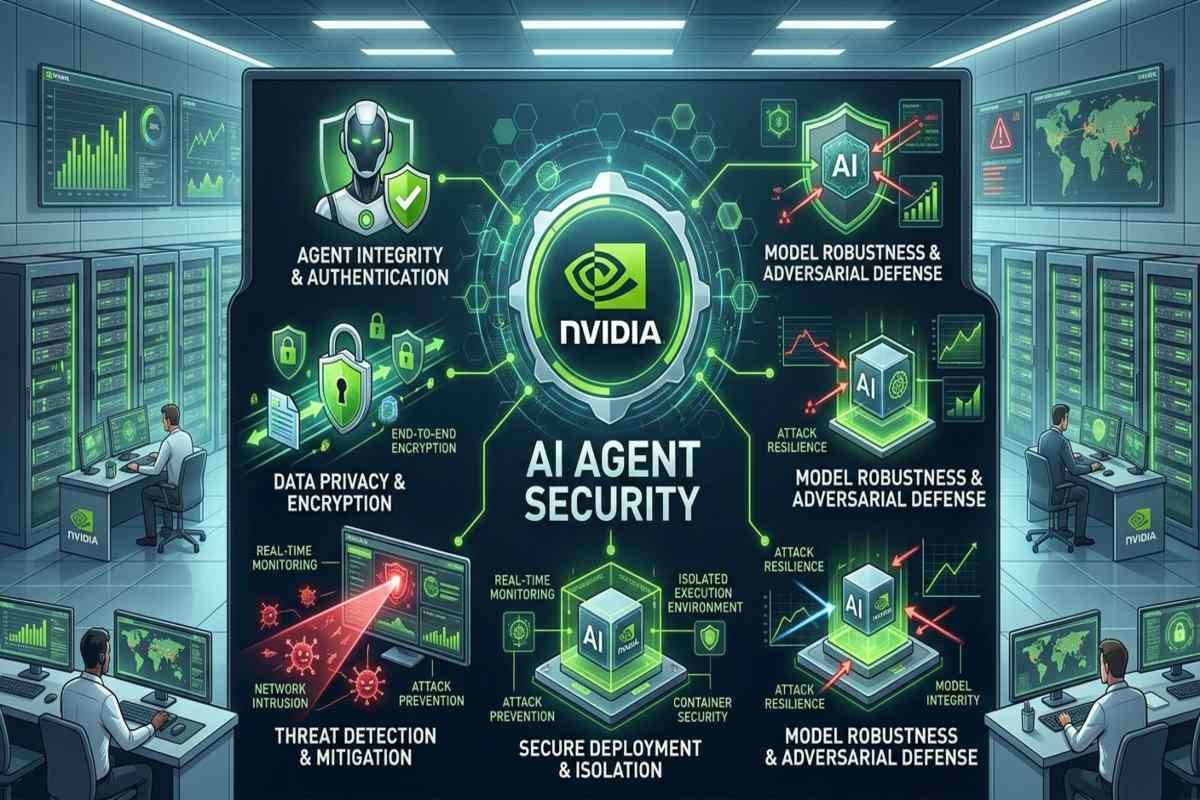
NVIDIA AI Agent Security has become a major focus as autonomous agents move beyond chat toward systems that can use tools, access files, execute code, and interact with enterprise infrastructure. On September 28, 2026, NVIDIA announced its Open Agent Safety Platform, combining OpenShell with the Sentry reference design to provide controls across software and hardware.
NVIDIA’s approach emphasizes security controls outside the AI model. OpenShell provides a secure runtime boundary, while Sentry is designed to monitor agent activity through NVIDIA BlueField 4 DPUs. The goal is to control identity, access, credentials, and agent actions at enterprise scale.
What Is NVIDIA AI Agent Security?
NVIDIA AI Agent Security refers to technologies, architectures, and engineering practices NVIDIA is developing to secure autonomous AI agents. The principle is that an agent should not receive unrestricted authority simply because its model can reason.
OpenShell is designed as a secure runtime for agents. It uses sandboxing, policy enforcement, access controls, credential brokering, and auditing so security decisions can be enforced outside the agent process. This matters because models can be influenced by untrusted instructions or data.
Latest NVIDIA AI Security Update
NVIDIA announced the Open Agent Safety Platform on September 28, 2026. It combines OpenShell with Sentry for full-stack governance and control.
OpenShell provides a runtime boundary that traces agent actions and enforces policy. NVIDIA says Sentry adds out-of-band monitoring using BlueField 4 DPUs. This extends visibility and enforcement beyond the model.
Key AI Agent Threats
Modern AI agent threats differ from traditional software vulnerabilities because agents can interpret instructions, make decisions, call tools, and act on external information. NIST has highlighted risks including indirect prompt injection, insecure models, data poisoning, and harmful autonomous behavior.
- Indirect prompt injection through webpages, emails, documents, or other data.
- Excessive permissions that let agents modify systems or retrieve sensitive information.
- Tool abuse involving shell commands, APIs, browsers, or development tools.
- Secret exposure when credentials are placed directly inside an agent environment.
- Network abuse that can enable data exfiltration or malicious downloads.
- Memory poisoning that influences later agent decisions.
NVIDIA’s red team research identified recurring weaknesses involving access control, arbitrary code execution, network egress, and plaintext secrets. NVIDIA recommends deterministic controls such as strict permissions, sandboxing, default deny network policies, and dedicated secret management.
How Organizations Can Reduce AI Agent Risk
Treat an agent as a privileged software component. Define which files, APIs, databases, commands, and network destinations it actually needs. Apply least privilege and isolate execution. Sensitive credentials should be brokered rather than exposed directly to the model. Network access should be restricted, while important state-changing operations can require human approval.
Organizations should also test agents against indirect prompt injection, tool abuse, data exfiltration, and privilege escalation. This aligns with NIST and OWASP guidance on identity, authorization, monitoring, threat modeling, and layered controls.
NVIDIA AI Security and the Future of Agentic Systems
The security challenge will grow as agents become more capable. Whether discussing NVIDIA systems, enterprise copilots, or emerging gpt 6 capabilities, greater autonomy creates more opportunities for automation and potentially greater impact when an agent is manipulated.
For AiSecMaster readers, the key lesson is simple: model safety alone is not enough. Secure agent deployment requires controls around the model, tools, identity, data, runtime, network, and hardware.
Frequently Asked Questions (FAQs)
What is NVIDIA AI Agent Security?
It is NVIDIA’s approach to protecting autonomous agents through runtime isolation, access control, policy enforcement, monitoring, credential protection, and hardware-assisted security.
What are the biggest AI agent threats?
Key threats include indirect prompt injection, excessive permissions, tool abuse, secret exposure, network misuse, data exfiltration, and memory poisoning.
Why is OpenShell important?
OpenShell moves security enforcement outside the model, using runtime controls and sandboxing that are harder for an agent’s instructions to bypass.
What should companies do first?
Begin with least privilege, sandboxing, restricted network access, protected credentials, continuous testing, logging, and human approval for high-impact actions.