An XML injection attack occurs when an attacker inserts malicious or unexpected XML data into an application that processes XML without properly validating or safely handling the input. Depending on how the application interprets that data, the attack may alter application behavior, manipulate records, bypass security controls, or expose sensitive information.
XML injection can affect web applications, APIs, authentication systems, and software integrations. Understanding how it works, recognizing its warning signs, and implementing secure XML processing practices can help developers and organizations reduce their exposure to this cybersecurity threat.
XML Injection Attack: At a Glance
- Definition: Manipulation of XML data or structure through unsafe input handling.
- Primary Weakness: Untrusted input is incorporated into XML without appropriate validation or safe processing.
- Potential Impact: Data manipulation, unauthorized actions, authentication weaknesses, or information disclosure.
- Common Targets: XML based APIs, SOAP services, configuration systems, and enterprise applications.
- Prevention: Use safe XML construction, input validation, secure parser settings, least privilege access, and security testing.
What Is an XML Injection Attack?
An XML injection attack is a security vulnerability that occurs when an application allows untrusted input to change the intended structure or meaning of an XML document. XML, short for Extensible Markup Language, organizes information using elements, attributes, and nested data. Applications frequently use XML to exchange information between systems, process configuration files, and communicate through SOAP based web services. When developers construct XML by directly combining user input with markup, an attacker may supply characters or elements that change how the resulting document is interpreted.
For example, an application might insert a username into an XML authentication request without using an XML library to escape or encode special characters correctly. Unexpected input could break the intended structure or modify the meaning of the request.
The central security issue is not XML itself. It is the application’s failure to preserve the intended data structure and enforce authorization when processing untrusted input.
How Does an XML Injection Attack Work?
XML injection typically follows a sequence of events in which unsafe input reaches an XML-processing component, creating potential risks for AI Agent Security when AI-powered applications process untrusted XML data. An application receives unexpected or malicious characters. The application inserts the input into XML without safe encoding or structured construction. The parser or downstream application interprets the altered structure, potentially causing data exposure, altered operations, or other unauthorized behavior, depending on the vulnerability.
A Simple XML Injection Example
The design becomes dangerous when the application directly inserts user input into the document as markup rather than treating it strictly as text. Unexpected XML elements could potentially change the document’s structure.
A secure implementation uses an XML library to create elements and assign text values. The library handles the necessary escaping, preventing user provided characters from unintentionally becoming markup. This example illustrates the underlying weakness without requiring a real target or a working exploit.
Common Types of XML Injection Attacks
XML injection is a broad category of weaknesses. Several related attacks involve XML processing, but they exploit different behaviors and require different defenses, similar to how OWASP LLM Security Risks involve distinct AI security vulnerabilities that require specialized protection measures.
| Attack Type | How It Works | Potential Impact |
|---|---|---|
| XML Structure Injection | Unexpected input changes XML elements or attributes. | Data manipulation or unintended application behavior. |
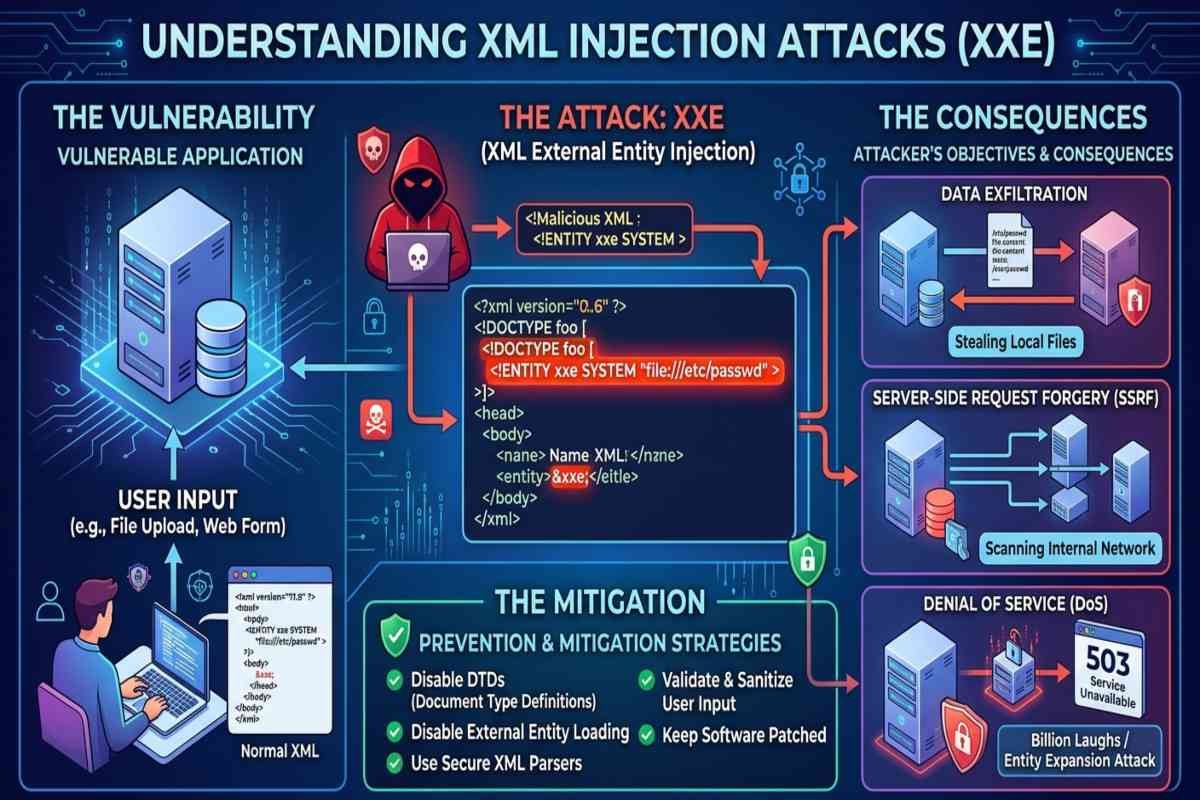
| XML External Entity (XXE) | A parser processes unsafe external entity references. | File disclosure, server-side request forgery (SSRF), or denial of service. |
| XPath Injection | Untrusted input changes an XPath query. | Unauthorized data retrieval or authentication bypass. |
| XML Entity Expansion | Excessive entity expansion consumes system resources. | Application slowdown or denial of service. |
These attacks are related, but they are not interchangeable. OWASP Security provides separate guidance for XML parser security and XPath injection because each requires specific protections.
XML External Entity (XXE) Attacks
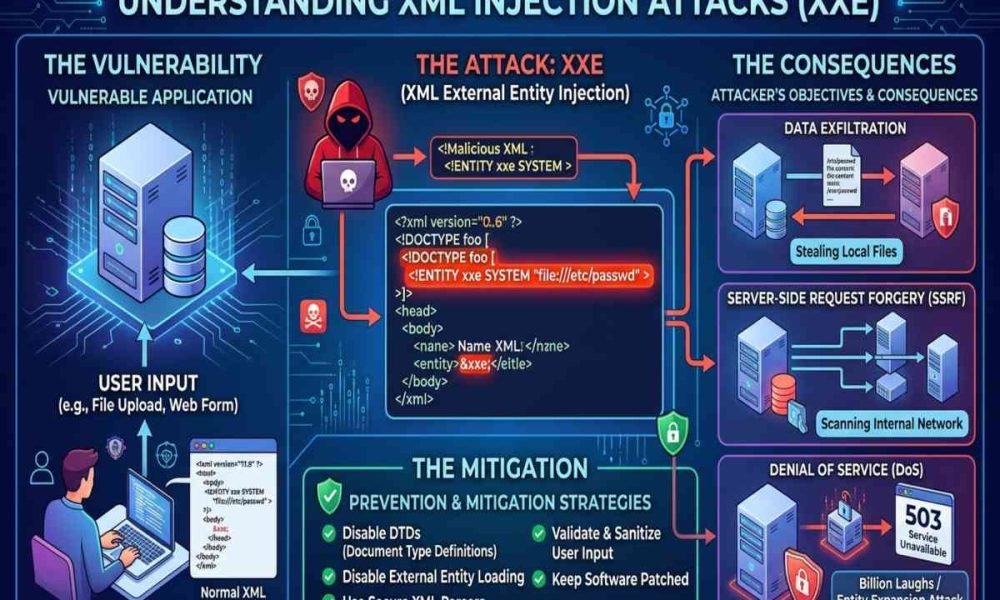
An XXE attack occurs when an XML parser processes external entity references from untrusted XML. If the parser is improperly configured, it may access local files or make unauthorized network requests.
For example, a vulnerable document processing service could process an uploaded XML file containing a reference to an external resource. Depending on its configuration and permissions, the server might disclose information or send requests to internal systems.
XPath Injection
XPath is a language for selecting elements and data from XML documents. XPath injection happens when an application inserts untrusted input directly into an XPath expression, allowing the input to change the query’s intended meaning and highlighting the importance of secure Supply Chain Planning when managing software dependencies and data-processing systems.
Developers should use parameterized or variable bound XPath expressions where supported, rather than constructing queries through string concatenation. Input validation and authorization checks provide additional protection.
What Are the Risks of XML Injection?
The consequences depend on the vulnerability, the application’s permissions, and the data it processes. A successful attack may cause several security problems.
- Sensitive Data Exposure: Improper XML parsing may reveal confidential files, personal information, or application data.
- Authentication Weaknesses: Unsafe XML or XPath handling may allow an attacker to manipulate authentication related queries.
- Unauthorized Data Modification: Applications that trust altered XML structures may process unintended values or operations.
- Server Side Request Forgery: XXE vulnerabilities can sometimes cause servers to request internal or external resources.
- Denial of Service: Malformed documents or excessive entity expansion may consume memory, processing time, or other resources.
- Compliance Concerns: Exposure of regulated or customer information may trigger incident response and reporting obligations, depending on the circumstances and applicable law.
An XML injection vulnerability does not automatically grant administrative access or enable remote code execution. Those outcomes depend on additional weaknesses and the application’s implementation, while AI Threat Intelligence can help security teams identify relevant threats, assess potential risks, and prioritize appropriate defensive measures.

How to Prevent XML Injection Attacks
Preventing XML injection requires protecting data at the point where it enters an application and securing every component that processes it.
Use Secure XML Libraries
Avoid building XML documents through manual string concatenation. Use established XML libraries to create elements, set attributes, and insert text values safely. Structured XML construction helps ensure that user input remains data instead of becoming executable markup or changing the document’s intended structure.
Disable External Entities and Unnecessary DTD Processing
Configure XML parsers to reject document type definitions (DTDs) and disable external entity resolution whenever these features are unnecessary. Also review XInclude, schema validation, and transformation settings, since these components may introduce additional external resource access and create security risks that could be exploited during an Agentic AI Attack targeting vulnerable application workflows.
OWASP recommends disabling DTDs where possible and applying parser specific security settings. Do not assume every library uses secure defaults; verify the configuration for the actual parser and runtime.
Validate Input Against Expected Rules
Validation should reflect what the application actually expects. If a field accepts a username, enforce reasonable length limits and the application’s permitted character rules.
However, rejecting a few special characters is not a complete defense. XML legitimately supports characters such as angle brackets when they are correctly represented as text. Use safe XML construction alongside validation rather than relying on a blocklist alone.
Secure XPath Queries
Do not combine user-controlled strings directly with XPath expressions. Bind values through supported variables or use fixed query structures. Also verify that users are authorized to access the records returned by a query, especially when Autonomous AI Agents interact with sensitive data or backend systems. A safely constructed query does not replace access-control checks.
Apply Least Privilege Access
XML parsers and application services should have only the file, database, and network permissions necessary for their tasks. Restricting outbound network connections can reduce the potential impact of XXE related SSRF.
Set reasonable limits on XML document size, processing time, nesting depth, and entity expansion. These controls help protect availability even when malformed input reaches the parser.
Test XML Processing During Security Reviews
Include XML endpoints, SOAP services, file uploads, configuration imports, and XPath queries in application security testing. Developers can use code reviews, static analysis, dependency scanning, and authorized dynamic testing to identify unsafe parsing and input handling. AiSecMaster recommends reviewing error messages and logs for unexpected parsing failures while ensuring sensitive XML content and stack traces are never exposed to users.
- Untrusted input cannot unexpectedly change XML structure.
- External entities and unnecessary DTD processing are disabled.
- XPath queries do not incorporate untrusted expressions.
- XML documents have appropriate resource limits.
- Application permissions and authorization checks are enforced.
- Security settings remain effective after dependency or runtime updates.
XML Injection in AI Applications and Modern Systems
XML injection is not limited to traditional web applications. XML may appear in enterprise integrations, data pipelines, AI powered workflows, and services that exchange structured information. For example, an AI application might receive XML from a customer system and pass the contents to a backend service. If that service processes the document unsafely, the application may face conventional XML injection or XXE risks.
AI Agent introduces additional considerations when an AI enabled workflow can call APIs, access files, or initiate actions. An attacker might attempt to manipulate structured data supplied to an agent, but successful XML injection still depends on a vulnerable XML processing component. This is distinct from prompt injection, which attempts to influence an AI model through instructions in its input.

Conclusion
An XML injection attack exploits weaknesses in how applications construct, parse, or query XML data. Secure XML libraries, hardened parser configurations, safe XPath queries, input validation, and least privilege permissions are essential defenses.
For developers and security teams, the next step is to review every point where untrusted XML enters the application, verify the security settings of the actual parser, and test the complete data processing workflow. AiSecMaster readers can use these practices as part of a broader application security and vulnerability prevention strategy.
Frequently Asked Questions (FAQs)
What is the main purpose of an XML injection attack?
The purpose of an XML injection attack is to exploit unsafe handling of XML data. Depending on the vulnerability, an attacker may manipulate document structure, interfere with application logic, access unauthorized information, or exploit weaknesses in XML parsing.
What is the difference between XML injection and XXE?
XML injection involves manipulating XML data or structure through unsafe input handling. XXE specifically exploits an XML parser that processes external entity references from untrusted input. XXE can cause file disclosure, SSRF, or resource exhaustion when appropriate protections are missing.
Can XML injection lead to data theft?
Yes, in certain circumstances. For example, an XXE vulnerability may expose local files, while XPath injection may allow unauthorized retrieval of XML based records. The actual impact depends on the application's permissions, parser configuration, and other security controls.
How can developers test for XML injection vulnerabilities?
Developers can review XML construction, test input validation, inspect XPath queries, and verify parser settings in an authorized test environment. Static analysis and dynamic application security testing can help identify weaknesses. Testing should also cover external entity resolution, resource limits, and authorization controls.
Is XML injection the same as SQL injection?
No. XML injection targets applications that construct or process XML unsafely, whereas SQL injection targets database queries. Both can occur when untrusted input changes the intended interpretation of data, but their vulnerable components and appropriate defenses differ.