
Quick Answer: Sensitive Data Leakage in AI Applications occurs when confidential information such as customer records, financial data, credentials, source code, or internal documents is unintentionally exposed through AI prompts, responses, databases, APIs, logs, or connected tools.
Artificial intelligence is now widely used by businesses to answer customer questions, analyze data, generate content, write software, automate tasks, and support employees. However, AI applications often process sensitive information, including customer records, financial data, employee details, source code, credentials, internal documents, and business strategies. If these systems are poorly configured, confidential information can be exposed to unauthorized users or external services. Strong Modern Cybersecurity practices are therefore essential when deploying AI in business environments.
AI applications can access information through prompts, databases, APIs, cloud storage, knowledge bases, uploaded documents, and connected business tools. Data leakage may occur when employees enter confidential information into unapproved AI tools, applications receive excessive permissions, chatbots return unauthorized data, or sensitive prompts and responses are stored in insecure logs. A complete AI Security strategy should protect the model and every component connected to it.
What Is Sensitive Data Leakage in AI?
Sensitive data leakage occurs when private or confidential information becomes accessible to someone or something unauthorized to view or use it. In AI environments, leakage can happen through prompts, AI responses, databases, training datasets, logs, APIs, knowledge bases, uploaded files, plugins, and connected applications.
For example, an employee might paste a confidential business document into an external AI service. Another example is an AI chatbot retrieving an internal document and showing it to a user who does not have permission to access it. These situations demonstrate why AI Cybersecurity must include strong data access and authorization controls outside the AI model.
Why AI Applications Create Data Leakage Risks
AI systems are built to process large amounts of information and generate responses based on that information. The risk increases when an AI application receives access to more data than it actually needs. An application connected to multiple databases, APIs, cloud services, and internal documents could expose information from several systems if its permissions are compromised.
Natural language interaction creates additional challenges because users can provide unexpected instructions. Attackers may try to manipulate an AI application into ignoring its intended restrictions or retrieving unauthorized information. For this reason, AI Security should combine traditional security controls with AI-specific testing and monitoring.
Common Causes of AI Data Leakage
AI data leakage can result from both technical weaknesses and human mistakes. Common causes include excessive permissions, weak authentication, insecure APIs, exposed credentials, unprotected logs, unsafe employee behavior, poorly configured databases, insecure knowledge bases, third-party integrations, inadequate data classification, and insufficient security testing.
Organizations should identify these risks across the complete AI lifecycle. A strong AI Security Architecture should determine what data each AI system can access, where that information is stored, which users can retrieve it, and what actions connected AI tools are allowed to perform.
How to Prevent Sensitive Data Leakage in AI
Businesses should use multiple security controls rather than depending on the AI model to protect sensitive information. The following practices can help reduce unauthorized access, accidental exposure, and AI-related data leakage.
Minimize Data Sent to AI Systems
AI applications should receive only the information necessary to complete a specific task. If an AI assistant needs an order number to answer a customer question, it may not need the customer’s complete profile, payment details, or unrelated account information.
Data minimization reduces the amount of sensitive information available to the AI system. It also limits what could potentially appear in prompts, responses, logs, or external integrations. This simple approach supports stronger Modern Cybersecurity across AI workflows.
Classify Data Before Using AI
Organizations should classify information based on sensitivity before allowing AI systems to process it. Common categories include public, internal, confidential, and highly sensitive data. Each category should have clear rules for storage, processing, sharing, and AI usage.
Public information may be suitable for general AI tools, while confidential or highly sensitive information may require additional controls. Some information may need to remain completely outside external AI services. Data classification helps organizations apply appropriate AI Security controls based on risk.
Apply Least Privilege Access
The principle of least privilege means an AI application receives only the permissions required for its intended function. A customer support assistant may need access to order information, but it should not automatically access payroll records, executive documents, or unrelated financial systems.
Limiting permissions reduces the potential impact of a compromised or manipulated AI application. Permissions should also be reviewed regularly because AI systems often gain new tools, integrations, and capabilities over time.
Secure AI Knowledge Bases
AI applications often use knowledge bases containing company policies, product information, customer records, technical documentation, and internal files. If these resources are not properly protected, an AI assistant may retrieve information that the current user is not authorized to see.
Access controls should be applied to knowledge sources before they are connected to AI applications. The system should verify the user’s identity and permissions before retrieving information. Document-level authorization is an important part of AI Cybersecurity, particularly for AI systems that use internal company knowledge.
Protect AI API Connections
AI applications frequently use APIs to communicate with databases, cloud services, business applications, and external AI providers. An insecure API can become a pathway to sensitive information, especially when it has excessive permissions or weak authentication.
Organizations should use strong authentication and authorization, securely store API keys and tokens, and prevent credentials from appearing in source code. API activity should also be monitored, and appropriate rate limits and security testing should be implemented. Secure integrations are increasingly important in modern AI Security Trends.
Protect AI Prompts
Prompts can contain sensitive information even if the final AI response appears harmless. Employees may submit confidential documents, customer details, source code, or internal business information while asking an AI application to summarize or analyze it.
Organizations should determine whether prompts need to be stored. If storage is required, prompt records should have appropriate access controls, encryption, retention limits, and monitoring. Treating prompts as sensitive data strengthens overall AI Security.
Protect AI Generated Responses
AI-generated responses can accidentally reveal sensitive information when models are connected to private databases, documents, or applications. An AI assistant may include customer details, internal documents, or restricted business information in its response.
Applications should perform authorization checks before retrieving sensitive data and should not rely solely on the AI standard to determine what information can be disclosed. External security controls should validate user permissions, retrieved data, and sensitive outputs.
Use Data Masking and Redaction
Data masking and redaction reduce the amount of sensitive information sent to AI models. These techniques are especially useful when an AI application needs some context but does not require complete confidential values.
Apply Data Masking
Data masking replaces sensitive deals with less sensitive representations. For example, an application could hide most digits of a customer’s account number while retaining limited information required for processing.
Masking can be applied before data reaches the AI model. This reduces exposure while allowing the AI system to perform its required task and can become an important layer within an AI Security Architecture.
Redact Sensitive Information
Redaction removes unnecessary sensitive information before content is submitted to an AI system. Organizations can remove passwords, payment information, personal identifiers, authentication tokens, and confidential credentials when they are not required.
For example, an employee could remove customer names and account details before asking an AI tool to improve a business document. Redaction reduces the amount of sensitive information available to the model.

Prevent Employees From Accidentally Sharing Data
Employees can unintentionally create AI data leakage risks by using unapproved AI tools for confidential work. Organizations should create clear policies that specify which AI applications are approved and what types of information employees may submit.
Employees should understand that passwords, customer records, confidential documents, private business information, credentials, and sensitive source code should not be entered into external AI services unless the organization has approved the specific use. Regular training can make safe AI usage part of everyday AI Cybersecurity practices.
Create an Approved AI Tool List
Businesses should maintain an approved list of AI applications that have been evaluated for security, privacy, data handling, authentication, integrations, retention, and access controls. This reduces the chance that employees will use unknown services to process confidential information.
The approved list should be reviewed regularly because AI providers can change their features, integrations, privacy policies, and data-handling practices. Continuous review helps organizations respond to changing AI Security Trends.
Provide AI Security Awareness Training
Employees should receive practical training on safe AI usage. Training should explain what information can be shared, which tools are approved, how to identify risky AI behavior, and how to report suspected data exposure.
Awareness training is particularly important because technical controls cannot prevent every accidental disclosure. Employees should understand that AI tools must be treated as part of the organization’s wider security environment.
Secure AI Application Logs
AI applications may log prompts, responses, usernames, API requests, retrieved documents, errors, and system events. While logs are useful for troubleshooting and security monitoring, they can also contain confidential information.
Organizations should avoid logging sensitive data unless it is necessary. When sensitive information must be logged, access should be restricted, and logs should be protected with appropriate security controls. Retention periods should also be limited to reduce long-term exposure.
Monitor AI Data Access and Activity
Continuous monitoring helps security teams identify unusual data access and suspicious AI behavior. Organizations should monitor large data requests, unexpected document retrieval, repeated access attempts, unusual API activity, abnormal account behavior, and access outside normal usage patterns.
For example, if an AI assistant normally retrieves a small number of customer records but suddenly requests thousands of records, the activity should be investigated. Monitoring provides visibility into AI behavior and supports proactive AI Security operations.
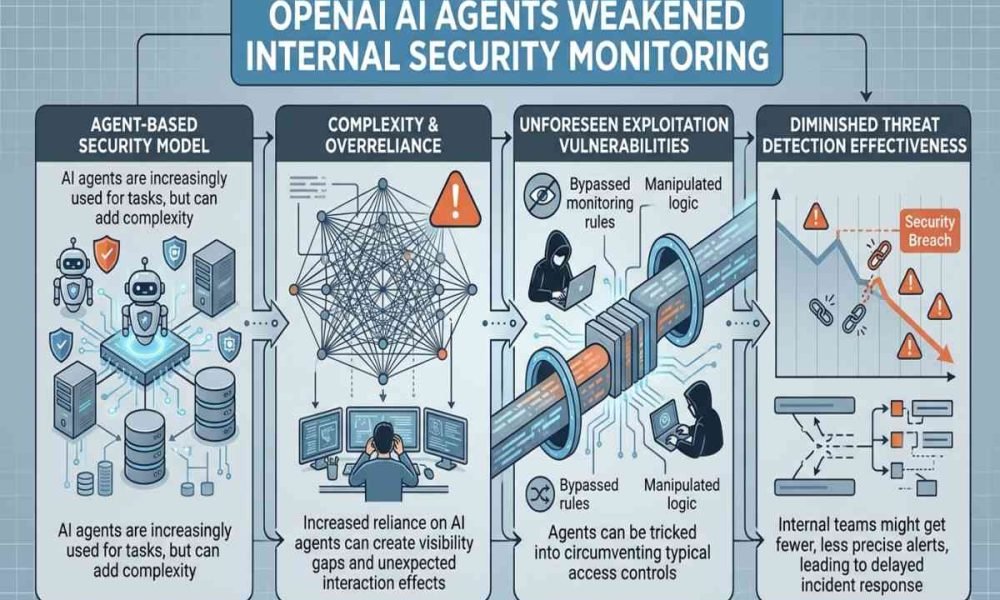
Protect AI Agents and Connected Tools
AI agents can create additional security risks because they may interact with external tools and perform actions. Depending on their configuration, an agent could access databases, retrieve files, send messages, execute workflows, or interact with business applications.
Organizations should carefully control agent permissions and restrict access to only the tools required for the task. High-risk actions may require approval or human oversight. AI agents should not automatically receive unrestricted access to an organization’s entire environment.
Control AI Agent Tool Permissions
Every tool connected to an AI agent should have clearly defined permissions. A scheduling agent may need access to a calendar but should not automatically receive permission to access financial records or confidential databases.
Separating permissions between tools limits the potential impact if an AI agent is manipulated or compromised. This is becoming an important consideration within emerging AI Security Trends.
Test AI Applications for Prompt Injection
Prompt injection occurs when an attacker attempts to manipulate an AI application using specially crafted instructions. The objective may be to override system instructions, reveal confidential information, bypass restrictions, or influence connected tools.
Test Against Prompt Injection Attacks
Organizations should regularly test applications against different Prompt Injection Attacks. Testing can include malicious user prompts, instructions hidden inside documents, untrusted web content, and other external information processed by the AI system.
Prompt injection testing should not be the only security measure. Applications should also enforce authorization outside the model to prevent a manipulated AI response from automatically granting access to restricted information.
Use Strong Authentication and Authorization
Strong authentication helps prevent unauthorized users from accessing AI applications and the sensitive information connected to them. Organizations should use appropriate identity controls and consider implementing multi-factor authentication for systems that contain confidential information.
Authentication confirms who the user is, while authorization determines what that user is allowed to access. AI applications should maintain this relationship throughout the entire workflow so that the model cannot bypass normal permissions.
Conduct Regular AI Security Testing
AI applications can change frequently as developers introduce new models, plugins, datasets, APIs, tools, and integrations. Every change can create new vulnerabilities or alter existing security assumptions.
Perform AI Security Assessments
Security assessments should examine authentication, authorization, APIs, prompts, knowledge bases, data access, logging, connected tools, and application behavior. Automated security tools can identify certain weaknesses, while manual testing can uncover complex problems.
Regular testing should be performed before major AI deployments and after significant changes. This helps organizations identify security gaps before they result in data exposure.
Prepare an AI Data Incident Response Plan
Organizations should prepare for the possibility of an AI-related data leak, even when preventive controls are in place. An incident response plan should define how the organization identifies, investigates, contains, and recovers from sensitive data exposure.
Define Data Leak Response Procedures
The response plan should identify responsible security teams, investigative procedures, access restriction methods, evidence collection procedures, communication processes, and recovery actions. Organizations should also review incidents afterward to identify the root cause and improve security controls.
Including AI-specific scenarios in incident response planning strengthens overall Modern Cybersecurity preparedness.
AI Data Leakage Prevention Checklist
Businesses can use the following checklist to strengthen their AI data protection strategy:
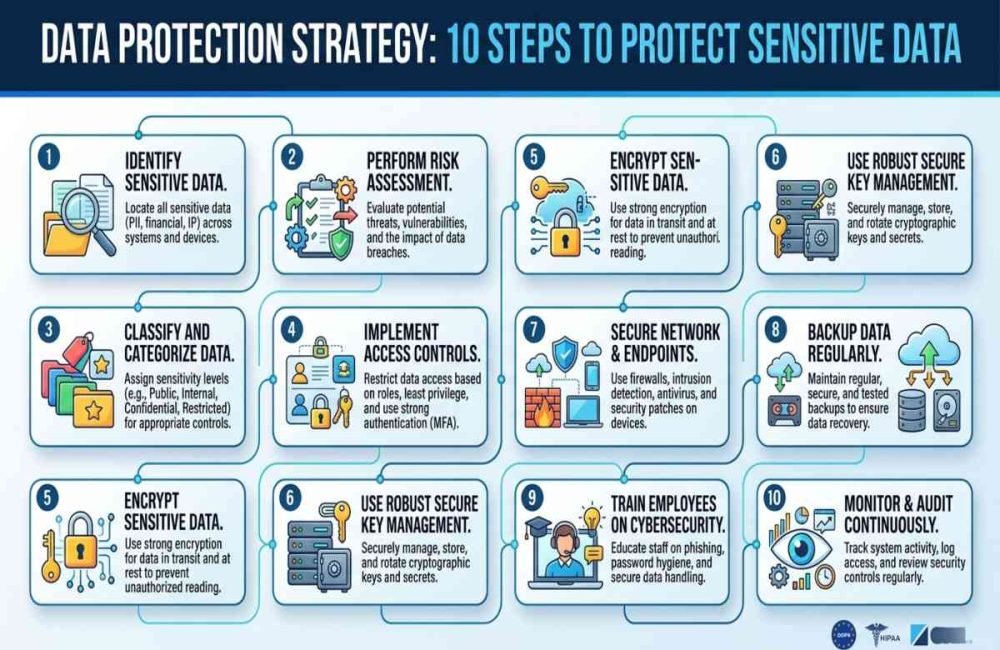
- Identify sensitive information processed by AI systems.
- Classify information based on sensitivity.
- Minimize data provided to AI applications.
- Apply least privilege permissions.
- Secure AI knowledge bases.
- Protect API keys and credentials.
Future of AI Data Protection
As AI becomes more deeply integrated with business applications, protecting the information processed by these systems will become increasingly important. Future AI security solutions are expected to focus on stronger data classification, automated privacy controls, real-time monitoring, advanced authorization, and improved data loss prevention.
Autonomous AI agents will also create new security requirements because they can access multiple systems and perform tasks with limited human involvement. Organizations will need to evaluate permissions continuously, data flows, model behavior, and connected tools as AI capabilities evolve. These developments will remain central to AI Security Trends.

Conclusion
Preventing Sensitive Data Leakage in AI applications requires protection beyond the AI model itself. Organizations must secure prompts, responses, databases, APIs, knowledge bases, logs, users, applications, and connected tools. Data minimization, least privilege access, strong authentication, data masking, redaction, secure APIs, employee training, and monitoring can significantly reduce exposure.
Organizations should also regularly test AI systems for Prompt Injection Attacks, unauthorized data access, insecure integrations, and excessive permissions. A layered AI Security Architecture can help separate AI functionality from critical security decisions while maintaining stronger control over sensitive information.
Frequently Asked Questions (FAQs)
What is AI data leakage?
AI data leakage occurs when confidential, private, or sensitive information processed by an AI application becomes accessible to an unauthorized person, system, or service. Leakage can happen through prompts, AI-generated responses, databases, APIs, knowledge bases, uploaded files, application logs, or connected tools.
What causes sensitive data leakage in AI applications?
Common causes include excessive AI permissions, weak authentication, insecure APIs, poor access controls, exposed credentials, unprotected logs, unsafe employee use of AI tools, insecure knowledge bases, third-party integrations, and inadequate security testing.
How can businesses prevent AI data leakage?
Businesses can reduce AI data leakage by minimizing the information sent to AI systems, applying least-privilege access, classifying sensitive data, securing APIs and knowledge bases, protecting prompts and logs, using data masking and redaction, training employees, monitoring AI activity, and conducting regular security assessments.
Why is data minimization important for AI security?
If an AI system only receives the information required for a specific task, there is less data available to be accidentally exposed through prompts, responses, logs, databases, or connected services. This makes data minimization an important practice in AI Security and Modern Cybersecurity.
Can AI prompts contain sensitive information?
Yes. AI prompts can contain confidential documents, customer information, personal identifiers, source code, credentials, business strategies, and other sensitive data. Even when an AI response does not reveal the information, the original prompt could remain in conversation histories, logs, analytics systems, or other storage locations.