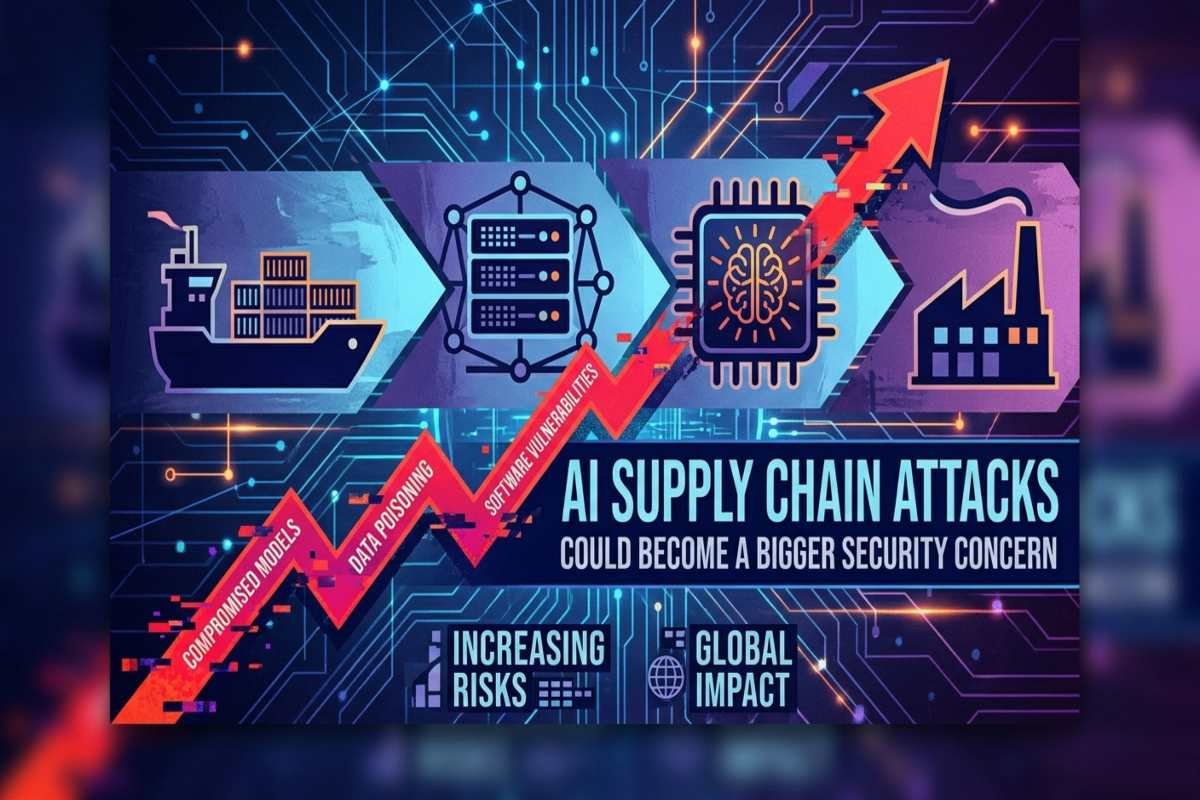
AI supply chain attacks could become a bigger security concern as organizations increasingly depend on third party AI models, datasets, software libraries, cloud platforms, and autonomous agents. A weakness anywhere in this ecosystem can expose multiple connected systems, making AI supply chain security an important priority for businesses adopting artificial intelligence. Unlike traditional software risks, AI supply chain threats can also involve poisoned training data, compromised models, malicious plugins, and manipulated instructions that influence how AI applications behave.
What Are AI Supply Chain Attacks?
AI supply chain attacks occur when attackers compromise or manipulate components, services, or dependencies used to build, deploy, or operate an artificial intelligence system. Rather than targeting only the final application, attackers exploit trust in the resources that the application depends on. These resources may include publicly available models, training datasets, third party APIs, open source packages, model repositories, and AI development tools. A compromised component can introduce vulnerabilities before deployment or create security risks during normal operation.
Why Could AI Supply Chain Attacks Become a Bigger Concern?
AI systems often combine components from multiple providers, making it difficult to verify every dependency. Organizations may integrate external models and data services quickly without conducting sufficient security reviews.
- Complex Dependencies: A single AI application may rely on numerous libraries, APIs, datasets, and external models.
- Limited Visibility: Security teams may not know how a model was trained, which datasets it used, or what components it contains.
- Expanded Access: AI agents connected to business tools may access files, databases, and applications, increasing the potential impact of a compromised component.
The concern is not that every AI Supply Chain is compromised. It is that one trusted but vulnerable dependency can create risks across several connected systems.
Common Types of AI Supply Chain Attacks
Understanding how attackers exploit dependencies helps organizations identify weaknesses before they affect production systems.
Compromised AI Models and Datasets
Attackers may tamper with third party models or training data to introduce hidden behaviors, biases, or backdoors. A poisoned dataset could cause a model to produce unreliable results under specific conditions, while a compromised model may behave unexpectedly when integrated into an application. OWASP Security identifies supply chain vulnerabilities as a key category of risks affecting large language model applications.
Malicious Software Libraries and Plugins
AI applications frequently depend on external packages and plugins. A vulnerable dependency or malicious update could expose credentials, compromise application components, or provide unauthorized access to connected systems.
Prompt Injection Through Trusted Content
An AI system that processes external documents, webpages, or emails may encounter malicious instructions hidden inside otherwise legitimate content. If the application fails to separate untrusted data from authorized instructions, attackers may influence its behavior.
How Agentic AI Increases Supply Chain Risks
Agentic AI systems can plan tasks, use tools, and perform actions with limited human supervision. If an agent relies on a compromised model, plugin, or external service, the consequences may extend beyond incorrect answers to unauthorized actions.
For example, a business agent connected to email and customer databases could process manipulated supplier documents. Without proper permissions and approval controls, an Agentic AI Attack could potentially lead to data exposure or fraudulent workflow changes. Strong AI Agent Security requires restricted permissions, trusted dependencies, activity logging, and human approval for sensitive actions.
How Businesses Can Reduce AI Supply Chain Risks
- Inventory AI Dependencies: Document models, datasets, APIs, plugins, software libraries, and External Providers.
- Verify Component Integrity: Check trusted sources, version histories, cryptographic hashes, and available provenance information.
- Assess Suppliers: Review security practices, vulnerability disclosures, update policies, and data handling requirements.
- Test AI Components: Evaluate models for data poisoning, prompt injection, insecure outputs, and unexpected behavior before deployment.
- Restrict Permissions: Apply least privilege access to AI agents, APIs, databases, and business applications.
- Monitor Continuously: Track suspicious activity, dependency changes, unusual model behavior, and unauthorized data access.
- Prepare Incident Response: Maintain rollback procedures, backup configurations, and a process for isolating compromised components.
Businesses should also integrate AI risks into existing cybersecurity governance. The NIST Generative AI Profile provides a useful framework for identifying, evaluating, and managing risks throughout the AI lifecycle.
Why AI Supply Chain Security Matters in 2026
AI supply chain security is becoming an important consideration as businesses connect AI systems to sensitive information and operational workflows. Traditional vendor assessments alone may not reveal whether a model’s training data, dependencies, or deployment configuration can be trusted.
Security teams should combine AI Threat Intelligence with dependency monitoring, model testing, and clear supplier accountability. Even Supply Chain Planning teams can contribute by evaluating supplier reliability, documenting AI related dependencies, and preparing alternatives when a critical provider becomes unavailable.
For additional guidance, AiSecMaster readers can explore related resources on LLM security best practices and source code security. These topics complement broader efforts to manage OWASP LLM Security Risks, software dependencies, and AI application vulnerabilities.
References
- Chainguard: AI Supply Chain Attacks: What They Are and How to Defend Against Them.
- NHI Management Group (NHIMG): What Is an AI Supply Chain Attack? Definition and Examples