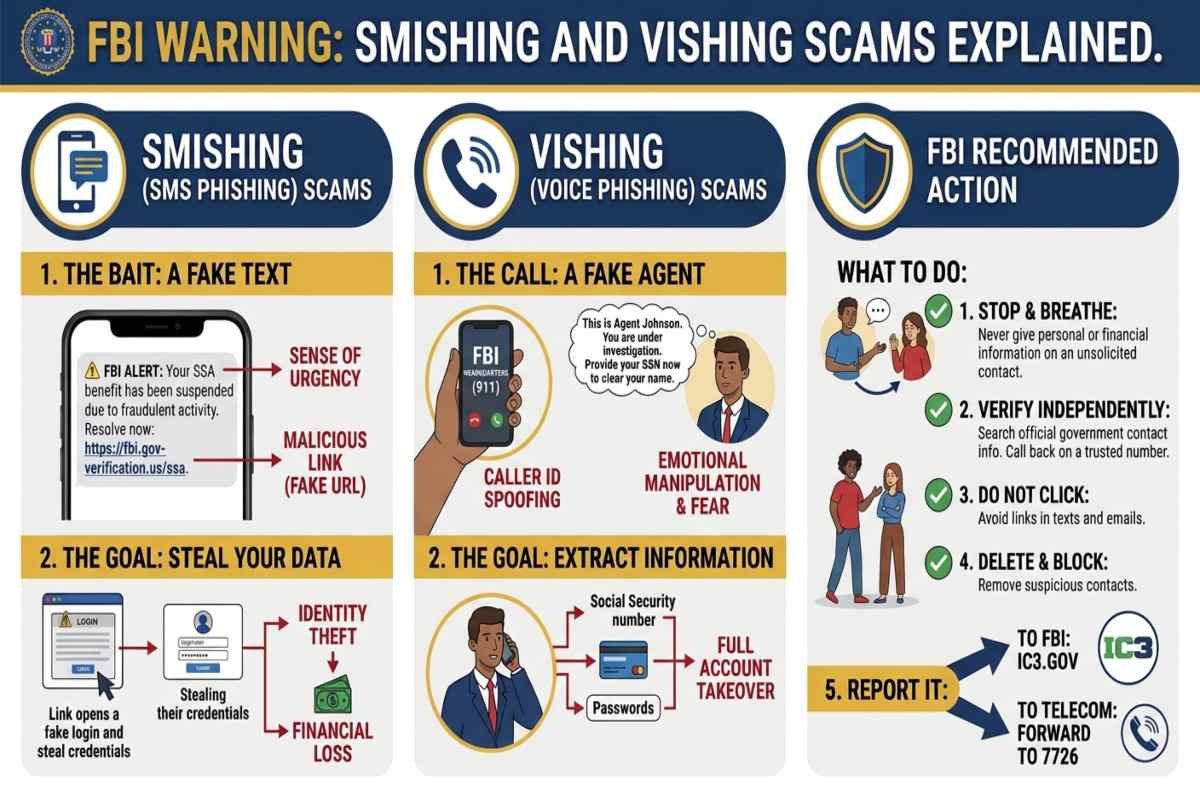
Quick Answer: The FBI warning on smishing and vishing highlights scams in which criminals use fraudulent text messages and deceptive voice calls, including AI-generated voices, to impersonate trusted people or organizations. Smishing uses text messages to steal personal information, while vishing uses voice communication to manipulate victims.
The FBI Warning Smishing Vishing highlights how criminals use deceptive text messages and AI-generated voice messages to impersonate trusted people, including senior U.S. officials. These attacks can trick victims into revealing authentication codes, sharing sensitive information, clicking on malicious links, or transferring money. For individuals and businesses in the United States, the key defense is to verify unexpected requests independently rather than trusting a familiar name, phone number, or voice.
At a Glance: FBI Smishing and Vishing Warning
Smishing uses fraudulent text messages to deceive recipients. Vishing uses fraudulent voice calls or voice messages to manipulate victims. Common targets include passwords, authentication codes, personal documents, and financial assets. Major red flags include urgent demands, unfamiliar links, requests to change messaging platforms, and pressure to disclose confidential information. Best protection is to verify identities independently, avoid suspicious links, and never share authentication codes.
What Are Smishing and Vishing Scams?
Smishing and vishing are forms of phishing that use different communication channels. Both rely on social engineering, a technique that manipulates people into taking actions that benefit a criminal. Smishing uses SMS or multimedia text messages to impersonate a trusted organization or person. Vishing uses voice calls or voice messages, sometimes incorporating AI generated audio to make an impersonation more convincing. The FBI explains both techniques in its official spoofing and phishing guidance.
A scam might begin with a message about suspicious banking activity. The sender then asks the recipient to click a link, provide a verification code, or move the conversation to another messaging application. The FBI Warning Smishing Vishing highlights how criminals exploit trust to steal credentials, access accounts, or obtain money.
What Did the FBI Warn About?
On December 19, 2025, the FBI published an updated public service announcement describing a malicious messaging campaign involving impersonation of senior U.S. government officials, members of Congress, and their contacts. The agency said the activity dated back to 2023 and involved text messages and AI generated voice messages.
According to the FBI Warning Vishing, attackers may begin by discussing familiar topics to establish rapport. They can then encourage targets to move to another messaging platform or ask for authentication codes, personal information, sensitive documents, or money. The risk extends beyond the initial victim. If criminals gain access to someone’s contact list or account, they may use trusted relationships to target additional people.
How Smishing Scams Work
Smishing messages often imitate banks, delivery companies, government agencies, employers, or online services. Their purpose is to make a recipient act before checking whether the message is genuine.
Common Smishing Text Examples
- Fake Bank Alert: “Your account has been restricted. Verify your details immediately.”
- Delivery Scam: “Your package is delayed. Pay a small fee to reschedule delivery.”
- Government Impersonation: “Your benefits are at risk unless you confirm your identity.”
- Account Takeover Attempt: “Your security code is required to prevent account suspension.”
These examples illustrate common tactics; they are not direct quotations from the FBI announcement.
How Vishing Scams Use Phone Calls and AI Voices
A scam might begin with a message about suspicious banking activity. The sender then asks the recipient to click a link, provide a verification code, or move the conversation to another messaging application. The FBI Warning Smishing Vishing highlights how criminals exploit trust to steal credentials, access accounts, or obtain money.
If someone claims to be a family member or colleague and requests money or confidential information, end the call and contact that person using a number you already trust. Similar verification controls can help prevent an Agentic AI Attack from exploiting automated systems. For urgent financial requests, require independent confirmation before taking action.
Smishing vs. Vishing: Key Differences
| Feature | Smishing | Vishing |
|---|---|---|
| Communication | Text messages | Voice calls or voice messages |
| Main technique | Fake alerts and malicious links | Voice impersonation and verbal pressure |
| Typical objective | Steal login details or personal data | Obtain information, money, or account access |
| Warning sign | Unexpected link or urgent text | Threats, secrecy, or requests for codes |
| Recommended action | Verify through an official channel | End the call and verify independently |
Both techniques can be combined with email phishing, account impersonation, or fraudulent messaging applications. The FBI Warning Vishing Smishing also warns that criminals may disguise phone numbers, names, and URLs to make communications appear legitimate.
How to Recognize Smishing and Vishing Warning Signs
Recognizing suspicious behavior is more reliable than judging a message by its appearance. Criminals can copy company logos, use public information to personalize messages, and imitate familiar communication styles.
- Unexpected Urgency: The sender threatens account suspension, financial loss, or legal consequences.
- Requests for Authentication Codes: Someone asks you to disclose a one time password or recovery code.
- Unfamiliar links: A message asks you to log in through a website you did not expect.
- Unusual Payment Methods: The caller demands cryptocurrency, gift cards, or an immediate wire transfer.
- Requests to Change Platforms: The sender insists that you move to a different messaging application.
- Identity Inconsistencies: Contact details or the story do not match information you can verify independently.
Similar impersonation tactics can disrupt Supply Chain Planning when criminals target businesses with fraudulent payment or delivery requests. The two contacts could be part of the same deception rather than independent confirmation that the alert is genuine.
How to Protect Yourself From Smishing and Vishing Scams
Effective protection combines cautious communication, secure accounts, and independent identity checks.
1. Verify Every Unexpected Request
If a message claims to come from your bank, use the bank’s official app or a known website address. For government communications, find the agency’s contact information independently. Do not rely on a phone number or link supplied in the suspicious message.
2. Protect Passwords and Authentication Codes
Use unique passwords and enable multifactor authentication wherever possible. Never share verification codes with unsolicited callers or message senders, even if they claim to be helping you secure an account.
3. Avoid Suspicious Links and Downloads
Do not open unexpected attachments or install applications at a stranger’s request. If you need to check a delivery, payment, or account status, navigate directly to the legitimate service.
For additional examples of deceptive messages, readers can explore Phishing Email Examples and learn how similar social engineering techniques appear in email.
4. Establish a Family Verification Method
Create a private verification phrase with family members to confirm unusual emergency requests. If someone claims a relative needs money urgently, contact that person directly through a previously verified number.
5. Report Suspicious Activity
In the United States, report suspected internet-enabled crime to the FBI’s Internet Crime Complaint Center. Consumer fraud can also be reported through the Federal Trade Commission. Preserve messages, phone numbers, screenshots, and transaction records when possible. Strong AI Agent Security practices also help organizations protect sensitive data and monitor suspicious activity. If money or account access is at risk, contact the relevant bank or service provider immediately.
What to Do If You Have Already Responded
If you clicked a link, shared sensitive information, or sent money, take action as soon as possible.
- Shared a Password: Change it from a trusted device and update any other account using the same password.
- Shared a Verification Code: Contact the affected service, secure your account, and review active sessions and recovery settings.
- Provided Banking Details: Call your bank using its official contact number and ask about blocking transactions or securing the account.
- Installed a Suspicious Application: Stop interacting with it, seek trusted technical assistance, and change important credentials from a separate, trusted device.
- Transferred Money: Contact your bank or payment provider immediately to ask whether the transaction can be stopped or recovered.
Do not let embarrassment prevent you from reporting an incident. Quick action can help limit further harm.
How AI Enabled Threats Connect to Modern Cybersecurity
The FBI warning also highlights a broader security challenge: criminals can use AI to make impersonation more convincing, but organizations need defenses that go beyond identifying suspicious messages. For example, AI Threat Intelligence can help security teams understand emerging attack patterns and investigate suspicious activity. This is a broader defensive discipline rather than a replacement for individual identity verification.
As companies deploy Autonomous AI Agents to perform tasks, they must also control what these systems can access and which actions they can perform. Strong AI Agent Security practices include limiting permissions, protecting credentials, monitoring actions, and requiring approval for sensitive operations.
For more practical cybersecurity explanations, AiSecMaster can connect readers with relevant guides on phishing, AI security, account protection, and emerging digital threats.
Conclusion
The FBI’s warning about smishing and vishing scams demonstrates how criminals exploit trust through deceptive messages, voice impersonation, and requests for sensitive information. AI generated voices can make these attacks harder to recognize, so familiar names and convincing voices should never replace verification.
The most effective response is to pause, independently confirm identities, protect authentication codes, and report suspicious activity. These straightforward practices help individuals and organizations reduce the risk of fraud and account compromise.
Frequently Asked Questions (FAQs)
What does the FBI warning about smishing and vishing mean?
The FBI warning describes malicious text and voice messages used to impersonate trusted individuals, including senior U.S. officials. Criminals may use these messages to obtain sensitive information, authentication codes, account access, or money.
What is the difference between smishing and vishing?
Smishing uses fraudulent text messages, while vishing uses fraudulent voice calls or voice messages. Both are phishing techniques designed to manipulate victims into disclosing information or taking unsafe actions.
Can scammers use AI to imitate a family member's voice?
Yes. AI generated audio can imitate a person's voice and make an emergency scam more convincing. Always verify unexpected requests for money or sensitive information through a separate, trusted communication channel.
How can I tell if a text message from my bank is fake?
Watch for unexpected links, urgent demands, requests for passwords or authentication codes, and unusual payment instructions. Open your bank's official app or contact it using a verified phone number rather than responding directly to the message.
Where can I report smishing and vishing scams in the United States?
You can report internet enabled crime to the FBI's IC3 website and consumer fraud to the FTC. Contact your bank immediately if you shared financial information or transferred money.