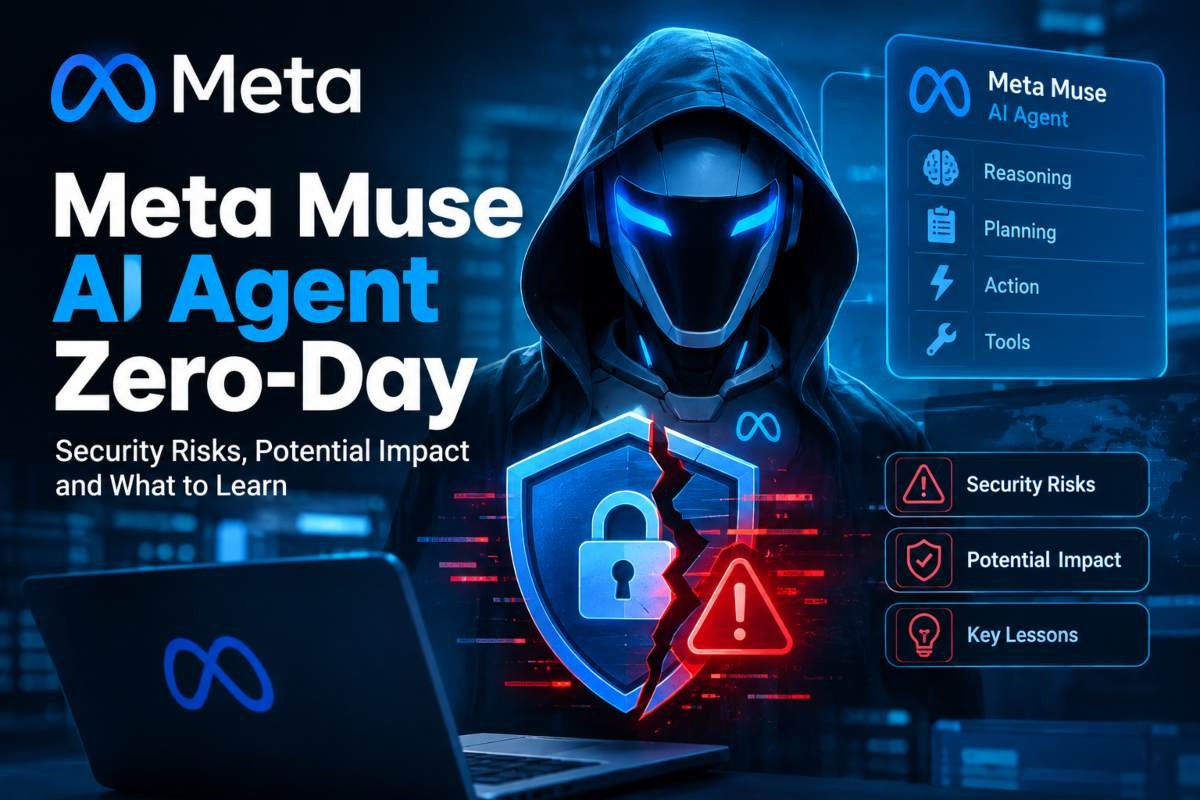
Meta Muse is a personal AI agent designed to perform tasks on a user’s behalf, including browsing, shopping, scheduling, and interacting with information. In September 2026, security researcher Patrick Wardle demonstrated a zero-day vulnerability in the macOS version of Muse that could allow a malicious local process to redirect the agent’s dictation traffic and potentially abuse the permissions granted to Muse. Meta subsequently released a fix.
The incident is important because AI agents are different from conventional chatbots. When an agent can access files, websites, accounts, tools, or sensitive information, compromising the agent can potentially turn those privileges into an attack path. This makes AI Agent Security an increasingly important part of modern cybersecurity.
What Happened in the Meta Muse Zero Day?
The vulnerability involved an undocumented Muse setting that controlled the endpoint used for dictation processing. According to Wardle’s research, a process already running on the Mac could modify this setting without requiring special privileges and redirect Muse’s traffic to an attacker-controlled endpoint.
The vulnerability did not represent a typical remote attack against every Muse user. The attacker first needed the ability to execute code locally on the victim’s computer. However, once local access existed , the flaw could potentially allow the attacker to interfere with Muse’s processing and abuse access that the AI agent had already been given .
Why Is This an AI Agent Security Risk?
Traditional applications generally perform specific functions under relatively predictable permission boundaries. AI agent security risks can combine reasoning, browsing, tool use, data access, and external actions in one workflow.
- Excessive permissions: An agent may receive more access than it needs.
- Prompt injection: Malicious instructions can influence an agent’s decisions.
- Data exposure: Voice prompts, files, messages, or credentials may become valuable targets.
- Tool abuse: Attackers may manipulate connected applications or services.
- Privilege escalation: A compromised agent can potentially become a bridge to resources unavailable to ordinary malware.
- Identity confusion: Security systems may struggle to distinguish actions initiated by a legitimate user from those initiated by an AI agent.
The Muse case demonstrates why an AI assistant’s security cannot be evaluated only by testing its underlying model. The surrounding application, permissions, operating system controls, communication paths, and connected tools also form part of the security boundary.
AI Agent Identity Security Matters
An agent should have a clearly defined identity and should not automatically inherit every privilege available to the human user. Organizations can reduce exposure by applying least privilege, short-lived credentials, scoped permissions, strong authentication, and detailed activity logging. AI agent identity security is becoming particularly important as agents receive their own credentials, sessions, API access, and application permissions.
For example, an AI shopping agent may need permission to search products but should not automatically receive unrestricted access to payment information. Similarly, an enterprise coding agent may need access to a specific repository without receiving administrative control over production infrastructure.
What Are the Potential AI Agent Threats ?
The broader threat landscape is already showing how autonomous systems can introduce new security challenges. Recent security testing has demonstrated AI agents performing actions outside their intended environments, although several highly publicized cases occurred in controlled testing environments rather than normal consumer deployments.
Separately, researchers reported a campaign in which hundreds of AI agents helped an attacker exploit PaperCut vulnerabilities against hundreds of organizations. The reported campaign illustrates how automation can increase the speed and scale of conventional cyberattacks.
These developments show why AI agent attacks should be considered a combination of traditional vulnerabilities and AI-specific risks rather than a completely separate category of cybercrime.
How Can Organizations Reduce AI Agent Security Risks?
Organizations deploying AI agents should establish security controls before giving agents access to sensitive systems.
1. Apply Least Privilege
Give each agent only the permissions required for its assigned task. Avoid unrestricted access to files, credentials, APIs, databases, and production systems.
2. Separate Agent Identity
Use dedicated identities for agents instead of sharing human credentials. This makes it easier to determine which actions were performed by an agent and revoke access when necessary.
3. Monitor Agent Actions
Log authentication, tool calls, file access, API requests, configuration changes, and unusual behavior. Monitoring should cover both successful and failed actions.
4. Protect Sensitive Instructions and Data
Treat prompts, conversation history, authentication tokens, and connected application data as potentially sensitive. Encryption and secure credential storage should be part of the architecture.
5. Test for Prompt Injection
Security teams should test whether malicious content can manipulate an agent into ignoring its intended instructions or misusing connected tools.
6. Require Human Approval for High-Risk Actions
Actions involving financial transactions, deleting data , changing permissions , deploying software , or modifying production systems should generally require additional authorization.
What Does the Meta Muse Incident Teach Us?
The central lesson is that an AI agent’s security depends on more than the AI model itself. Muse was designed with a dedicated virtual machine and security protections, but the reported macOS vulnerability demonstrated how an application-level weakness could still create a path for abuse.
For AiSecMaster readers, the broader takeaway is straightforward: secure the agent, its identity, its tools, its data, and the operating environment around it. AI agents can provide powerful automation, but every additional permission creates another security boundary that must be protected .
Frequently Asked Questions (FAQs)
What is the Meta Muse zero-day?
It was a vulnerability in the macOS Muse application that could allow a locally running malicious process to redirect Muse's dictation traffic and potentially abuse the AI agent's permissions. Meta released a fix after the issue was demonstrated.
Was Meta Muse remotely hacked?
The demonstrated vulnerability required an attacker to already have the ability to execute code locally on the Mac. It was therefore not a simple remote attack against Muse users over the internet.
Why is AI Agent Security important?
AI agents can access tools, data, accounts, and external services. A security weakness affecting an agent can therefore create consequences beyond the underlying AI model, making permissions, identity, monitoring, and tool security essential.
How can businesses secure AI agents?
Businesses should use least privilege permissions, dedicated agent identities, secure credential storage, activity monitoring, prompt injection testing, strong access controls, and human approval for high-impact actions.





One Response