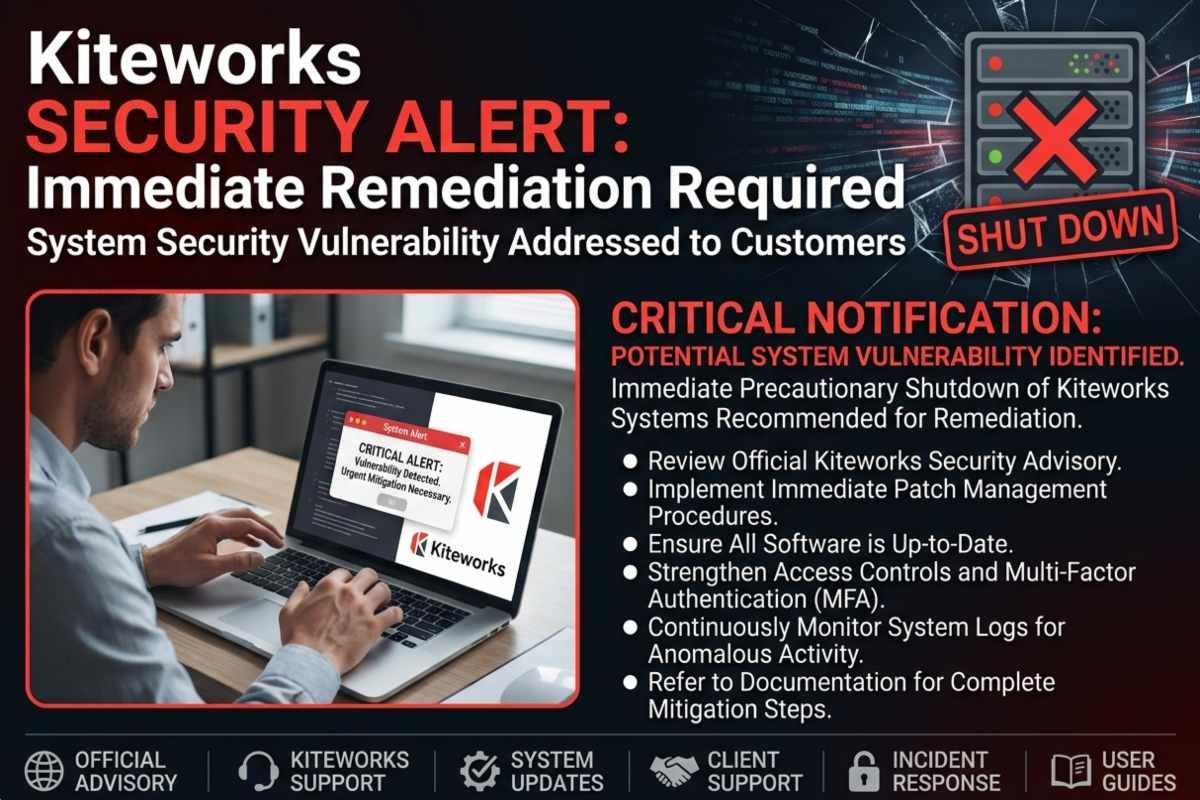
Kiteworks security alert issued a precautionary security alert urging customers who self-manage its systems to shut them down during a specified weekend window after receiving credible threat intelligence from federal intelligence authorities. Kiteworks says there is currently no indication that its systems or customer environments have been compromised, making this a preventative response rather than a confirmed breach.
The warning is significant because Kiteworks handles sensitive data transfers for organizations across sectors including healthcare, government, technology, finance, and other industries. The incident also highlights a broader cybersecurity lesson, organizations must be prepared to isolate critical systems quickly when credible intelligence points to a possible attack.
Kiteworks Security Alert
On September 25, 2026, Kiteworks announced that it had received credible threat intelligence indicating that a threat actor may attempt to target some customer systems. The company recommended a precautionary shutdown for self-managed Kiteworks deployments while it continues working with federal intelligence authorities. Kiteworks stated that the advisory is not a response to a confirmed compromise. The company also said that its current software release, version 9.5.1, addresses all vulnerabilities currently known to it and recommends customers use the latest release.
Is This a Confirmed Kiteworks Breach?
No confirmed breach has been publicly established in the information currently available. Kiteworks says it does not indicate that either its own systems or customer systems have been compromised. However, reporting indicates that the company was concerned about potential exploitation involving vulnerabilities that were not yet known to Kiteworks.
Who Needs to Shut Down Kiteworks Systems?
The company announced a nine-hour precautionary shutdown window in customers’ local time zones. Because the exact timing depends on the customer’s environment and location, organizations should follow the specific instructions delivered directly by Kiteworks rather than relying on generalized times reported elsewhere. For readers of AiSecMaster, this also highlights the importance of Cloud Security Management, AI agent security risks, and broader AI Security practices when protecting critical systems and connected infrastructure.
Why Is the Kiteworks Warning Important?
Kiteworks provides managed file transfer and secure data exchange capabilities. These systems can sit close to sensitive business information, making them valuable targets for attackers. The current situation also demonstrates why Cloud Security Management and third-party risk management cannot stop at routine vulnerability scanning. Security teams need processes for acting on threat intelligence even when a public CVE, exploit, or detailed technical advisory is not yet available.
A shutdown can create business disruption, but keeping a potentially targeted system online can create a different form of risk. Organizations therefore need incident response procedures that balance availability, confidentiality, integrity, regulatory requirements, and operational continuity.
What Should Kiteworks Customers Do Now?
Organizations using self-managed Kiteworks systems should treat the vendor’s direct advisory as the primary operational instruction. A practical response includes:
- Confirm your deployment. Determine whether your organization operates Kiteworks on premises, AWS, Azure, or through a Kiteworks-hosted environment.
- Follow the shutdown window. Self-managed customers should follow the exact timing provided by Kiteworks.
- Preserve security evidence. Before shutdown, ensure relevant authentication, application, network, endpoint, and security logs are retained.
- Review recent activity. Look for unusual logins, administrative changes, unexpected accounts, suspicious file transfers, or abnormal outbound connections.
- Update to release 9.5.1. Kiteworks says the current release addresses all vulnerabilities known to the company.
- Coordinate with security teams. SOC, incident response, infrastructure, legal, and business teams should understand the temporary service impact.
- Wait for trusted guidance before restoration. Do not assume that the end of a shutdown window automatically means the underlying threat has disappeared.
For organizations handling regulated or highly sensitive information, preserving logs before taking systems offline can be particularly important for later investigation.
What Does This Mean for AI Security?
The Kiteworks event is not itself an AI attack, but it connects to a wider security issue involving modern software ecosystems. AI Coding Agents and autonomous AI agents increasingly interact with repositories, APIs, cloud infrastructure, credentials, and third-party software. That creates additional AI agent security risks when an agent can access systems without sufficiently narrow permissions. A compromised dependency, malicious plugin, stolen credential, or manipulated repository can potentially become part of a larger attack chain.
This is why Agent Supply Chain Attacks deserve attention alongside traditional software supply chain security. Security teams should understand not only which software is deployed, but also which automated agents, integrations, packages, APIs, and services can reach sensitive environments.
The Supply Chain Security Lesson
Kiteworks has previously been targeted through vulnerabilities in its file transfer technology. TechCrunch reported that before the company’s rebrand from Accellion, a vulnerability in its file transfer application was exploited in a campaign affecting hundreds of organizations.
That history illustrates why software supply chain security matters. A vulnerability in a widely deployed platform can potentially create downstream exposure across many organizations. Modern security programs therefore need strong management for supply chain risk. Organizations should maintain inventories of critical vendors, monitor security advisories, segment sensitive systems, restrict administrative access, and establish tested emergency shutdown procedures.
Could Agentforce and Other AI Systems Face Similar Risks?
AI platforms introduce another layer of dependency. For example, Agentforce Zero Click security discussions focus on how automated agents can interact with data and applications without requiring traditional user-by-user actions.
The important security question is not whether a product uses AI, but what the system can access and what actions it can perform. The same principle applies to technologies such as Meta Muse AI Agent and other agent-based platforms: organizations should evaluate permissions, connected applications, credentials, data flows, and auditability.
What Organizations Can Learn From the Alert
The immediate Kiteworks warning offers several practical lessons for cybersecurity teams:
- Maintain an accurate inventory of critical third-party systems.
- Establish emergency shutdown and isolation procedures before an incident occurs.
- Monitor vendor advisories and credible threat intelligence.
- Keep current software versions and tested backups available.
- Segment sensitive systems so one compromised service cannot provide unrestricted access.
- Review identities, credentials, APIs, and integrations connected to critical platforms.
- Include AI-enabled applications and agents in third-party risk assessments.
These controls help organizations respond to both conventional vulnerabilities and emerging AI-enabled attack paths.
Frequently Asked Questions (FAQs)
Is Kiteworks currently confirmed to be breached?
No. Kiteworks says it has no indication that its systems or customer systems have been compromised and describes the advisory as preventative.
Who should shut down Kiteworks systems?
Customers who self manage Kiteworks systems on premises, AWS, or Azure should follow the company's shutdown instructions. Kiteworks says hosted customers do not need to take action because it will handle the shutdown.
What Kiteworks version should customers use?
Kiteworks recommends its current 9.5.1 release and says it addresses all vulnerabilities currently known to the company.
Is the alert related to AI agent attacks?
The publicly available advisory does not identify AI agents as the cause. The confirmed information concerns a potential threat against Kiteworks systems, so connections to AI agent attacks should be treated as broader security context rather than evidence about this incident.
What should security teams do after a shutdown?
Teams should preserve relevant evidence, review recent activity, monitor official Kiteworks communications, and restore systems only according to trusted vendor and incident response guidance.