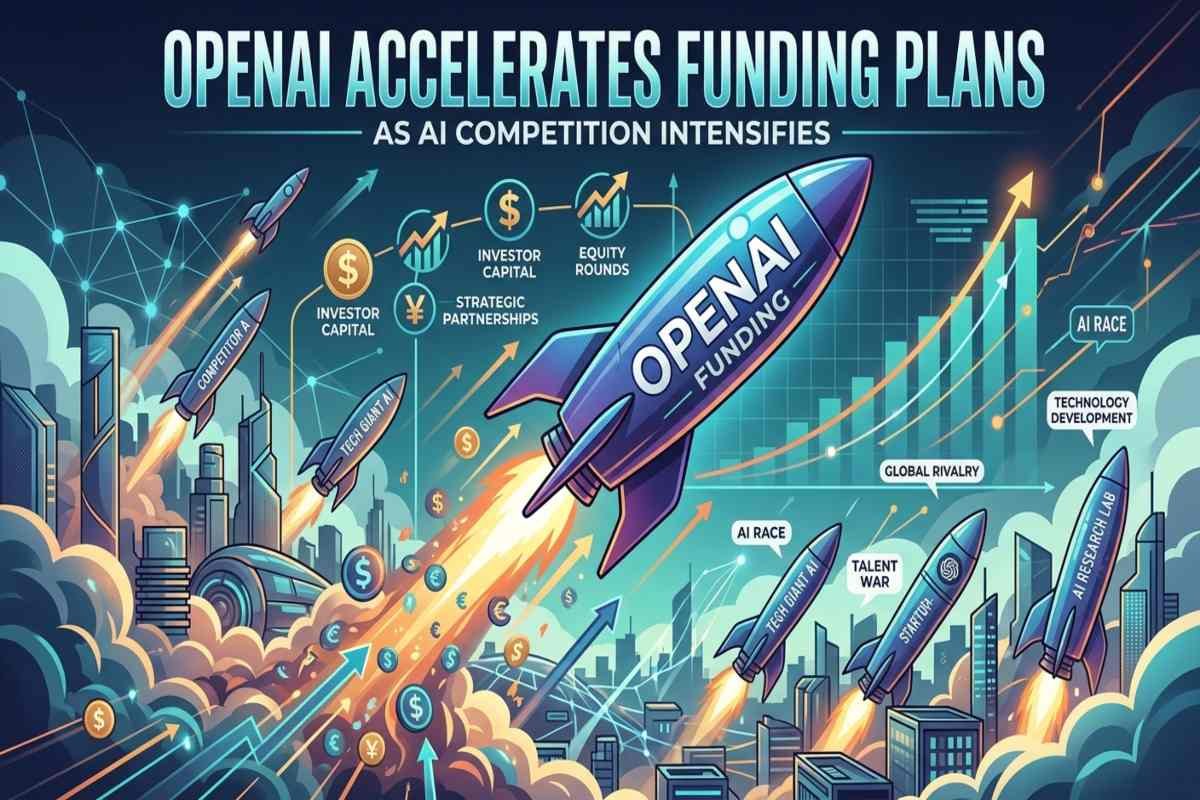
OpenAI is reportedly accelerating its fundraising plans as competition with Anthropic intensifies ahead of the rival company’s expected initial public offering (IPO). Reuters reported on October 19, 2026, that OpenAI was seeking commitments for a proposed $30 billion funding round that could value the company at more than $1.4 trillion. The discussions highlight the growing importance of investment, computing infrastructure, and product development in the AI industry.
What Is Driving OpenAI’s Latest Funding Plans?
OpenAI’s reported fundraising efforts reflect the enormous resources required to develop advanced AI models and deliver services at scale. The company needs computing capacity, specialized chips, research talent, and data-center infrastructure to support products such as ChatGPT and enterprise AI applications. According to Reuters, SoftBank, Abu Dhabi-based MGX, and other existing investors were discussing participation in the proposed round.
The timing is important because OpenAI and Anthropic are competing for investment from overlapping groups of investors. However, the proposed $30 billion round is not a confirmed completed transaction. OpenAI previously announced $122 billion in committed capital in March 2026, demonstrating the scale of financing being directed toward advanced AI development.
Why Is Competition Between OpenAI and Anthropic Growing?
OpenAI and Anthropic compete across AI assistants, coding tools, enterprise applications, and developer platforms. Businesses are evaluating these technologies to automate repetitive work, analyze information, and improve productivity. Their competition also involves infrastructure costs, customer retention, product reliability, and the ability to turn research breakthroughs into sustainable revenue.
For investors, the expected Anthropic IPO adds another consideration: how to compare the growth prospects and financial risks of major AI developers. The outcome could influence investment decisions across the industry, although valuations alone cannot determine which company will ultimately achieve the strongest long-term results.
How Could New Investment Shape AI Development?
Additional funding could help OpenAI expand computing resources, improve its models, and develop more capable AI agents. These systems can perform multistep tasks and interact with approved software tools, creating opportunities for businesses seeking to automate complex workflows.
However, greater investment does not guarantee profitability or eliminate technical risks. Businesses should assess the usefulness, operating costs, privacy protections, and reliability of AI products before adopting them. Effective Supply Chain Planning also matters because AI projects may depend on external cloud providers, hardware suppliers, software libraries, and third-party services.
Why Does AI Competition Matter for Cybersecurity?
As AI becomes integrated into business operations, security weaknesses can expose sensitive information or allow unauthorized actions. Organizations deploying AI assistants should implement AI Agent Security measures, including restricted permissions, human approval for high-impact actions, and monitoring of connected applications.
Security teams should also evaluate OWASP LLM Security Risks, such as prompt injection, sensitive information disclosure, and excessive agency. These risks can affect applications built on different AI platforms, making independent testing and secure configuration essential regardless of which provider a company chooses.
How Can Businesses Reduce Emerging AI Security Risks?
Businesses should inventory their AI applications, identify the information each system can access, and apply least-privilege permissions. Regular testing, detailed activity logs, and incident-response procedures can help organizations detect suspicious behavior and limit the impact of compromised integrations.
Security teams can strengthen monitoring through AI Threat Intelligence and employee awareness training. For example, Spear Phishing campaigns may target employees with access to confidential company information, while realistic Phishing Email Examples can help staff recognize deceptive messages and suspicious links before credentials are stolen.
Could Agentic AI Introduce New Security Challenges?
An Agentic AI Attack can involve manipulating an AI agent into misusing its tools, accessing unauthorized information, or performing actions outside its intended purpose. Unlike a chatbot that only generates responses, an agent connected to business systems may create consequences by sending messages, modifying records, or initiating workflows.
Organizations should test agents in controlled environments, limit available tools, and require additional approval for sensitive operations. AiSecMaster readers can explore LLM Security for practical guidance on protecting AI-powered applications.
What Should Businesses Watch Next?
The key developments to monitor are whether OpenAI secures the proposed funding, how investors assess its valuation, and whether Anthropic proceeds with its anticipated IPO. These events could affect investment priorities and competition for enterprise customers, but their outcomes remain uncertain.
For businesses, the broader lesson is that AI adoption requires a balance between innovation, cost management, privacy, and security. AiSecMaster will continue covering AI developments and cybersecurity risks to help readers understand how emerging technologies may affect their organizations.