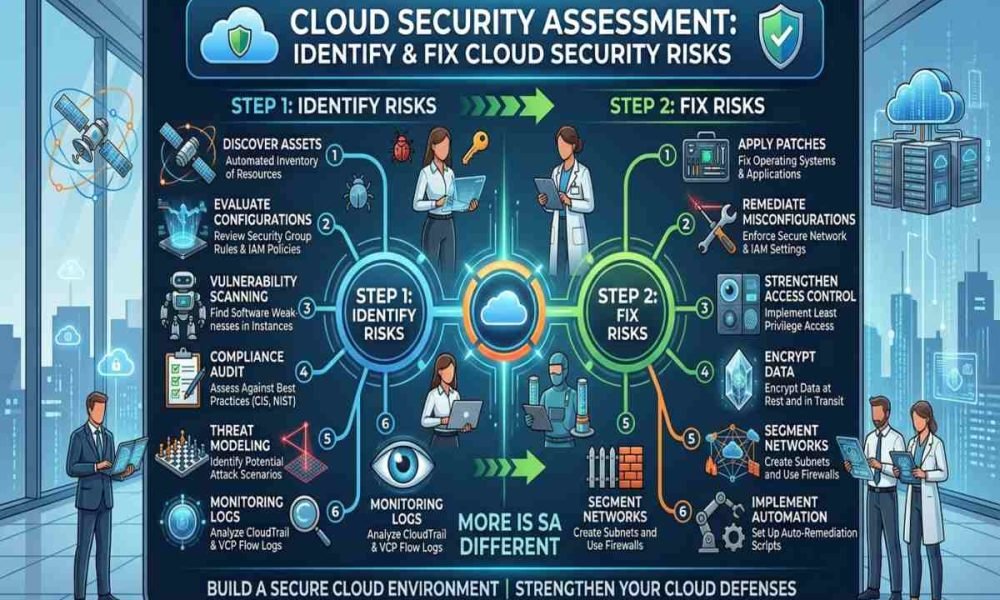
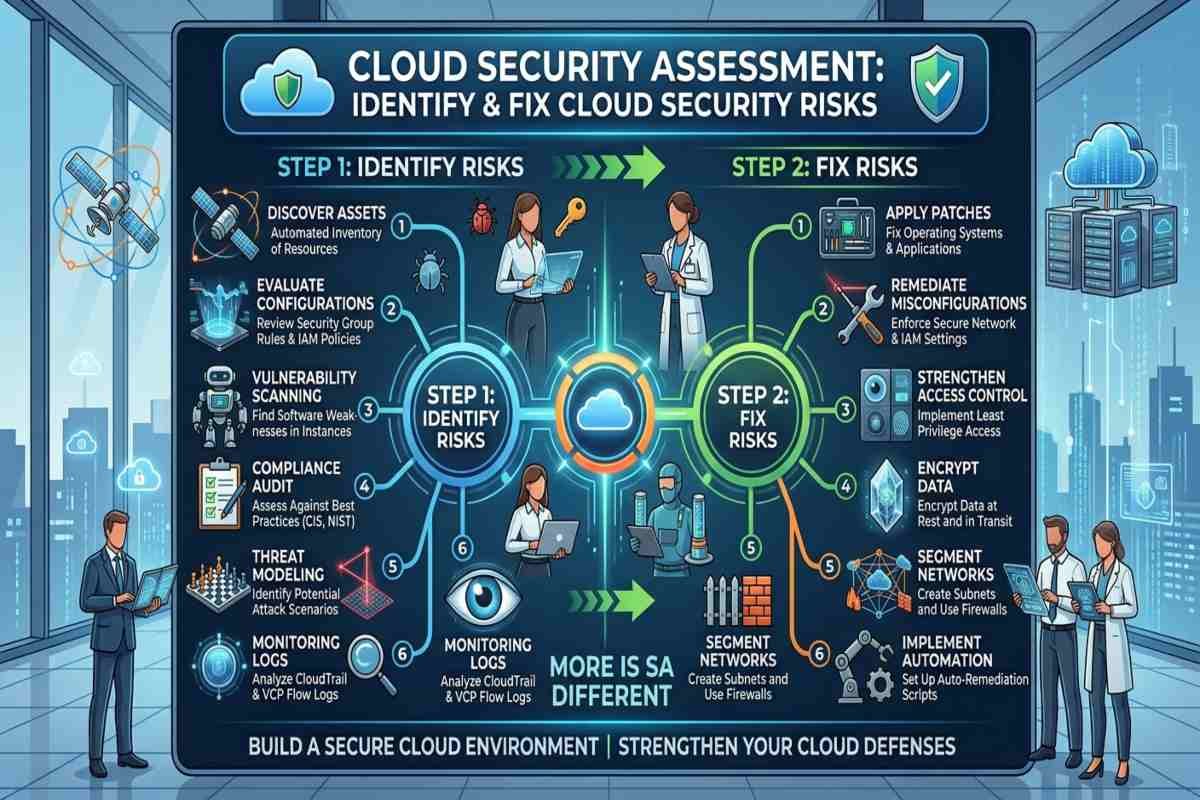
A Cloud Security Assessment is a structured review of an organization’s cloud infrastructure, applications, identities, configurations, and security controls. Its purpose is to identify weaknesses that could expose systems or sensitive data, determine the level of risk, and provide practical remediation steps.
For organizations operating workloads on AWS, Microsoft Azure, Google Cloud, or hybrid environments, security assessments provide visibility into risks that may not be obvious during routine operations. A professional assessment goes beyond automated vulnerability scanning by examining identity permissions, network exposure, data protection, application security, monitoring, and cloud governance.
What Is a Cloud Security Assessment?
A cloud security assessment is a systematic evaluation of cloud environments to determine whether infrastructure, applications, identities, data, and security controls are configured and protected appropriately.
- Cloud accounts and subscriptions
- Virtual machines and containers
- Databases and cloud storage
- Network architecture and security controls
- User and service identities
- APIs and cloud applications
- Encryption and key management
- Logging and security monitoring
- Backup and recovery controls
- Compliance and governance requirements
A key distinction is that a cloud security assessment is broader than a vulnerability scan. Vulnerability scanning primarily identifies known technical weaknesses, while an assessment evaluates how configurations, permissions, architecture, and security controls work together.
What Are the Benefits of a Cloud Security Assessment?
Cloud environments evolve continuously. New workloads are deployed, permissions change, applications are updated, and services are connected to external systems. Regular assessments help organizations detect security gaps before they become major incidents.
Improved Risk Visibility
An assessment provides a clearer picture of the organization’s cloud attack surface. Security teams can identify exposed services, excessive privileges, vulnerable workloads, and misconfigured resources.
Stronger Identity and Access Security
Identity is a central security boundary in modern cloud environments. Reviewing permissions can reveal dormant accounts, excessive privileges, unsecured credentials, and inappropriate access between workloads.
Better Data Protection
Assessments help verify whether sensitive information is appropriately encrypted, stored, accessed, transmitted, and backed up.
Reduced Attack Surface
Removing unnecessary public exposure, unused accounts, outdated services, and overly permissive network rules can reduce the number of opportunities available to attackers.
Improved Compliance Readiness
A structured assessment can help organizations evaluate technical and administrative controls against applicable requirements and security frameworks.
More Effective Incident Response
Security assessments can identify weaknesses in logging, monitoring, alerting, and response procedures. This helps security teams determine whether suspicious activity could be detected and investigated quickly.
Why Cloud Security Assessments Are Necessary
Cloud Security risks often result from configuration drift rather than a single software vulnerability. A resource that was securely configured when deployed may become exposed after a permission change, application update, or infrastructure modification.
Misconfigured Cloud Resources
Publicly accessible storage, unrestricted network rules, exposed management interfaces, and insecure service configurations can unintentionally increase cloud exposure.
Identity and Access Management Weaknesses
Excessive permissions, compromised credentials, missing multifactor authentication, and poorly controlled service accounts can provide attackers with unauthorized access.
Vulnerable or Unpatched Workloads
Operating systems, applications, libraries, containers, and third-party dependencies can contain vulnerabilities that attackers may exploit.
Inadequate Logging and Monitoring
Without appropriate audit logs and security alerts, organizations may struggle to detect unauthorized access, privilege escalation, or suspicious data transfers.
Data Exposure
Weak encryption controls, excessive data permissions, insecure storage, and poor key management can expose confidential information.
Cloud Application Security Risks
Cloud hosted applications and APIs can introduce additional attack paths. Cloud Application Security should therefore be evaluated alongside infrastructure security, particularly for authentication, authorization, API exposure, secrets management, and application configuration.
Considerations When Performing a Cloud Security Assessment
A professional assessment should begin with clearly defined objectives and boundaries rather than immediately scanning the environment.
Define the Scope
Document the cloud accounts, subscriptions, applications, workloads, networks, databases, storage services, and third-party integrations included in the assessment. Identify internet-facing systems and business-critical assets so that security testing can be prioritized appropriately.
Shared Responsibility Model
Cloud security responsibilities are divided between the provider and the customer. The exact division depends on the service model and provider. Organizations remain responsible for areas such as identity management, data protection, application security, and many configuration decisions. The assessment should therefore focus on controls that the organization actually owns.
Classify Sensitive Information
Identify systems containing customer information, financial records, authentication credentials, intellectual property, or regulated data. Understanding data sensitivity helps security teams prioritize findings based on potential business impact.
Establish Testing Boundaries
Security testing should be authorized and carefully controlled, particularly in production environments. Define permitted testing methods, systems, maintenance windows, escalation procedures, and contacts before beginning intrusive activities.
Use Recognized Security Guidance
Organizations can use established frameworks and technical guidance to structure their assessments. NIST publications, CIS Benchmarks, OWASP resources, and applicable regulatory requirements can provide useful reference points.
Key Components of a Cloud Security Assessment
A comprehensive assessment should examine multiple layers of the cloud environment rather than focusing on a single technology.
| Security Area | What to Evaluate |
|---|---|
| Identity and Access | Privileges, MFA, service accounts, roles, and credentials |
| Network Security | Firewalls, segmentation, exposed ports, and access rules |
| Data Protection | Encryption, keys, storage permissions, and backups |
| Vulnerability Management | Software vulnerabilities, outdated dependencies, and patches |
| Application Security | APIs, authentication, authorization, and secrets |
| Monitoring | Audit logs, alerts, detection coverage, and retention |
| Governance | Policies, ownership, documentation, and compliance |
| Resilience | Backups, recovery procedures, and disaster recovery |
Identity and Access Management
Review human and machine identities, administrative roles, service accounts, access keys, and cross-account permissions. Apply the principle of least privilege. Users and workloads should receive only the permissions required to perform their legitimate functions.
Network Security
Review network architecture, security groups, access control lists, routing, segmentation, and internet-facing services. A detailed Firewall Configuration review should identify unnecessary inbound and outbound access, overly broad rules, and administrative interfaces that should not be publicly accessible.
Data Security
Evaluate encryption at rest and in transit, key management, storage permissions, backup protection, and data retention. Organizations should also understand where sensitive data moves between cloud services and applications. Data protection becomes particularly important when cloud platforms support AI workloads.
Application and API Security
Applications should be reviewed for authentication weaknesses, authorization failures, insecure APIs, exposed secrets, vulnerable dependencies, and unsafe data flows. AI-enabled applications may require additional controls for threats such as prompt injection, sensitive information disclosure, and unauthorized model or agent actions.
Monitoring and Threat Detection
Verify that security-relevant events are logged and that alerts are generated for important activities such as unusual authentication, privilege changes, suspicious network activity, and modifications to critical resources. AI Threat Intelligence can provide additional analytical context for identifying emerging threats, but it should not replace fundamental security controls and reliable telemetry.
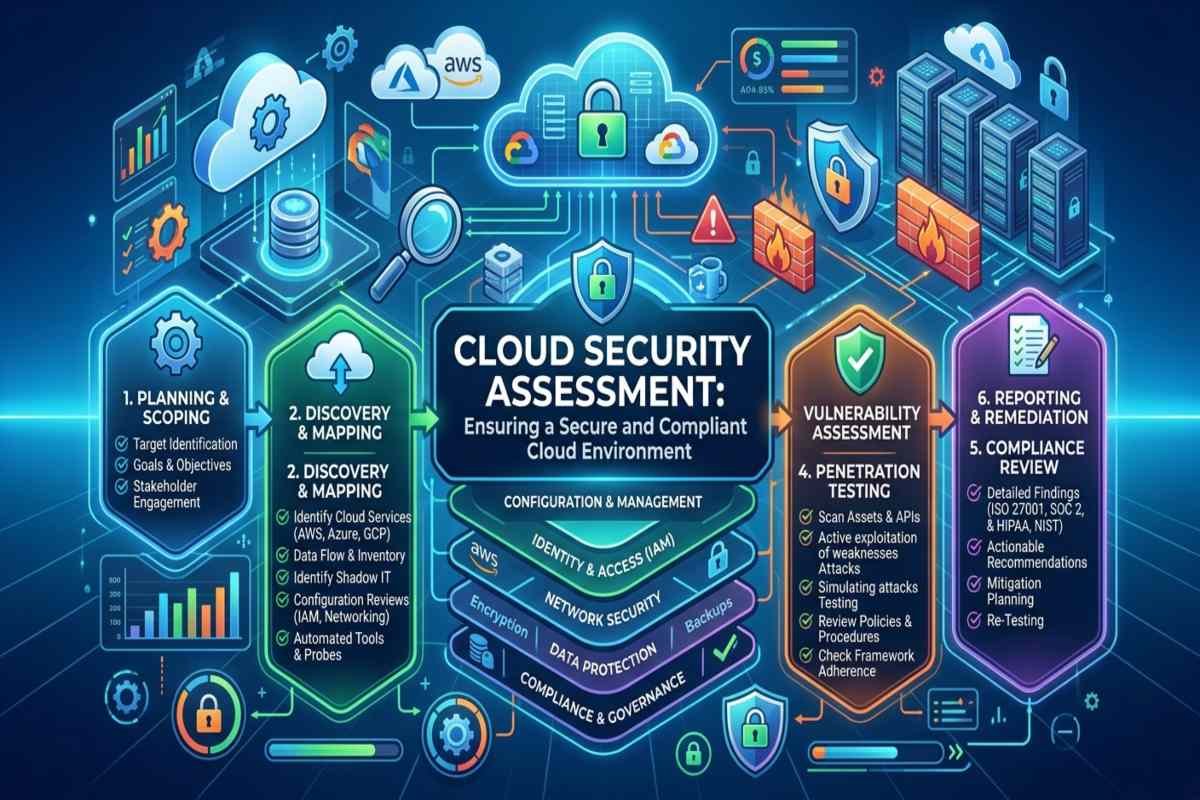
8 Steps to Execute a Cloud Security Assessment
A repeatable methodology makes assessments easier to manage and helps organizations consistently prioritize remediation.
1. Inventory Cloud Assets
Create an authoritative inventory of cloud accounts, workloads, databases, storage resources, APIs, applications, and identities. Mark assets according to their business importance, sensitivity, and internet exposure. Unknown or unmanaged assets can represent significant blind spots.
2. Review Identity and Access Controls
Analyze privileged accounts, service identities, access keys, roles, and permissions. Look for excessive privileges, inactive accounts, unnecessary credentials, and inappropriate cross-resource access. Enable strong authentication controls for privileged users where supported.
3. Identify Vulnerabilities and Misconfigurations
Use appropriate cloud native tools, vulnerability scanners, configuration assessment platforms, and manual reviews. Look for publicly exposed storage, insecure configurations, vulnerable software, exposed secrets, and unnecessary services. Findings should be validated before remediation, particularly when production systems are involved.
4. Evaluate Network Exposure
Analyze firewall rules, security groups, network access controls, routing, segmentation, and externally accessible services. Databases and administrative interfaces should generally be restricted to approved networks and users. Network rules should be reviewed periodically because temporary exceptions can become permanent sources of exposure.
5. Assess Data Protection
Determine where sensitive data is stored, processed, and transferred. Verify encryption, key management permissions, backup protection, access restrictions, and retention controls. For AI-powered systems, also examine whether prompts, uploaded files, model outputs, or application logs could unintentionally contain sensitive information.
6. Test Detection and Response
Determine whether security teams can detect suspicious authentication, privilege escalation, configuration changes, unusual data access, and other relevant events. Review logging coverage, alert quality, escalation procedures, and incident response plans.
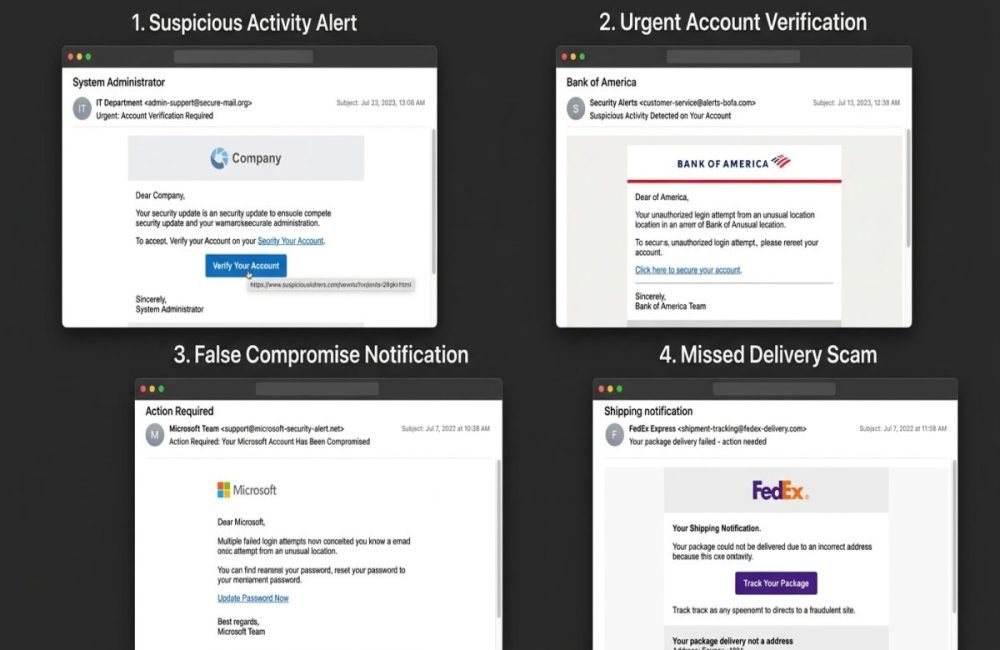
Security teams using Advanced Phishing Detection should also consider how compromised credentials could be used to access cloud resources. A malicious Phishing Email can potentially become the initial access vector for a larger cloud compromise.
7. Prioritize and Remediate Findings
- Internet exposure
- Exploitability
- Data sensitivity
- Business criticality
- Privilege level
- Existing security controls
- Potential operational impact
For example, an internet accessible database containing sensitive customer information should generally receive significantly higher priority than a low-impact configuration issue isolated within a development environment.
8. Validate Remediation
After fixes are implemented, retest the affected systems. Confirm that the original exposure has been removed and that the remediation has not introduced a new problem. Maintain a remediation record showing the finding, owner, corrective action, deadline, and verification status. A cloud security assessment should then become part of an ongoing security program rather than a one-time exercise.
Common Cloud Security Assessment Mistakes
Several practices can reduce the effectiveness of an assessment.
- Focusing only on infrastructure: Applications, APIs, identities, and integrations can introduce significant risks.
- Relying exclusively on automated tools: Automated scanners cannot identify every business logic or architectural weakness.
- Ignoring forgotten resources: Abandoned accounts, test environments, and unused storage can remain exposed.
- Treating every vulnerability equally: Risk should be evaluated according to context and business impact.
- Failing to verify remediation: A closed security ticket does not necessarily mean the vulnerability is fixed.
- Performing assessments only once: Cloud environments change continuously, making periodic reassessment essential.
For organizations deploying AI agents, the assessment may also need to consider emerging risks involving Agentic AI Attack techniques and AI Agent Security. Where NVIDIA technologies or AI agent infrastructure are part of the environment, organizations can also evaluate relevant NVIDIA AI Agent Security considerations.
Cloud Security Assessment Checklist
- Inventory cloud accounts, workloads, applications, and data.
- Identify internet facing and business critical resources.
- Review privileged accounts and excessive permissions.
- Verify MFA and credential management practices.
- Check public storage and exposed services.
- Review firewall and network access rules.
- Scan workloads and dependencies for vulnerabilities.
- Verify encryption and key management controls.
- Review application and API security.
- Confirm logging and monitoring coverage.
- Test backup and recovery procedures.
- Prioritize findings based on business risk.
- Assign remediation owners and deadlines.
- Retest fixes after remediation.
Effective Cloud Security Management transforms these activities into a continuous security process. Rather than waiting for an incident to expose weaknesses, organizations can proactively identify and address risks as their cloud environment changes.
Why Choose AI Security Master for Your Cloud Security Assessment?
AI Security Master provides practical, easy to understand guidance for evaluating and improving cloud security. Our cloud security assessment resources help businesses identify security risks, discover potential vulnerabilities, protect sensitive data, and follow effective cloud security best practices. Whether you manage a small business environment or a complex cloud infrastructure, AI Security Master delivers actionable insights to help you strengthen your security posture and build a safer, more resilient cloud environment.
Conclusion
A Cloud Security Assessment provides organizations with a structured way to discover security weaknesses before attackers can exploit them. The most effective assessments evaluate the complete environment , including identities, networks, applications, data, monitoring, and governance, rather than focusing on isolated vulnerabilities.
Because cloud environments continuously evolve, security assessments should be integrated into an ongoing Cloud Security Management program. Regular reviews, continuous monitoring, strong access controls, and disciplined remediation can significantly improve an organization’s ability to protect cloud infrastructure and sensitive data.
Frequently Asked Questions (FAQs)
What is a cloud security assessment?
A cloud security assessment is a structured evaluation of cloud infrastructure, applications, identities, configurations, data protection, and security controls. It identifies weaknesses, evaluates their potential impact, and provides recommendations for reducing cloud security risks.
How often should a cloud security assessment be performed?
The appropriate frequency depends on organizational risk, regulatory requirements, and the rate of infrastructure changes. Assessments should also be performed after major deployments, significant architecture changes, serious security incidents, or other events that materially alter the environment.
What is included in a cloud security assessment?
A comprehensive assessment can include identity and access management, network security, vulnerability management, data protection, application and API security, logging, monitoring, governance, compliance, backup, and disaster recovery controls.
What is the difference between a cloud security assessment and penetration testing?
A cloud security assessment evaluates the broader security posture of a cloud environment, including configurations, permissions, policies, vulnerabilities, and controls. Penetration testing focuses on authorized attempts to exploit weaknesses. Penetration testing can be one component of a broader cloud security assessment.
Who should perform a cloud security assessment?
An assessment can be performed by a qualified internal security team or an experienced independent security provider. The personnel conducting it should understand cloud architecture, identity security, network controls, vulnerability management, application security, and relevant compliance requirements.
References
- CrowdStrike — Cloud Security Assessment: Guides on identifying cloud security misconfigurations and evaluating areas such as access control, data protection, network security, incident management, and cloud risk management.
- Sangfor — Cloud Security Assessment: Explains cloud security assessment concepts, including security policies, IAM, vulnerability and configuration assessments, threat detection, compliance, risk prioritization, and remediation practices.