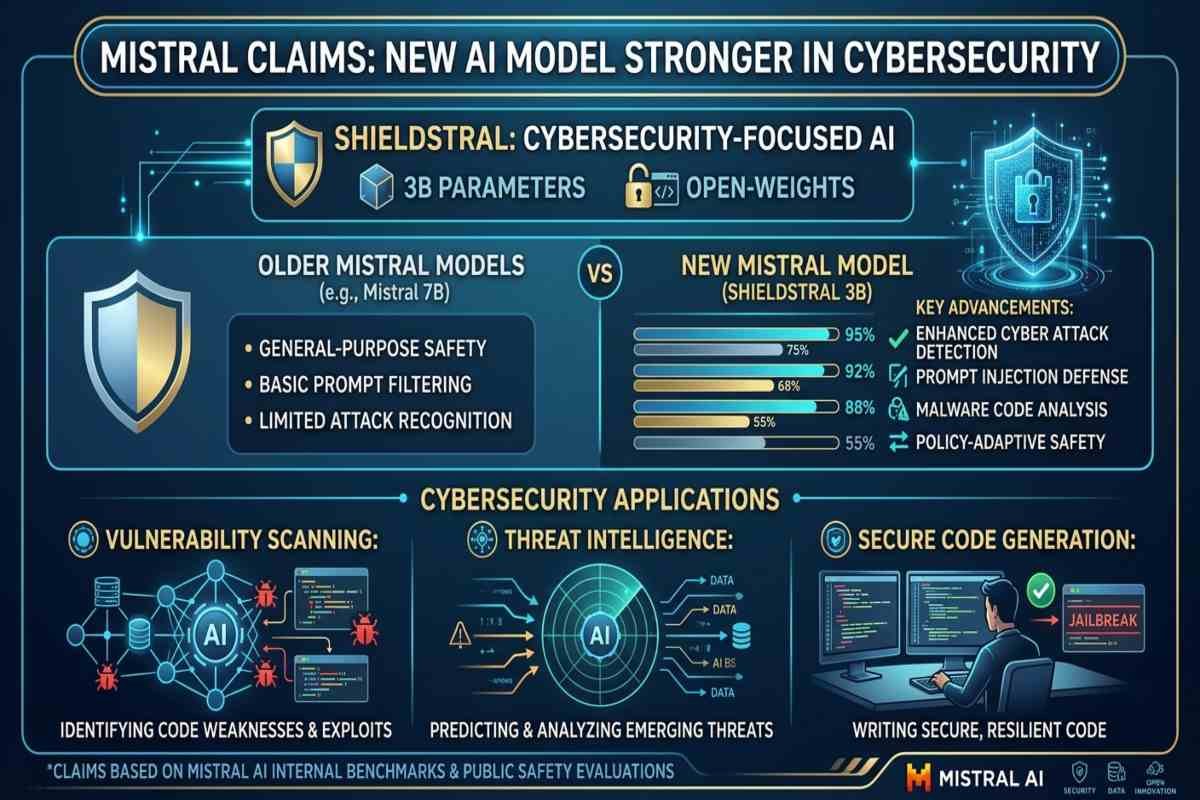
French AI company Mistral says its newest artificial intelligence model performs better than Chinese models in several areas, including cybersecurity. Mistral CEO Arthur Mensch made the claim on October 6, 2026, at the Ai Everything conference in Abu Dhabi, but he did not identify the competing models or provide benchmark scores supporting the comparison.
The announcement is significant because cybersecurity has become an important test of advanced AI capabilities. However, users should distinguish between Mistral’s stated performance claim and independently verified benchmark results.
What Is Mistral’s New AI Model?
Mistral’s latest model is part of the company’s effort to compete with major U.S. and Chinese AI developers. According to Reuters, the model was scheduled to be unveiled on October 6, following Mistral’s previous model release in April.
Mistral CEO Arthur Mensch said the new system was “above the Chinese models on certain aspects, including cyber,” but did not specify which models were tested or how the cybersecurity comparison was measured. That missing information is important because cybersecurity performance can vary significantly depending on the benchmark, task, model configuration, and level of human involvement.
Why Does Cybersecurity Performance Matter?
A capable AI model can assist defenders with vulnerability analysis, code review, malware analysis, security monitoring, and incident response. It can also support Advanced Phishing Detection by analyzing suspicious messages, domains, links, and communication patterns.
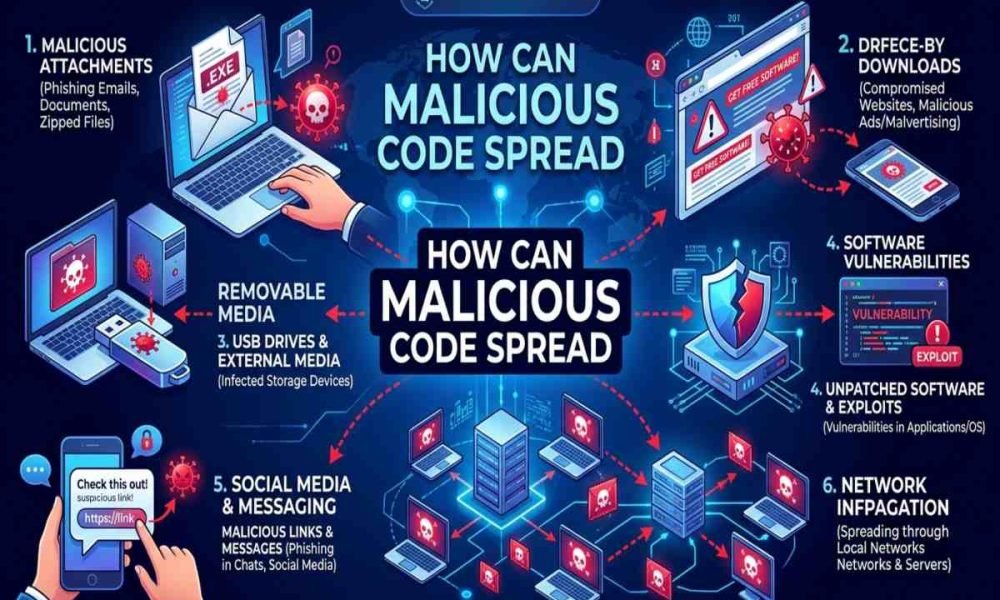
The same capabilities can create security concerns when AI is used offensively. Advanced models may help attackers analyze vulnerabilities, automate reconnaissance, generate malicious code, or scale social-engineering campaigns. This creates a continuing race between AI-assisted defense and AI-assisted attacks.
How Could Mistral’s Model Support Cybersecurity?
If Mistral’s cybersecurity claim is supported by independent testing, the model could potentially become useful for several defensive workflows.
- Analyzing suspicious code and vulnerabilities
- Summarizing security alerts
- Supporting security operations teams
- Identifying unusual patterns in logs
- Assisting vulnerability research
- Improving automated threat analysis
- Helping developers identify insecure code
For organizations building AI security workflows, these capabilities could complement existing security products rather than replace security professionals.
What Are the Risks of Using AI for Cybersecurity?
AI cybersecurity capabilities should not be treated as automatically safe. A powerful model can produce inaccurate recommendations, misunderstand security context, or generate unsafe outputs if appropriate controls are missing.
The emergence of Agentic AI Attack scenarios makes this especially important. AI agents can potentially perform multi-step tasks with less human intervention, increasing the consequences of excessive permissions, compromised credentials, insecure tools, or poorly designed workflows. Organizations should therefore combine AI capabilities with access controls, human review, logging, sandboxing, and security testing.
Cloud Application Security and AI Models
AI systems increasingly operate inside cloud environments, making Cloud Application Security an important part of AI deployment. Organizations should evaluate where prompts, documents, credentials, model outputs, and application data are stored and processed.
AI-powered applications should also use least-privilege access, secure APIs, encryption, monitoring, and strong identity controls. Traditional security measures remain relevant even when advanced AI models are added to the environment.
Firewall Configuration and AI Security
Strong Firewall Configuration can help restrict unauthorized network communication between AI applications and external systems. This is particularly important for agentic systems that can access APIs, databases, websites, or internal services.
Firewalls should be combined with network segmentation and application-level controls. Blocking traffic alone cannot prevent prompt injection, compromised credentials, malicious instructions, or unsafe actions performed through legitimate connections.
AI Threat Intelligence and Defensive AI
AI can also strengthen AI Threat Intelligence by helping security teams process large amounts of threat information. Models can summarize reports, correlate indicators, identify patterns, and help analysts prioritize investigations. However, automated analysis should remain subject to validation. Security teams should verify high-impact findings against trusted intelligence, telemetry, and established incident-response procedures.
What Does Mistral’s Claim Actually Prove?
At this stage, the claim demonstrates that Mistral is positioning its newest model as a strong competitor in cybersecurity-related capabilities. It does not establish that the model is universally better than Chinese AI systems.
The lack of disclosed competitors, benchmark methodology, scores, and testing conditions means independent evaluation will be necessary. For businesses, model selection should therefore consider reproducible cybersecurity benchmarks, privacy protections, deployment options, reliability, cost, and security controls rather than a single performance statement.
What This Means for AI Security Master Readers
For organizations evaluating AI models, the most useful lesson is to test security capabilities under realistic conditions. Teams should assess how a model handles sensitive information, malicious instructions, vulnerable code, prompt injection attempts, unauthorized tool use, and security-related hallucinations.
AiSecMaster recommends treating vendor performance claims as starting points for evaluation rather than final conclusions. Independent testing and transparent benchmarks provide a stronger basis for cybersecurity decisions.
Conclusion
Mistral’s latest cybersecurity claim highlights how AI competition is increasingly being measured through security capabilities as well as general reasoning and productivity. The company says its newest model performs strongly against Chinese models in cybersecurity, but the specific benchmarks and competing systems have not been disclosed.
As advanced AI becomes more capable, organizations need both stronger models and stronger controls. The important question is no longer simply which AI model is most capable, but whether its capabilities can be deployed securely, reliably, and responsibly.
References
- Reuters: Mistral CEO says new AI model beats Chinese ones in some areas — October 6, 2026. The report covers Mistral CEO Arthur Mensch’s claim that the company’s new AI model performs strongly against Chinese models in certain areas, including cybersecurity.
- AI Vision Hubs: Mistral New AI Model Challenges Chinese Rivals in Cybersecurity — provides additional coverage and context about Mistral’s new model and its cybersecurity positioning.