

Quick Answer: Advanced Phishing Detection combines AI, threat intelligence, URL analysis, and behavioral monitoring to identify and respond to modern phishing attacks before they compromise users or organizations.
Phishing attacks are no longer limited to obvious fake emails with spelling mistakes. Modern attackers use realistic websites, social engineering, AI-generated messages, malicious attachments, and automated attack infrastructure to make scams harder to recognize. Advanced Phishing Detection combines email analysis, URL inspection, threat intelligence, behavioral signals, and AI to identify suspicious activity before it becomes a serious security incident. This guide explains how modern phishing detection works, the role of AI and Agentic AI, practical protection techniques, and a cybersecurity checklist organizations can use to reduce phishing risk.
At a Glance
| Area | What It Does |
|---|---|
| Email analysis | Examines sender, headers, content, and attachments |
| URL analysis | Detects suspicious domains, redirects, and links |
| Website analysis | Identifies fake login pages and impersonation |
| Threat intelligence | Compares indicators with known malicious activity |
| Behavioral analysis | Detects unusual communication and account behavior |
| AI/ML | Finds complex patterns across multiple signals |
| Risk scoring | Assigns a threat level to suspicious activity |
| Automated response | Warns, quarantines, blocks, or escalates threats |
What Is Advanced Phishing Detection?
Advanced Phishing Detection is a layered security approach designed to identify phishing attempts across email, websites, messaging platforms, and other communication channels. Traditional filters may look for known malicious URLs, suspicious senders, or predefined keywords. Advanced systems go further by combining multiple signals and examining the context and behavior surrounding a message.
Phishing can involve credential theft, financial fraud, malware delivery, or social engineering. NIST recommends combining technical controls with employee awareness, email security technologies, authentication protections, and reporting processes.
How Advanced Phishing Detection Works
A modern detection pipeline can be understood as:
Incoming Message → Data Extraction → URL/Content Analysis → Threat Intelligence → AI/Behavior Analysis → Risk Score → Response
Email and Message Analysis
The system examines information such as:
- Sender address and domain
- Email headers and authentication signals
- Message content
- Attachments
- Embedded links
- Urgency or unusual requests
- Requests for passwords, payments, or sensitive information
The goal is not simply to find suspicious words. It is to determine whether the entire communication behaves like a legitimate message or a social-engineering attempt.
URL and Domain Analysis
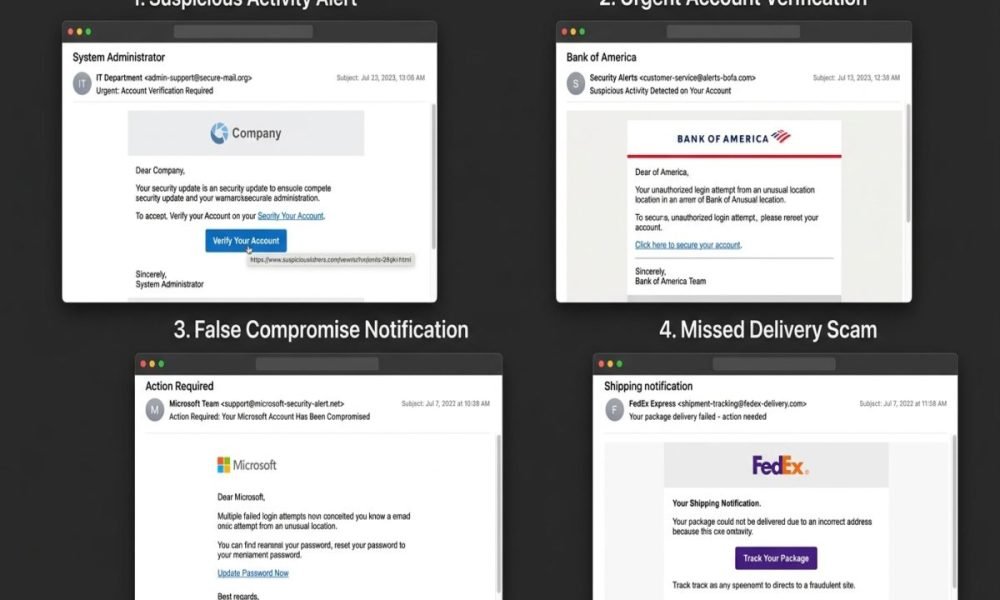
A phishing message often depends on a malicious or deceptive link. Advanced AI Threat Detection systems can analyze the destination domain, URL structure, redirects, reputation, and other available indicators. For example, a link may visually appear to belong to a familiar company while actually directing the user to an unrelated domain.
URL analysis can also help identify newly created or suspicious domains that have not yet appeared on traditional blocklists.
Website and Login Page Analysis
Attackers frequently create websites that imitate banks, cloud services, email providers, or other trusted brands. Detection systems can examine:
- Domain characteristics
- Page structure
- Login forms
- Branding and visual similarity
- Scripts and redirects
- Certificate and hosting information
- Connections to suspicious infrastructure
This is especially important because a convincing website can make even a carefully written phishing message appear legitimate.
The Role of AI in Phishing Detection
AI can analyze large numbers of messages and signals much faster than manual investigation. Machine-learning systems can identify patterns associated with phishing, while modern AI systems can add contextual analysis to help security teams understand why a message appears suspicious. For example:
Unknown sender + unusual request + suspicious domain + abnormal behavior
↓
AI risk analysis
↓
High risk phishing classification
AI should not be treated as a magic solution. Effective detection still depends on good data, security controls, threat intelligence, monitoring, and human oversight.
Recent Microsoft research has shown that attackers are also using AI Security to improve phishing campaigns and obfuscate malicious content. Microsoft reports that defenders can counter these techniques by emphasizing behavioral signals, delivery infrastructure, and message context rather than relying only on static indicators or language patterns.
Machine Learning vs. Generative AI
Machine learning can classify suspicious messages by learning patterns from security data. Generative AI adds another capability: understanding and summarizing complex message context.
For example, an AI system may identify that an email:
- Appears to impersonate a known organization.
- Creates artificial urgency.
- Requests sensitive information.
- Contains a suspicious link.
- Uses infrastructure associated with unusual activity.
This contextual reasoning can help security analysts prioritize investigations.
Generative AI can also benefit defenders by summarizing incidents, explaining indicators, and assisting with phishing triage. However, AI systems themselves require security controls, as AI Application Security introduces additional security and privacy considerations. OWASP highlights risks associated with AI systems, including their broader attack surface and specialized threats.

Agentic AI and Automated Phishing Defense
Agentic AI takes automation a step further. Instead of only classifying an email, an AI agent can potentially assist with a sequence of defensive tasks under defined permissions and security policies. A simplified workflow is:
Suspicious Email
→ Agent analyzes message
→ Checks links and context
→ Correlates threat intelligence
→ Assigns risk
→ Recommends or performs an approved response
→ Creates an investigation summary
Modern security platforms are beginning to apply AI agents to phishing triage. Microsoft, for example, describes a Phishing Triage Agent that uses large language model-based analysis to classify reported emails and reduce repetitive investigation work.
Agentic AI should still operate within strict permissions, logging, approval controls, and human oversight. Giving an AI agent unrestricted authority to delete messages, change accounts, or modify security policies can create a new AI Attack surface.
Why Modern Phishing Attacks Are Harder to Detect
Today’s phishing campaigns can combine multiple techniques rather than relying on a single obvious indicator. Attackers may use:
- Highly personalized social engineering
- AI-generated writing
- Brand impersonation
- Compromised accounts
- Malicious attachments
- QR-code phishing
- SMS or voice-based phishing
- Multi-stage redirects
- Fake authentication pages
- Automated infrastructure
NIST notes that phishing can arrive through email, text messages, social media, phone calls, and other channels, while AI can make phishing messages increasingly convincing. This means organizations should move beyond a single spam filter and adopt layered defenses.
Advanced Phishing Detection Techniques
Behavioral Analysis
Behavioral detection looks for unusual activity rather than relying solely on known indicators. Examples include an unexpected sender requesting an urgent payment or an account suddenly interacting with unfamiliar infrastructure.
Threat Intelligence
Threat Intelligence provides information about malicious domains, IP addresses, URLs, malware, campaigns, and attacker infrastructure. Correlating these indicators can improve detection and investigation.
Email Authentication
Organizations should use appropriate email authentication technologies to reduce spoofing and improve confidence in message origins. NIST specifically recommends deploying email security technologies and authentication controls to protect against phishing.
Phishing Resistant MFA
Detection is important, but preventing stolen credentials from becoming account compromise is equally valuable. NIST’s current digital identity guidance defines phishing resistance as preventing the disclosure of authentication secrets or valid authenticator outputs to an impostor verifier. FIDO-based authenticators are a widely available example of phishing-resistant authentication.
Cybersecurity Best Practices
A strong phishing defense should combine technology and human processes.
Cybersecurity Checklist
- Use email filtering and security controls.
- Enable MFA on important accounts.
- Prefer phishing-resistant authentication for sensitive systems.
- Train employees to recognize suspicious requests.
- Verify unusual financial or credential requests independently.
- Keep operating systems and security software updated.
- Monitor suspicious domains and infrastructure.
NIST recommends employee education, Phishing Reporting Procedures, email filtering, security technologies, and phishing-resistant MFA as part of a broader protection strategy.
Common Mistakes to Avoid
One common mistake is relying entirely on spelling errors or obvious suspicious language. Modern phishing can be professionally written and personalized. Another mistake is trusting a familiar brand name. Attackers can impersonate trusted organizations or compromise legitimate accounts. Organizations should also avoid treating AI detection as infallible. AI can produce false positives and false negatives, so high-impact automated actions should have appropriate controls and review.

Conclusion
Advanced Phishing Detection is no longer just about identifying suspicious emails. Modern defense requires multiple layers: email and URL analysis, threat intelligence, behavioral detection, AI-assisted investigation, strong authentication, user awareness, and rapid response. AI, Generative AI, and Agentic AI can make phishing defense faster and more contextual, but they should strengthen, not replace, established cybersecurity controls. For organizations, the most effective strategy is a layered approach that assumes attackers will continuously adapt.
Frequently Asked Questions (FAQs)
What is Advanced Phishing Detection?
Advanced Phishing Detection uses multiple security techniques, including URL analysis, email inspection, threat intelligence, behavioral analysis, and AI, to identify sophisticated phishing attempts.
How does AI detect phishing?
AI can analyze patterns across message content, sender behavior, URLs, infrastructure, and other signals. It can then help classify suspicious communications and prioritize investigations.
Can AI stop all phishing attacks?
No. AI can improve detection and response, but no single technology eliminates phishing. Layered security, authentication, user awareness, and incident response remain important.
What is the difference between phishing and an AI Attack?
Phishing is an attack technique used to deceive users into revealing information or taking harmful actions. An AI Attack is a broader category involving attacks against or through AI systems. Attackers can also use AI to make phishing more convincing.
Is Agentic AI useful for phishing detection?
Yes. Agentic AI can assist with repetitive investigation and triage tasks, correlate security information, and recommend responses. Its permissions should be carefully controlled.

5 Responses