
AI coding agents can write code, install dependencies, modify files, run tests, access tools, and increasingly interact with development infrastructure. That autonomy creates a new security problem: a compromised dependency, malicious repository instruction, poisoned tool, or over-permissioned agent can turn a trusted development workflow into a supply chain attack. OWASP specifically identifies agent supply chain risks, prompt injection, tool abuse, excessive autonomy, and data exposure as important security concerns for modern AI agents.
For development teams, the key issue is not simply whether AI-generated code contains bugs. The larger concern is whether an AI coding agent can be manipulated into introducing unsafe dependencies, changing CI/CD configuration, executing attacker-controlled commands, or exposing secrets. This makes AI agent security risks a software supply chain, identity, application security, and cloud security problem at the same time.
What Are AI Coding Agent Supply Chain Attacks?
AI coding agent supply chain attacks occur when an attacker compromises something an autonomous coding agent trusts or consumes during development. The target can be a software dependency, repository, package registry, documentation file, MCP server, plugin, API, build script, model, or another development component. Traditional software supply chain attacks already target dependencies and development infrastructure. AI agents expand this attack surface because they can autonomously interpret external content and then take actions based on what they read.
If one of those sources contains a malicious instruction, the agent may treat it as legitimate context and perform an unsafe action. OWASP describes this as indirect prompt injection in the development loop and highlights malicious issue bodies, pull requests, README files, documentation, and dependencies as possible attack surfaces.
Why AI Coding Agents Increase Supply Chain Risk
The fundamental difference is autonomy. A traditional coding assistant may suggest a package or code snippet that a developer manually reviews. An agent can potentially perform the next steps itself: install the package, modify configuration, run commands, and continue working.
Developer → AI coding agent → repository → dependencies → tools → CI/CD → production
If an attacker compromises one trusted link, the agent may unintentionally carry that compromise further through the development process. Google’s recent guidance on AI-assisted software engineering also notes that AI-generated code can introduce supply chain concerns because models may suggest stale, unmaintained, or inappropriate third-party dependencies.
Major AI Agent Supply Chain Attack Vectors
1. Malicious Dependencies
An AI agent may select an external package to solve a development problem. If the package is malicious, compromised, typosquatted, or abandoned and later taken over, installing it can introduce malicious code into the project.
The risk becomes greater when the agent automatically executes package installation or lifecycle scripts. OWASP recommends heightened review of files such as package.json, CI/CD workflows, Dockerfiles, Makefiles, and other files that can execute automatically during development or deployment.
2. Indirect Prompt Injection
Indirect prompt injection is one of the most important AI agent attacks affecting coding workflows. An attacker does not necessarily need direct access to the agent. Instead, malicious instructions can be placed inside a GitHub issue, pull request comment, README, documentation page, or other content that the agent later reads.
A simple request such as “fix this issue” can therefore cause an agent to consume attacker-controlled instructions. If the agent also has shell, network, filesystem, or credential access, the impact can extend beyond the original repository.
3. Malicious MCP Servers and Tools
Modern coding agents increasingly connect to tools through Model Context Protocol (MCP) and similar integrations. These tools can provide access to databases, APIs, files, browsers, cloud services, or command execution.
That creates another supply chain layer. OWASP warns that compromised or malicious MCP servers can become direct supply chain risks and recommends approved server allowlists, tool restrictions, change detection, and argument validation.
4. CI/CD and Build Configuration Changes
AI agents do not only modify application source code. They can also change GitHub Actions, Dockerfiles, package scripts, infrastructure as code, and deployment configurations.
A seemingly small change to a build script can therefore create a privileged execution path. OWASP recommends treating AI-generated modifications to build and deployment configuration as security-sensitive changes requiring additional review.
5. Credential and Secret Exposure
An agent with broad access may encounter environment variables, API keys, cloud credentials, private repositories, or configuration files. If malicious instructions convince the agent to include those values in a tool call, log, generated file, or external request, sensitive information can leave the development environment.
This is why AI agent security risks cannot be addressed only by scanning generated source code. Identity, authorization, data protection, and runtime monitoring must also be part of the security model.
Rogue AI Agents and Excessive Autonomy
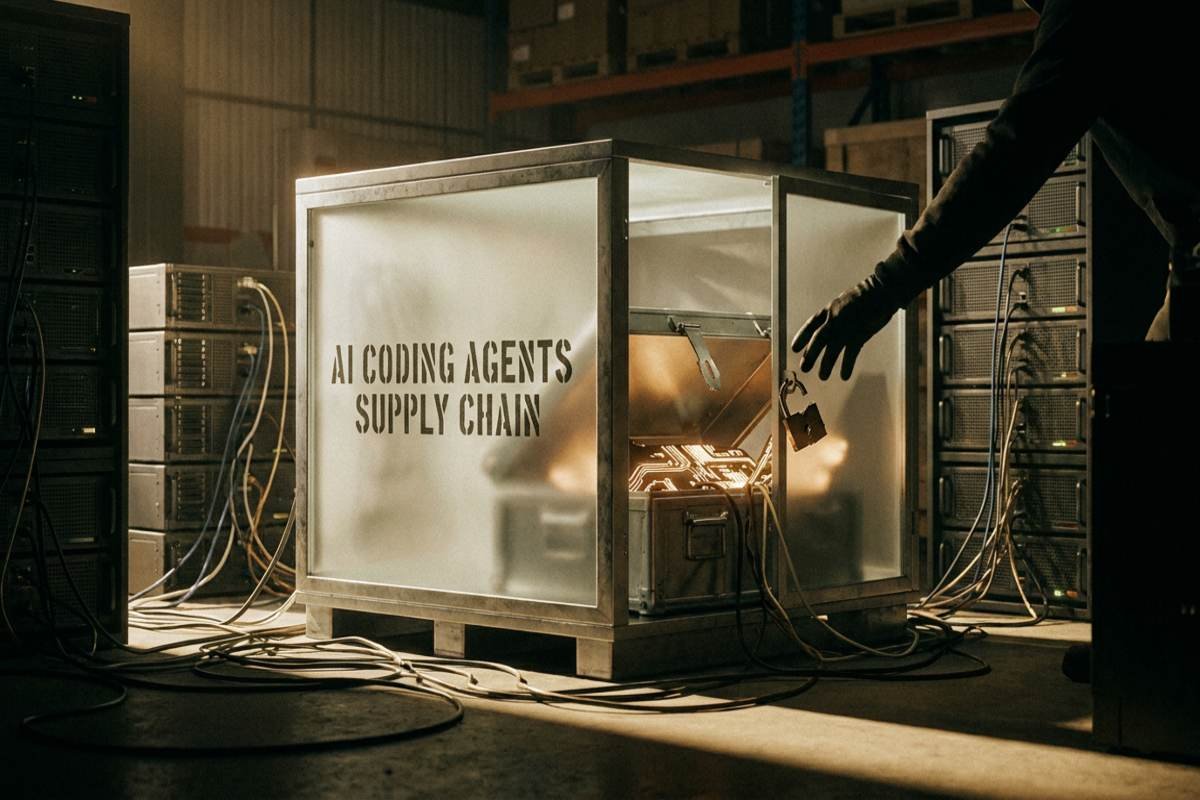
Rogue AI agents do not necessarily have to be intentionally malicious. An otherwise legitimate agent can behave dangerously after receiving manipulated context, incorrect instructions, poisoned data, or excessive permissions. The security problem becomes especially serious when the agent can modify production infrastructure, create credentials, push code, approve changes, or communicate with external services without independent validation.
NIST’s 2026 analysis of AI agent security feedback found broad agreement that agents introduce novel security threats and that traditional cybersecurity practices need adaptation for agent-based systems.
How to Prevent AI Coding Agent Supply Chain Attacks
Use Least Privilege Access
Give an agent only the permissions required for its current task. A coding agent working on a frontend component generally does not need unrestricted access to production databases, cloud administration, email, payment systems, or private credentials. Separate read and write permissions where possible. Sensitive operations should require explicit authorization outside the model.
Sandbox Agent Execution
Agent-generated commands should run in isolated environments with restricted filesystem, network, and credential access. Google’s current zero trust agent guidance demonstrates this approach using isolated code execution, cryptographic controls, and deterministic gateways rather than relying solely on instructions inside the model’s context.
Verify Dependencies
Maintain an inventory of dependencies and review new packages before they enter trusted development workflows. OWASP recommends supplier verification, vulnerability management, software bills of materials (SBOMs), integrity checks, signing, and ongoing monitoring for AI-related supply chains.
Protect CI/CD Pipelines
Require human approval for security-sensitive modifications to:
- CI/CD workflows
- Package installation scripts
- Dockerfiles
- Infrastructure as code
- Authentication configuration
- Deployment permissions
- Build and release processes
Branch protection, signed commits, isolated runners, and automated security scanning can reduce the consequences of a compromised agent.
Audit AI Tools and Agent Integrations
Create an inventory of every MCP server, plugin, API, agent skill, and external service connected to coding environments. Do not automatically trust a tool because it was previously approved. Tool definitions and behavior can change, so organizations should monitor changes and maintain clear ownership.
OWASP’s 2026 Agent Control Standard emphasizes that enterprise agents should be inspectable, traceable, instrumentable, and controllable at runtime.
Cloud Security Management for AI Coding Agents
As development agents connect to cloud environments, Cloud Security Management becomes part of AI agent protection. A secure architecture should separate development, testing, and production credentials. Cloud roles should be narrowly scoped, temporary credentials should be preferred where practical, and agent activity should be logged so unusual access can be investigated.
This principle also applies beyond coding agents. Enterprise agent systems, including zero-click workflows such as Salesforce Agentforce use cases, demonstrate why autonomous access to business data requires strong authorization and monitoring. Salesforce describes zero-click data agent experiences that can work with authenticated customer and transaction information, making access control an important architectural consideration.
A Practical Security Workflow for Development Teams
A safer AI-assisted development process can follow six steps:
- Classify the task. Decide whether the agent only needs code generation or also needs execution and external access.
- Restrict permissions. Give the agent minimum filesystem, network, repository, and cloud permissions.
- Validate inputs. Treat issues, README files, documentation, dependencies, and tool outputs as untrusted content.
- Scan changes. Run SAST, dependency scanning, secret detection, and configuration checks before merging.
- Review sensitive modifications. Require human approval for CI/CD, authentication, infrastructure, and package management changes.
- Monitor runtime behavior. Record tool calls, unusual network activity, privilege changes, and unexpected file modifications.
This approach combines conventional software security with controls designed specifically for autonomous systems.
Where AI Agent Security Is Heading
The security model for coding agents is moving from simple code review toward continuous control of agent behavior. OWASP’s 2026 Agentic Applications guidance identifies supply chain vulnerabilities among the important risks affecting autonomous systems, while its newer Agent Control Standard focuses on visibility and runtime enforcement.
The development ecosystem is also becoming more interconnected. Google has introduced tooling that allows coding agents to interact with cloud infrastructure and deployment workflows, while emerging standards are being developed for distributing agent skills and MCP servers. That means organizations should treat every new agent capability as another trust boundary. More automation can improve developer productivity, but it can also increase the blast radius when an agent, dependency, tool, or external data source is compromised.

Conclusion
AI coding agents supply chain attacks represent a broader evolution of software security. The danger is not limited to vulnerable AI-generated code; attackers can target the dependencies, repositories, tools, instructions, credentials, and infrastructure that autonomous agents rely on.
For AiSecMaster readers, the practical takeaway is straightforward: treat an AI coding agent as a privileged software component, not simply an advanced autocomplete tool. Combine least privilege, dependency verification, sandboxing, secure CI/CD, tool governance, and runtime monitoring to reduce the impact of AI agent threats and build safer autonomous development workflows.
Frequently Asked Questions (FAQs)
Are AI coding agents a supply chain security risk?
Yes. AI coding agents can introduce supply chain risk because they interact with dependencies, repositories, tools, APIs, build systems, and external content. A compromised component can influence agent behavior and potentially reach downstream development or deployment systems.
What is the biggest risk of autonomous coding agents?
The risk depends on the agent's permissions and workflow. Important concerns include indirect prompt injection, malicious dependencies, tool abuse, credential exposure, unexpected code execution, and unauthorized changes to CI/CD or infrastructure.
How can developers secure AI coding agents?
Use least privilege, sandbox execution, dependency verification, secret isolation, protected branches, security scanning, human approval for sensitive changes, and monitoring of agent tool calls and runtime behavior.
Can prompt injection cause a supply chain attack?
Yes. An attacker can place malicious instructions in content an agent reads, such as an issue, README, pull request, or documentation. If the agent follows those instructions and has execution privileges, the attack can potentially affect dependencies, source code, credentials, or build systems.
What should companies monitor when using AI coding agents?
Organizations should monitor dependency changes, tool connections, filesystem activity, command execution, network requests, credential access, CI/CD modifications, and unusual agent behavior. Runtime visibility becomes increasingly important as agents gain more autonomy.



One Response