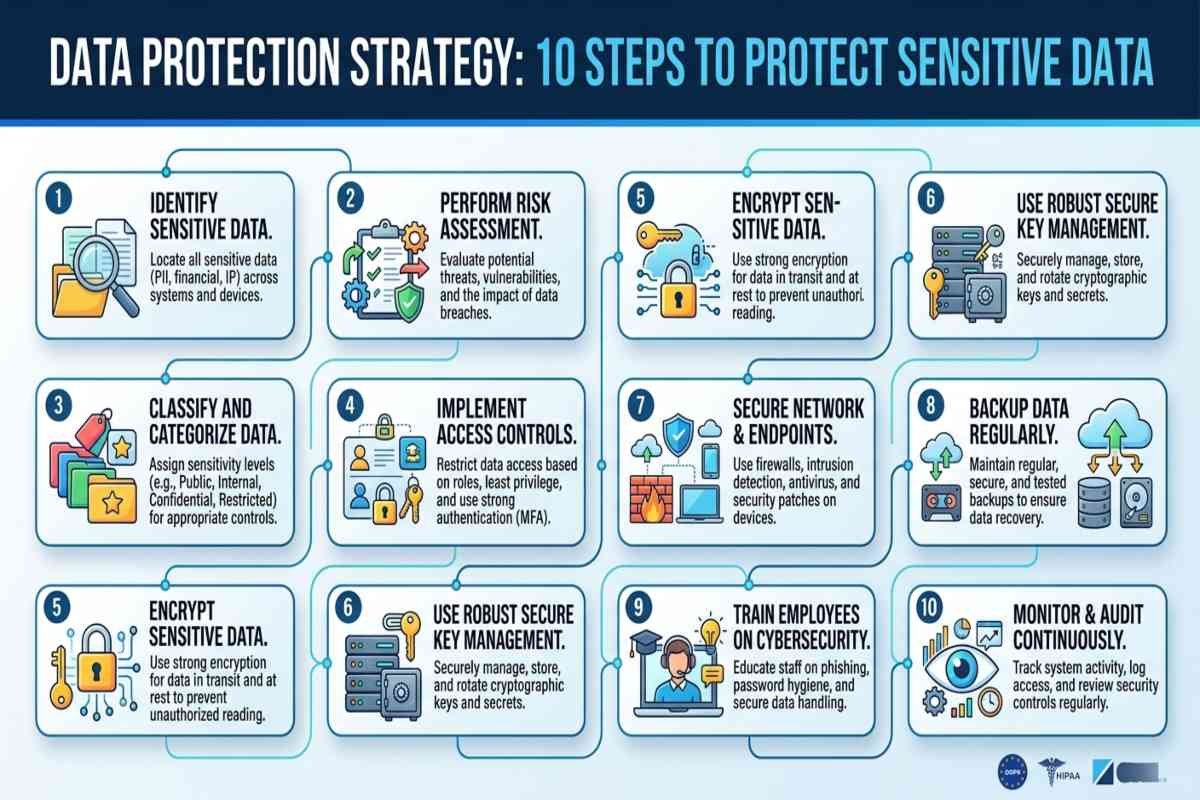
A strong Data Protection Strategy helps individuals and businesses identify sensitive information, prevent unauthorized access, reduce data loss, and maintain customer trust. It combines data classification, access controls, encryption, secure backups, employee training, and incident response to protect information throughout its lifecycle.
For organizations in the United States, protecting data also means understanding applicable privacy requirements, managing third party risks, and securing AI powered applications. The following 10 steps provide a practical framework for building a data protection program that supports business operations without exposing confidential information.
What Is a Data Protection Strategy?
A data protection strategy is a documented plan for collecting, storing, accessing, sharing, retaining, and securely deleting information. Its purpose is to reduce privacy and security risks while ensuring that authorized users can access the information they need.
- Data discovery and classification
- Access control and encryption
- Secure backups and recovery
- Employee awareness and training
- Third party and AI security
- Monitoring, incident response, and compliance
The NIST Privacy Framework provides a useful starting point for organizations seeking to identify and manage privacy risks. It is a voluntary framework, not a substitute for applicable legal requirements. NIST Privacy Framework.
Why Is a Data Protection Strategy Important?
Organizations handle customer records, employee information, payment details, intellectual property, and operational data. Without appropriate safeguards, this information may be exposed through phishing, compromised accounts, misconfigured cloud storage, malicious software, or mistakes by authorized users. A documented strategy helps businesses determine which information requires the strongest protection and which security controls should receive priority. It also supports business continuity by preparing teams to respond to incidents and restore affected systems.
For example, a small business may store customer addresses in a cloud application, employee records in an HR platform, and payment information through a third party provider. Each system has different access requirements and risks, so applying one identical security rule to every dataset may leave important gaps.
10 Steps to Build an Effective Data Protection Strategy
Identify and Classify Sensitive Data
Start by discovering where information is stored, who owns it, how it moves between systems, and why it is collected. Review databases, employee devices, cloud storage, email systems, backups, and third party applications.
- Public: Information approved for public distribution.
- Internal: Routine business information intended for authorized staff.
- Confidential: Customer records, contracts, and internal financial documents.
- Restricted: Highly sensitive credentials, regulated records, or critical business secrets.
Document where each category resides and which teams need access. This inventory becomes the foundation for decisions about encryption, retention, monitoring, and recovery.
Apply Least Privilege Access Controls
Users should receive only the permissions necessary to perform their responsibilities. This principle, known as least privilege, limits the damage that can occur if an account is compromised or an employee accesses information accidentally. Use role based access control where appropriate, require multifactor authentication (MFA) for important accounts, and remove unnecessary permissions when employees change roles or leave the organization.
Review administrator accounts separately because they often have broad access to systems and data. Periodic permission reviews can reveal former employees’ accounts, unused service accounts, and excessive privileges that would otherwise remain unnoticed.
Encrypt Data at Rest and in Transit
Encryption helps prevent unauthorized parties from reading information without the necessary cryptographic keys. Organizations should evaluate encryption for stored data, database systems, portable devices, backups, and information transmitted between applications.
Encryption alone does not prevent every Data Breach. If an attacker gains access through an authorized application or compromised account, the attacker may still retrieve readable information. Combine encryption with access restrictions, logging, and endpoint protection.
Create Reliable and Tested Data Backups
Backups help organizations recover from accidental deletion, hardware failures, ransomware, and other disruptive events. A backup is useful only if it contains the necessary information and can be restored when needed. Maintain protected backup copies, restrict who can modify or delete them, and consider offline or immutable copies for critical systems. Separate backup administration from everyday production access where practical.
Test restoration procedures regularly rather than assuming that successful backup reports guarantee recovery. Record how long important services can remain unavailable and how much recent data the organization can afford to lose. A practical data protection strategy should define recovery time objectives (RTOs) and recovery point objectives (RPOs) for important systems.
Establish Clear Data Retention and Deletion Rules
Keeping information indefinitely increases the amount of data that could be exposed in a breach. Define how long each category of information must be retained, who approves exceptions, and how records are securely deleted when they are no longer needed. Retention periods should reflect business needs, contractual obligations, litigation holds, and applicable laws. Avoid deleting records that must legally be preserved.
Include cloud platforms, employee devices, archived records, and third party systems in the process. Where deletion cannot happen immediately because of immutable backups or technical limitations, document the process and ensure the data is removed according to an appropriate schedule.
Secure Cloud Applications and Network Configurations
Cloud services introduce risks when storage permissions, identity settings, network rules, or administrative interfaces are configured incorrectly. Review who can access each resource and whether systems are exposed to the public internet unnecessarily. A Cloud Security Assessment can help identify configuration weaknesses, excessive permissions, exposed services, and gaps in monitoring. Correct high risk findings first, validate the fixes, and establish a regular review schedule.
Do not assume that a cloud provider automatically handles every security responsibility. Responsibilities differ by service model, so document which controls belong to the provider and which must be implemented by your organization.

Train Employees to Recognize Data Security Risks
Human mistakes can expose information even when technical safeguards are in place. Employees should understand how to recognize phishing messages, verify unexpected requests, handle confidential files, and report suspected incidents.
Include AI Privacy in awareness programs. Employees should understand organizational rules for entering customer records, source code, internal documents, or personal information into external AI applications. Use approved tools, review their data handling terms, and avoid assuming that information submitted to an AI service will always remain private.
Protect Data Across Third Party Supply Chains
Vendors, software providers, contractors, and cloud services may process or access business information. A weakness in any of these relationships can create risks for the organization that owns the data. Evaluate vendors before sharing sensitive information. Consider their security controls, incident notification procedures, access permissions, data retention practices, and contractual commitments.
For software and AI systems, review dependencies, integrations, model providers, datasets, and external plugins. Effective Supply Chain Planning should account for the security impact of changing providers, replacing components, or responding to a compromised supplier.
Secure AI Systems and Prevent Sensitive Information Disclosure
AI powered applications can introduce data protection challenges when they process confidential prompts, retrieve internal documents, connect to business systems, or take actions on behalf of users. Organizations should identify which information AI systems can access and prevent them from receiving unnecessary sensitive data. Apply authorization checks to retrieval systems, restrict tool permissions, monitor outputs, and test whether unauthorized users can obtain protected information.
The OWASP LLM Security Risks guidance identifies issues such as prompt injection, sensitive information disclosure, supply chain vulnerabilities, and excessive agency. These risks are especially relevant when language models interact with private databases or external tools. See the official OWASP GenAI LLM Top 10.
- AI Agent Security: Restrict agent permissions and require approval for high impact actions.
- AI Threat Intelligence: Use relevant threat information to improve detection and incident planning.
- Generative AI Tasks: Separate public, internal, and restricted data when designing workflows.
- Agentic AI Attack: Test whether malicious instructions could cause an agent to reveal data or misuse connected tools.
These measures help reduce exposure, but no single safeguard eliminates all AI related risks.
Monitor Security Events and Prepare for Incidents
Prevention is essential, but organizations must also prepare for incidents that bypass their controls. Collect relevant logs from identity systems, endpoints, cloud services, databases, and security tools. Monitor unusual access patterns, unexpected downloads, suspicious account activity, and unauthorized configuration changes.
Conduct tabletop exercises to test the plan. A useful scenario might involve a compromised employee account downloading customer records from cloud storage. The team should determine how to disable access, assess the exposure, preserve evidence, and meet applicable notification obligations.
Common Data Protection Mistakes to Avoid
Even well-intentioned organizations can leave gaps in their security programs. Common mistakes include:
| Mistake | Why It Matters | Recommended Action |
|---|---|---|
| Giving users excessive permissions | Compromised accounts may expose more information. | Apply least privilege and review access regularly. |
| Keeping unnecessary data | More stored information can increase exposure. | Establish retention and deletion schedules. |
| Trusting backups without testing them | Recovery may fail during an emergency. | Test restoration and recovery objectives. |
| Sharing confidential data with unapproved AI tools | Information may be processed outside intended controls. | Define approved AI use and data restrictions. |
| Ignoring vendor access | Third parties may retain unnecessary permissions. | Review contracts, access, and supplier security. |
| Treating compliance as complete security | Legal compliance does not eliminate every technical risk. | Combine compliance activities with risk-based security controls. |
How to Measure the Success of Your Data Protection Strategy
Measure whether security controls work instead of relying only on the number of policies or tools deployed. Select indicators that reflect the organization’s actual risks and operational priorities.
- Percentage of sensitive data repositories with assigned owners and classifications.
- Percentage of privileged accounts protected by MFA.
- Time required to remove access when employees leave.
- Success rate of scheduled backup restoration tests.
- Number and severity of unresolved data exposure findings.
- Time taken to detect, investigate, and contain security incidents.
- Percentage of critical vendors reviewed within the defined assessment period.
A Data Protection Strategy should evolve as the organization adopts new applications, changes vendors, introduces AI workflows, or faces new threats. Regular assessments help ensure that controls remain appropriate as the business changes.

Conclusion
A reliable Data Protection Strategy starts with knowing what information you hold and then applying safeguards proportionate to its sensitivity and business importance. Classification, restricted access, encryption, tested backups, secure vendor relationships, AI security controls, and incident response work together to reduce risk.
For organizations building a stronger security program, AiSecMaster recommends reviewing data access and retention practices first, addressing the highest risk weaknesses, and testing recovery and incident response procedures regularly. Use the NIST Privacy Framework and OWASP GenAI security guidance as starting points for evaluating privacy and AI related risks.
Frequently Asked Questions (FAQs)
What is the main goal of a data protection strategy?
The main goal is to protect sensitive information from unauthorized access, disclosure, alteration, loss, and misuse. A good strategy defines how data is classified, accessed, stored, shared, retained, and recovered while supporting legitimate business needs.
What are the most important data protection measures?
The core measures include data classification, least privilege access, multifactor authentication, encryption, tested backups, secure configurations, employee training, vendor assessments, monitoring, and incident response. The right combination depends on the sensitivity of the data and the organization's risk profile.
How can small businesses protect sensitive data?
Small businesses can begin by inventorying important records, enabling MFA, using a password manager, applying software updates, restricting access, encrypting supported devices, and testing backups. They should also establish clear rules for sharing customer information and using third party or AI services.
How does AI affect data protection?
AI systems may process confidential prompts, retrieve private documents, or share information through connected tools. Organizations should limit data access, evaluate provider data handling practices, test for sensitive information disclosure, and monitor agent permissions. AI specific security testing should complement established privacy and cybersecurity controls.
What is the difference between data protection and data privacy?
Data protection focuses on safeguards that prevent unauthorized access, loss, alteration, or disclosure. Data privacy concerns how information about people is collected, used, shared, retained, and governed. The two areas overlap, but privacy responsibilities can remain even when data is technically secure.