
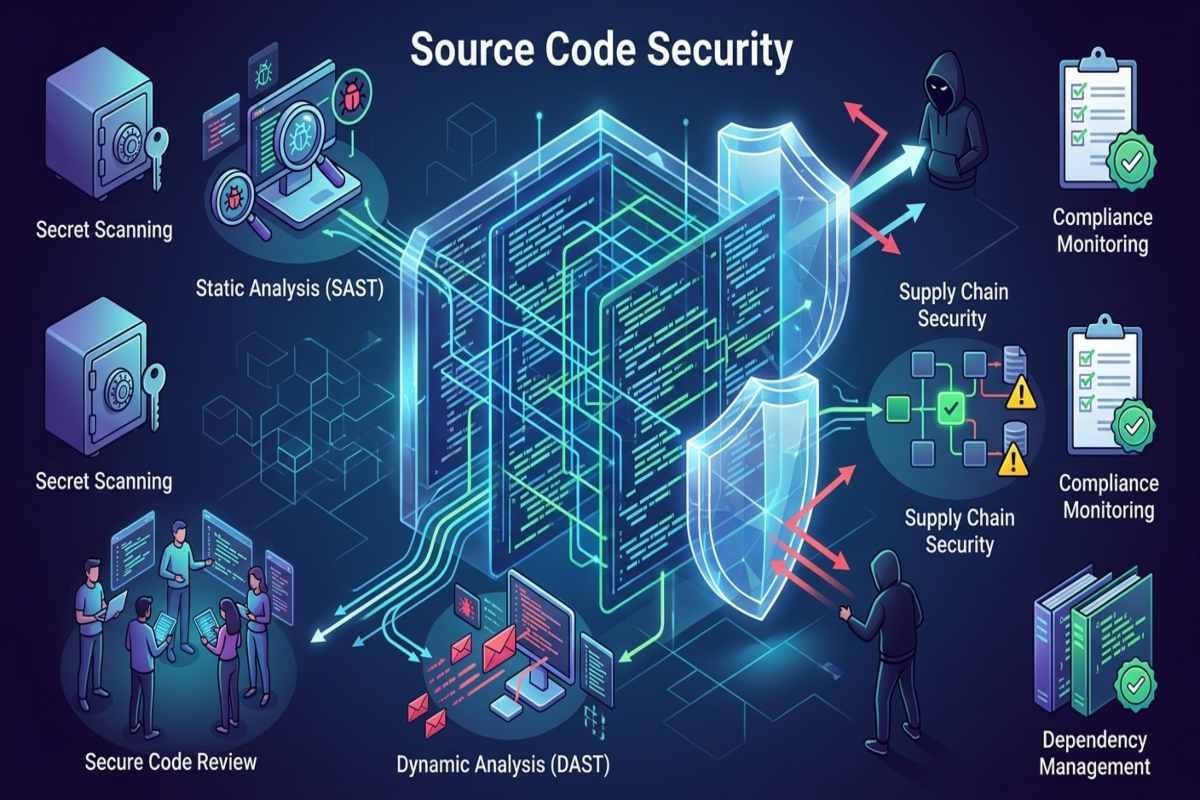
Source code security is the practice of protecting software code, repositories, development environments, and related assets from unauthorized access, modification, theft, and vulnerabilities. It helps organizations prevent attackers from introducing malicious code, stealing intellectual property, exposing credentials, or exploiting weaknesses before software reaches users.
For modern businesses, source code security is more than protecting a Git repository. It includes developer accounts, third party dependencies, secrets, CI/CD pipelines, cloud environments, and the systems used to build and deploy applications. Secure development practices should therefore be applied throughout the software development lifecycle.
Source Code Security at a Glance
Source code security focuses on preventing unauthorized access and reducing vulnerabilities throughout software development.
- Protect source code repositories with strong authentication and access controls.
- Follow the principle of least privilege for developers and applications.
- Never store passwords, API keys, or private credentials directly in source code.
- Review code changes before they are merged or deployed.
- Scan dependencies for known vulnerabilities.
- Monitor development environments and repository activity.
- Integrate security testing into CI/CD pipelines.
- Consider AI specific risks when source code includes AI models, agents, APIs, or prompts.
Why Source Code Security Matters
Source code contains the instructions that determine how an application works. It can also reveal database connections, API endpoints, authentication logic, cloud configurations, third party services, and other information that could help an attacker understand an organization’s environment. A compromised repository can create risks beyond data theft. An attacker who obtains write access could modify code, insert malicious functionality, introduce vulnerabilities, or manipulate a software build.
NIST’s Secure Software Development Framework recommends protecting software from unauthorized access and tampering and integrating security practices throughout development. Organizations can use this approach to make security part of development rather than treating it as a final stage activity.
Common Source Code Security Risks
Unauthorized Repository Access
One of the most direct risks is unauthorized access to a source code repository. Attackers may obtain credentials through phishing, credential theft, malware, or compromised developer accounts. As Agentic AI Attack techniques become a growing security concern, compromised accounts could also be used to automate malicious actions across development environments. Organizations should use strong authentication, role based permissions, multi-factor authentication where supported, and regular access reviews.
Hardcoded Secrets
Developers sometimes accidentally place API keys, passwords, tokens, or private keys inside source files. Even when the line is later deleted, the sensitive value may remain within version control history. Secrets should instead be stored using appropriate secret management systems. Automated secret scanning can also identify credentials before they become a larger security problem.
Vulnerable Dependencies
Applications commonly rely on open source libraries and third party packages. A vulnerability in one of these components can introduce risk into an otherwise carefully developed application. Dependency inventories, vulnerability scanning, controlled updates, and software composition analysis can help development teams understand and manage these risks.
Malicious Code Changes
A compromised developer account or insider threat could be used to introduce unauthorized changes. Protected branches, peer review, signed commits where appropriate, and strong repository permissions can make unauthorized modifications more difficult.
How to Improve Source Code Security
1. Apply Least Privilege Access
Developers should have only the repository and system permissions required for their responsibilities. Administrative privileges should be separated from ordinary development activities. Access permissions should also be reviewed periodically. A developer who changes teams may no longer need the same repository access they previously had.
2. Secure Developer Accounts
Developer accounts can provide access to source code, cloud infrastructure, CI/CD systems, and deployment environments. Protecting these accounts should therefore be a core AI Security priority. Organizations should use strong authentication, multi factor authentication, credential protection, and monitoring for suspicious login or repository activity.
3. Perform Regular Code Reviews
Code review helps identify security weaknesses before changes become part of the production application. Reviewers should consider authentication, authorization, input validation, data handling, error management, secrets, dependencies, and security sensitive configuration. Critical changes may require review from someone with additional security expertise.
4. Automate Security Testing
Automated tools can identify many common weaknesses during development. Depending on the technology stack, organizations can use.
- Static application security testing
- Software composition analysis
- Secret scanning
- Dependency vulnerability scanning
- Infrastructure as code scanning
- Container security scanning
- Dynamic application security testing
5. Protect the Software Supply Chain
Modern software depends on many external components. Libraries, packages, containers, build tools, plugins, and third party services can all become part of the application’s attack surface. Organizations should understand which components their software depends on and evaluate security risks before introducing new dependencies.

Source Code Security and AI Applications
AI powered applications introduce additional considerations for development teams. Source code may control how models receive data, interact with APIs, retrieve information, or perform actions. Applications using Autonomous AI Agents require particular attention because code may give an agent access to external tools, databases, APIs, or business systems. Developers should carefully define what actions an AI agent can perform and what information it can access.
AI Specific Code Security Risks
AI applications can combine traditional application vulnerabilities with emerging AI security threats. A vulnerable API, insecure permission model, or poorly protected data source can become more significant when connected to an AI system. Teams should understand OWASP LLM Security Risks when reviewing applications that use large language models. Relevant concerns can include prompt injection, sensitive information disclosure, insecure tool use, excessive agency, and weaknesses in AI application architecture.
A secure AI application should not assume that model generated output is automatically trustworthy. Applications should validate sensitive actions and enforce authorization independently of model decisions.
Source Code Security Beyond the Repository
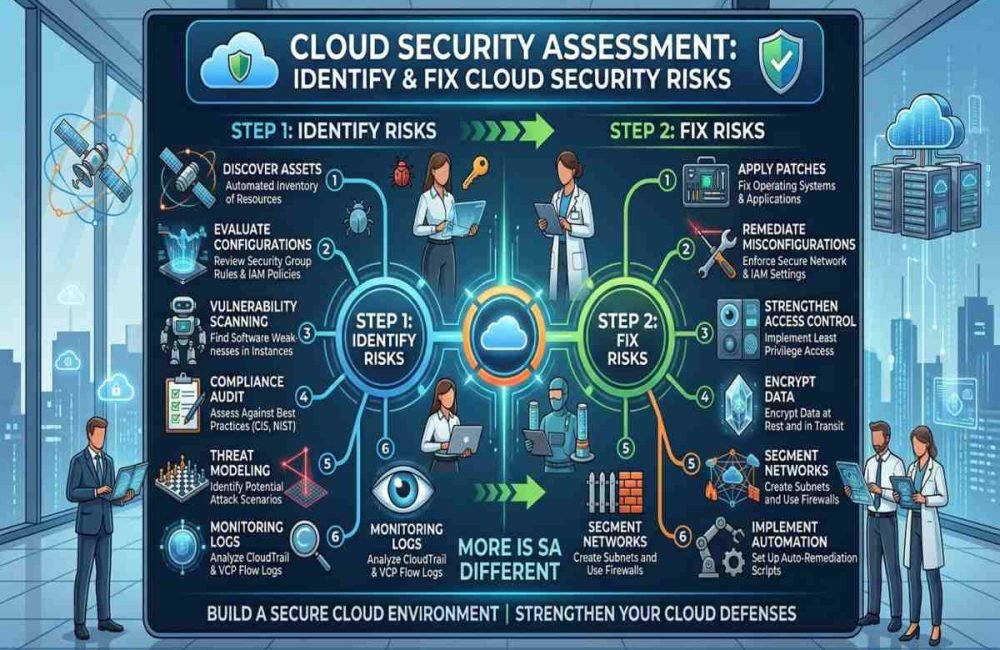
Source code protection should extend into the infrastructure where applications are developed, tested, and deployed. A Cloud Security Assessment can help organizations evaluate cloud identities, storage, network configurations, development environments, and access permissions. This is particularly important when source code is hosted or deployed through cloud infrastructure. Organizations should also examine CI/CD systems because build pipelines can have access to source code, credentials, deployment environments, and production systems.
Security Controls for Development Environments
Security teams should monitor the infrastructure surrounding software development rather than protecting only the repository. This can include endpoint security, identity management, network segmentation, logging, vulnerability management, and secure configuration.
For applications exposed to the internet, Cloud Application Security should also address APIs, authentication, authorization, data protection, application configurations, and monitoring. Network level controls may provide another layer of defense. Appropriate Firewall Configuration can help restrict unnecessary network access to development and infrastructure systems.
Source Code Security and Cybersecurity Operations
Source code security works best when integrated with an organization’s wider cybersecurity program. Security teams should establish processes for detecting suspicious repository activity, responding to compromised credentials, investigating unauthorized code changes, and recovering affected systems. A practical Cybersecurity Checklist for source code protection should include.
| Security Area | Recommended Practice |
|---|---|
| Repository Access | Use least privilege permissions |
| Authentication | Protect developer accounts with strong authentication |
| Secrets | Use secret management and scanning |
| Code Review | Require review for important changes |
| Dependencies | Scan and update vulnerable components |
| CI/CD | Secure and monitor build pipelines |
| Monitoring | Log important repository activity |
| Integrity | Protect important branches and releases |
| Cloud | Review development and deployment environments |
| Incident Response | Prepare for compromised accounts or repositories |
Common Source Code Security Mistakes
One common mistake is assuming that a private repository is automatically secure. Private repositories can still be compromised through stolen credentials, vulnerable integrations, excessive permissions, or insecure developer devices.
Another mistake is removing a secret from the latest version of the code without checking repository history. Sensitive credentials may continue to exist in previous commits or branches and should be treated as exposed when discovered.
Threat Detection for Modern Development
Development environments can also be affected by phishing and social engineering. Attackers may attempt to compromise developer accounts before accessing repositories or cloud systems. Advanced Phishing Detection can help organizations identify suspicious messages and reduce the likelihood of credential theft. Security awareness should complement technical controls because developers are often targeted precisely because their accounts can provide access to valuable systems.
Security teams can also use AI Threat Intelligence to track emerging attack techniques, vulnerabilities, and campaigns that could affect development environments and software supply chains.
Source Code Security for AiSecMaster Readers
For readers of AiSecMaster , source code security is an important part of understanding the wider relationship between software security, AI security, cloud security, and cybersecurity. A secure development strategy should consider the entire environment rather than focusing on one security tool. Repository protection, identity security, code review, dependency management, cloud controls, monitoring, and incident response should work together.
Organizations should also consider how emerging AI technologies change traditional application security. AI agents, AI powered development tools, and machine generated code can introduce new security considerations that require appropriate review and testing.

Conclusion
Source code security is a fundamental part of protecting modern software. Effective protection requires more than securing a repository; organizations should also protect developer identities, secrets, dependencies, CI/CD pipelines, cloud infrastructure, and deployment processes.
The strongest approach combines least privilege access, secure authentication, code review, automated testing, dependency management, secret protection, monitoring, and incident response. AI powered applications require additional consideration because models, agents, APIs, and external tools can introduce new security risks.
Frequently Asked Questions (FAQs)
What is source code security?
Source code security is the practice of protecting software code and development systems from unauthorized access, modification, theft, and vulnerabilities. It includes repository security, access controls, code reviews, secret management, dependency protection, testing, and monitoring.
Why is source code security important?
Source code can contain valuable intellectual property and information about an application's architecture, dependencies, credentials, and security controls. Protecting it can reduce the risk of unauthorized changes, code theft, exposed secrets, and vulnerabilities reaching production.
How can developers secure source code?
Developers can improve source code security by using strong authentication, least privilege access, protected repositories, code reviews, secret scanning, dependency management, automated security testing, and continuous monitoring.
Should API keys be stored in source code?
No. API keys, passwords, private keys, and other sensitive credentials should generally not be hardcoded into source files. Organizations should use appropriate secret management solutions and scan repositories for accidentally exposed credentials.
Does source code security apply to AI applications?
Yes. AI applications can contain source code controlling models, prompts, APIs, data processing, tools, and agent permissions. Developers should therefore combine traditional software security practices with controls addressing AI specific risks such as prompt injection, sensitive data exposure, and excessive AI permissions.
References
- Preemptive : Explains key source code security risks and the importance of protecting application code, development environments, and sensitive information throughout the software development lifecycle.
- Wiz : Provides guidance on protecting source code repositories, developer environments, credentials, and other components involved in secure application development.




2 Responses